Unit Plan Template: Free Editable Word and PDF, Plus a Filled-In Example
A free unit plan template in Word and PDF, with a complete Grade 5 science example: standards, big ideas, assessment evidence, an 8-lesson sequence and a rubric.
Draft My Lesson Team
A lesson plan tells you what happens on Tuesday. A unit plan tells you why Tuesday matters: which standards the next two or three weeks serve, what evidence will show that students learned, and how each lesson moves them closer to it. When the unit plan is clear, individual lessons get faster to write, because each one has a job.
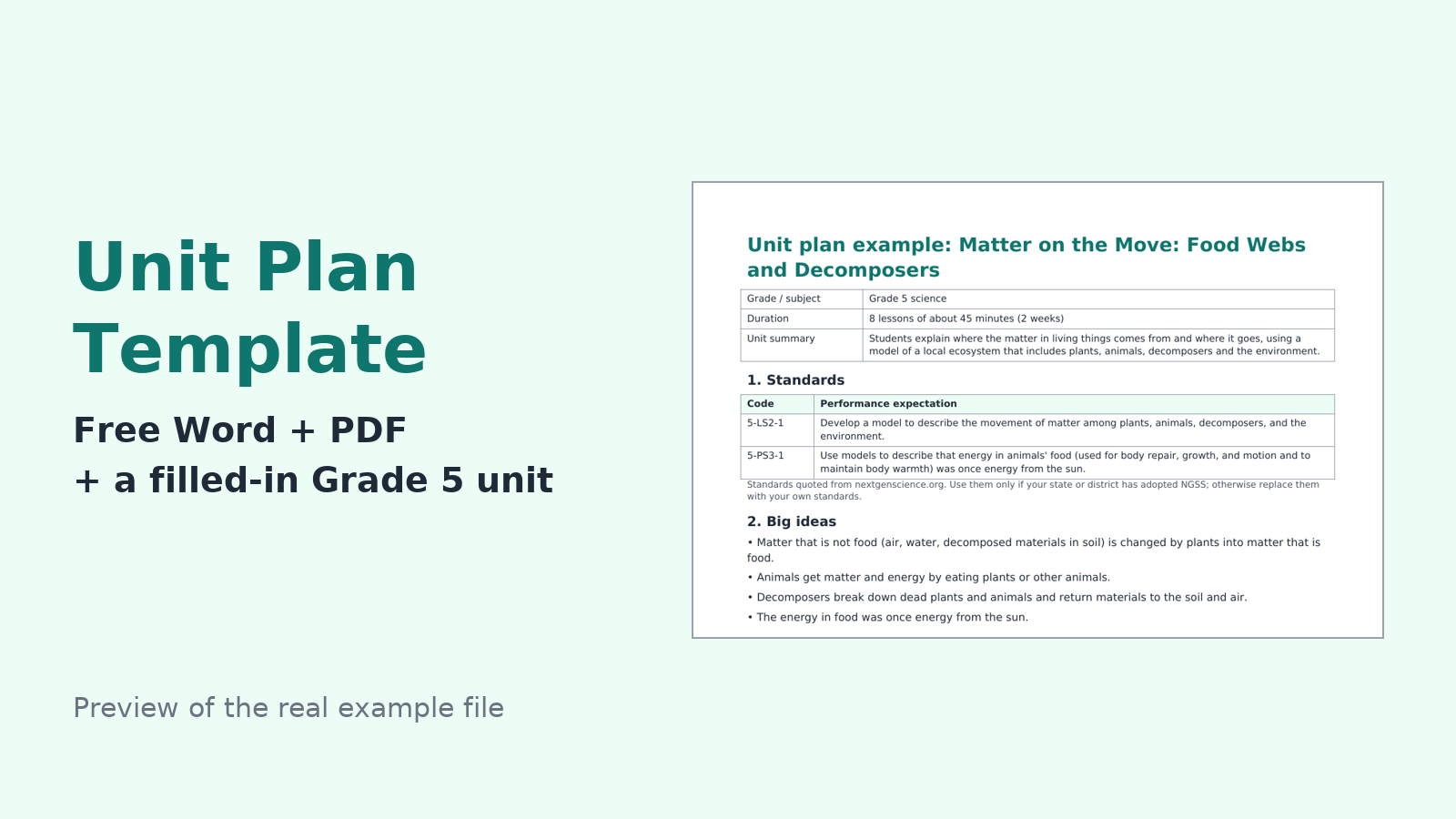
This page gives you two free files and one complete example:
- a blank unit plan template in Word (editable) and in PDF (print and write);
- a filled-in Grade 5 science unit in Word and in PDF, so you can see what each section looks like when it is done.
No account is needed to download them.
What goes in a unit plan
Most districts and teacher-preparation programs ask for the same core sections, even when the template looks different. The blank template follows this order:
| Section | What to write | Quick test |
|---|---|---|
| Unit overview | Title, grade, subject, number of lessons, a two-sentence summary | Could a substitute explain the unit from this box? |
| Standards | The exact codes and wording adopted by your state or district | Is every standard assessed somewhere in the unit? |
| Big ideas | What students should still understand months later | Is it bigger than a single fact? |
| Essential questions | Two or three open questions that drive the unit | Can students return to them in lesson 1 and lesson 8? |
| Learning objectives | Measurable "I can" statements | Could you check each one in five minutes? |
| Assessment evidence | Pre-assessment, formative checks, the summative task and its criteria | Does the final task require the big ideas, not just recall? |
| Lesson sequence | One row per lesson: focus, activities, check for understanding, materials | Does each lesson feed the final task? |
| Differentiation | Scaffolds, language supports, extensions | Can every student reach the same task with different support? |
| Reflection | What worked, what to change next time | Written within a week of finishing the unit? |
If you plan the assessment evidence before the lesson sequence, you are using the logic of backward design. Our backward design guide walks through the three stages in detail, so this page does not repeat them.

How to fill in the template in six steps
- Start from the standards. Copy the exact wording your school uses. If you teach in a state that adopted NGSS or the Common Core, use the official text; otherwise use your state framework.
- Write one or two big ideas. Rephrase the standards as ideas a student could explain in their own words.
- Decide the final task before the lessons. Ask what students would have to make, explain or solve to show they understood the big ideas. Write the criteria now, as a short rubric.
- Add a pre-assessment and two or three quick checks. They tell you whether to slow down or move on. Exit tickets work well here; see our exit ticket examples.
- Sequence the lessons. Each row needs a focus, the main activity and one way to check understanding. Leave materials for last.
- Plan supports for the final task. Sentence frames, vocabulary cards and partially completed models let more students reach the same task.
The filled-in example: Grade 5 science, "Matter on the Move"
The example unit covers food webs and decomposers in 8 lessons of about 45 minutes. It is built on two NGSS performance expectations, quoted exactly from nextgenscience.org:
- 5-LS2-1: "Develop a model to describe the movement of matter among plants, animals, decomposers, and the environment."
- 5-PS3-1: "Use models to describe that energy in animals' food (used for body repair, growth, and motion and to maintain body warmth) was once energy from the sun." (source)
Use these standards only if your state or district has adopted NGSS. The structure of the unit works with other frameworks too.
Big ideas and essential questions
Students should leave the unit able to explain that plants change air and water into matter that is food, that animals get matter and energy by eating, that decomposers return materials to the soil and air, and that the energy in food was once energy from the sun. Three questions drive the unit: Where does the matter in a tree come from? What happens to a leaf after it falls? Why would an ecosystem without decomposers be in trouble?
Assessment evidence
| When | Evidence |
|---|---|
| Lesson 1 | Quick draw: "Where does the wood of a tree come from?" Students revise it in lesson 8. |
| Lessons 2 to 7 | One-question exit tickets, a partner food-web explanation, peer feedback on a model draft |
| Lesson 8 | Performance task: a labeled model of matter moving in a local ecosystem, with a written explanation, scored on four criteria |
Lesson sequence
| # | Focus | Main activity | Check for understanding |
|---|---|---|---|
| 1 | Notice the phenomenon | Compare a fresh log and a rotting log; quick draw; question board | Question board |
| 2 | Plants make food | Short reading on plants using air and water; start a class model | Exit ticket |
| 3 | Consumers and food chains | Sort organism cards; build chains with arrows | Fix a wrong arrow |
| 4 | Food webs | Build a woodland web; remove an organism and predict effects | Partner explanation |
| 5 | Decomposers at work | Set up sealed decomposition jars; first observation | Predict the jar in a week |
| 6 | Energy from the sun | Trace energy from sun to plant to animal; compare with matter | Exit ticket |
| 7 | Build the model | Draft, peer feedback with the rubric, revision | Feedback form |
| 8 | Explain and reflect | Final model and explanation; revise the lesson 1 drawing | Performance task |
For lesson 4, you can reuse the free Grade 5 ecosystems lesson pack and its teacher guide, also used in our 5E lesson plan guide.
The full rubric, differentiation ideas and a safety note for the decomposition jars are in the downloadable example.
Unit plan, lesson plan, scope and sequence: which one do you need?
A scope and sequence covers the whole year or course: which units, in what order. A curriculum map adds what is taught each month or term. A unit plan zooms into one unit of two to six weeks. A lesson plan zooms into a single lesson. You usually write them in that order, from the year down to the day.
- For the year view: scope and sequence template and curriculum map template.
- For single lessons: editable lesson plan template and how to write a lesson plan.
Common unit planning mistakes
- Too many standards. Two to four well-assessed standards beat ten that are only "covered".
- An assessment that only checks vocabulary. If the final task can be completed from memory, it will not show understanding of the big ideas.
- Lessons that do not feed the final task. If a lesson could be removed without affecting the performance task, question whether it belongs in this unit.
- No time for revision. Build at least one lesson for drafting, feedback and revising before the final task.
Draft a unit plan for your own class
The template works on paper. If you want a first draft to edit instead of a blank page, Draft My Lesson can draft a unit plan for your grade, subject and topic, then generate each lesson of the unit as a full lesson plan with a student handout and homework. Every draft is a starting point to review and adapt before teaching. Your free account includes two complete lessons and one unit plan after you verify your email; unlimited unit plans are part of the Annual Pro plan.
Related articles
I Do, We Do, You Do: The Gradual Release Model With a Template and Example
How the "I do, we do, you do" gradual release model works, where it comes from, when to move to the next phase, a free lesson plan template and a complete Grade 7 math example.
Read articleBloom's Taxonomy Verbs: 150 Action Verbs by Level, With Question Stems
A complete list of Bloom's taxonomy verbs for the six revised levels, with question stems, sample objectives and a free printable verb chart.
Read articleMadeline Hunter Lesson Plan: The 7 Steps, a Free Template and Two Examples
The seven elements of Madeline Hunter's lesson design explained step by step, with a free Word and PDF template and two complete K-12 examples.
Read articleDaily Lesson Log Template: Format, Parts and a Filled Sample
An editable daily lesson log (DLL) template with the six parts, a filled weekly sample and tips to fill it in less time.
Read article