Curriculum Map Template: Plan a Term That Holds Together
Copy a practical curriculum map template, see an eight-week example, and connect outcomes, evidence, lessons, and reteaching across a term.
Draft My Lesson Team
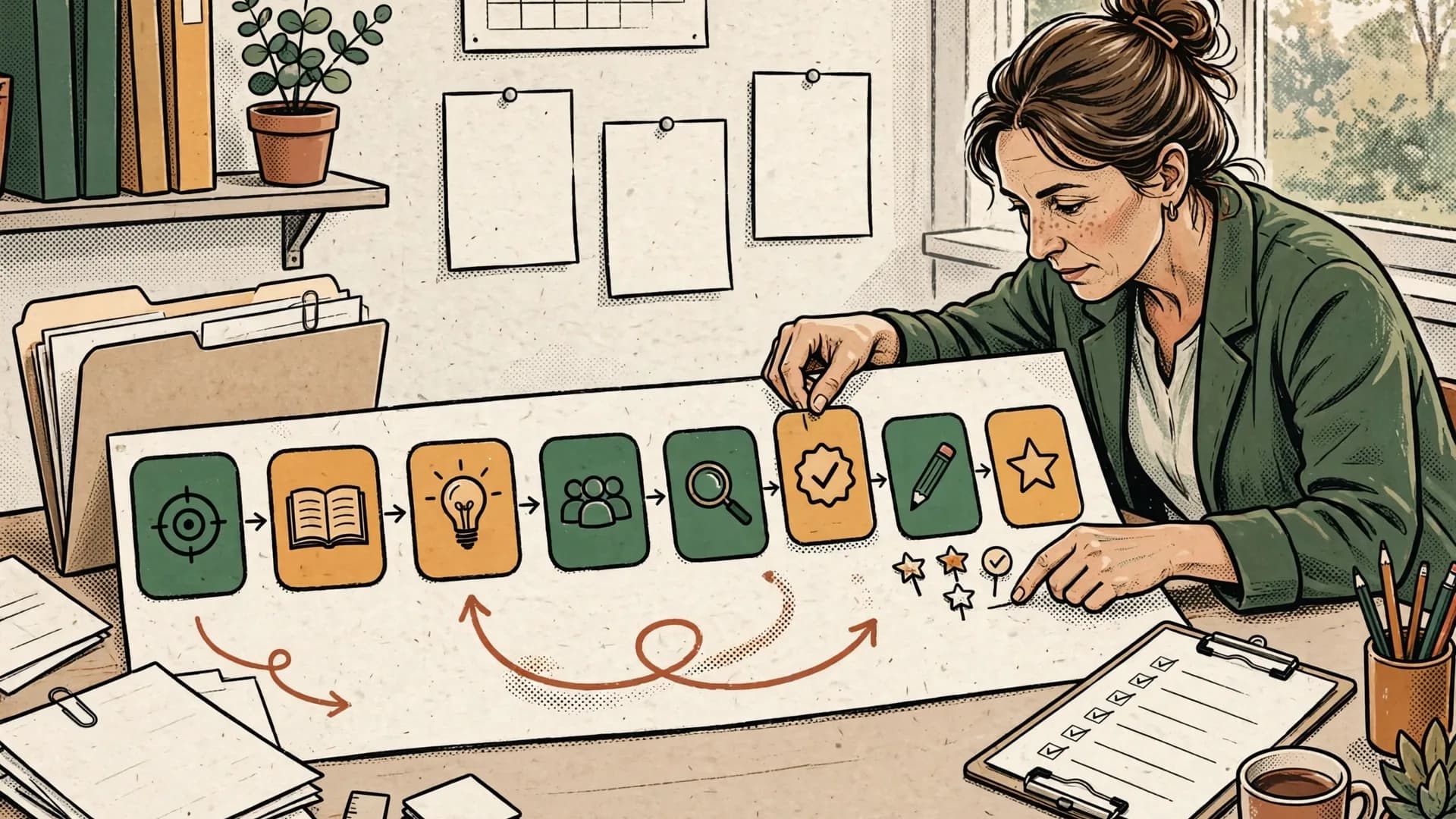
A curriculum map is the bridge between a list of required learning and the lessons you teach on Tuesday. It shows what students should learn, what evidence will count, how the learning develops over time, and where you will pause to respond.
The template below is intentionally practical. It does not assume one national, state, or school framework. Put your required standard or framework reference in its own column, using the wording and version your school expects. Then translate that reference into teachable outcomes and evidence.
Start from the source that governs your setting, not a third-party standards summary. For example, use the current catalogues from the California Department of Education, the New York State Education Department, or the Department for Education in England when one of those jurisdictions applies. The map should preserve the exact local reference and keep it separate from your lesson-sized outcome.
Use this map to answer four planning questions
- What should students know or be able to do by the end of this period?
- What evidence will show that learning?
- In what order should concepts and practice appear?
- Where will I check, reteach, or extend before moving on?
Copyable curriculum map template
Copy this table into a document, spreadsheet, or planning system. Use one row per week, topic, or instructional phase. A week works well for a first draft, but the map should follow the learning, not the calendar.
| Week or phase | Required reference | Teachable outcome | Core concepts and vocabulary | Learning experiences | Evidence and assessment | Support, reteaching, or extension | Resources and notes |
|---|---|---|---|---|---|---|---|
| 1 | [Exact local reference] | Students will... | |||||
| 2 | [Exact local reference] | Students will... | |||||
| 3 | [Exact local reference] | Students will... | |||||
| 4 | [Exact local reference] | Students will... | |||||
| Checkpoint | [References reviewed] | Students can now... | Review, conference, or application task | Evidence summary | Reteach or extension groups | Adjust the next phase |
Add three lines above the table:
Course / grade / subject:
Planning period:
End-of-period performance or product:
The last line keeps the map pointed toward a meaningful destination. If the period ends only with “cover chapter 6,” the map is tracking teacher activity rather than student learning.

What belongs in each column
Required reference
Record the exact standard, programme, syllabus, pacing-guide, or school-framework reference that applies. Keep it separate from your objective. A reference may cover a larger span of learning than one week or lesson.
Teachable outcome
Write what students will do with the content. “Fractions” is a topic. “Compare fractions with unlike denominators and justify the comparison with a visual model” is a teachable outcome. The guide to lesson plan objectives includes a verb bank and copyable objective structure.
Learning experiences
Name the instructional work, not every activity detail. “Model two comparisons, guided number-line practice, partner error analysis” is enough for a map. Save timings, materials setup, questions, and transitions for the individual lesson plan template.
Evidence and assessment
Choose evidence before you fill the calendar with activities. The evidence can be a short explanation, worked problem, performance, discussion record, annotated text, quiz, or larger product. Match it to the verb in the outcome.
Support, reteaching, or extension
Plan the decision you will make after reviewing evidence. You do not need to predict every learner response. You do need a place where the map can change. Note the likely prerequisite, the extra model or practice you could use, and the extension that deepens the same outcome.
Eight-week curriculum map example
This Grade 7 English language arts example builds toward an evidence-based comparison of how writers shape a reader's view of a shared event. It is an instructional example, not a claim of alignment to a particular curriculum.
| Week | Outcome | Core learning experiences | Evidence | Response |
|---|---|---|---|---|
| 1 | Distinguish topic, claim, and supporting detail | Sort examples, model annotation, short text practice | Annotated paragraph and three-item check | Reteach claim versus topic with a new paragraph |
| 2 | Identify point of view and relevant context | Narrator comparison, source-context cards, think-aloud | Source note that names point of view and one effect | Add audio reading or sentence frames where needed |
| 3 | Select evidence that supports a stated claim | Evidence ranking, partner justification, independent selection | Two details selected and explained | Conference with students choosing interesting but irrelevant details |
| 4 | Compare two accounts of one event | Double-entry notes, modeled comparison, paired discussion | Comparison paragraph using both sources | Regroup by claim, evidence, or explanation need |
| 5 | Explain how word choice shapes tone | Vocabulary continuum, close reading, rewrite task | Annotated excerpt and tone explanation | Provide a smaller word set or extend to connotation |
| 6 | Evaluate which account is more convincing | Criteria building, source review, structured discussion | Written judgment with evidence from both sources | Reteach the difference between preference and criteria |
| 7 | Draft and revise a comparative response | Teacher model, planning outline, peer feedback | Full draft checked against shared criteria | Targeted mini-lessons based on draft patterns |
| 8 | Present and reflect on the final comparison | Revision, publication or presentation, reflection | Final response and self-assessment | Record the next writing goal for each student |
The sequence moves from identifying parts to making and defending a judgment. Each week's evidence feeds the next planning decision. Week 6 is a real checkpoint: if students cannot justify a source judgment, moving straight to the full draft would hide the gap rather than solve it.
Curriculum map, scope and sequence, unit plan, or lesson plan?
These tools overlap, but they answer different questions.
| Planning tool | Main question | Useful level of detail |
|---|---|---|
| Curriculum map | How do outcomes, evidence, and instruction connect across a period? | Weeks, units, or phases |
| Scope and sequence | What content and skills are included, and in what order? | Course or year progression |
| Unit plan | How will one connected body of learning develop? | Several lessons around one outcome or product |
| Lesson plan | What will happen in this class period? | Timings, teacher and student actions, checks, materials |
A curriculum map can include a scope and sequence, but it adds assessment evidence and instructional response. A unit plan goes deeper into one section of the map. A lesson plan turns one piece into teachable moves.
Build the map in the right order
- Set the period and destination. Define the course span and the final performance, product, or body of evidence.
- Group required learning. Cluster references by idea or skill before assigning dates.
- Write teachable outcomes. Translate each cluster into observable student actions.
- Choose evidence. Decide what will prove each outcome and where a checkpoint belongs.
- Sequence the learning. Order prerequisites, models, practice, application, and review.
- Add resources and lesson ideas. Activities come after the learning logic is visible.
- Leave adjustment space. Protect a checkpoint, flex day, or review block rather than filling every cell.
This is backward design at course level. The backward design lesson plan guide shows the same reasoning in more depth.
Turn the map into weekly work
A map is useful only if it stays close to the lessons and evidence. At the end of each week, record what students demonstrated, then change the next row if needed. Do not preserve a sequence simply because it was tidy in August.
Use Agenda to organize classes, weeks, and teaching content as the map becomes actual work. When you reach the lesson level, the free lesson plan template gives you the objective, evidence, sequence, support, and reflection fields for one class period.
Frequently asked questions
How detailed should a curriculum map be?
Detailed enough to show the relationship among outcomes, evidence, sequence, and response. It should not contain the full script for each lesson. If a cell holds timings, every question, and every material, move that detail into a lesson plan.
Should I map by week or by unit?
Use the time scale that matches your decisions. Weekly rows help when schedules and checkpoints drive planning. Unit or phase rows work better when learning takes uneven amounts of time. You can draft by unit, then add a week column after the sequence makes sense.
Can several standards or framework references appear in one row?
Yes, when the lesson sequence genuinely integrates them. Keep one primary outcome clear. A row with many unrelated references usually needs to be split or moved to a longer planning period.
When should I revise the map?
Revise it when student evidence changes the next instructional decision, when the calendar changes, or when a resource does not produce the intended learning. Record the reason so next year's map starts from evidence rather than memory.
Related articles
Backward Design Lesson Plan: A Practical Guide for K-12 Teachers
Backward design flips traditional lesson planning on its head. Start with the results you want, work backward to the assessment, then plan the activities. Here is how to do it without burning a weekend.
Read articleLesson Plan Objectives: 3 Types, Bloom's Verbs, and ABCD Examples
The 3 objective types are cognitive, affective, and psychomotor. Use the free builder, Bloom's verb bank, and ABCD examples to write your own.
Read articleHow to Write a Lesson Plan: A 7-Step Guide for Teachers
A step-by-step method for writing a classroom-ready lesson plan in under 30 minutes, with three real K-12 examples and the components every plan needs.
Read articleScope and Sequence Template: Build a Course in the Right Order
Copy a scope and sequence template, see a nine-week algebra example, and check prerequisites, pacing, assessment, and gaps before lessons begin.
Read article