The 5E Lesson Plan: A Practical Guide for K-12 Teachers
The 5E model (Engage, Explore, Explain, Elaborate, Evaluate) is the most widely used inquiry framework in US K-12 science. Here is what each phase looks like, where it works, and two full worked examples.
Draft My Lesson Team
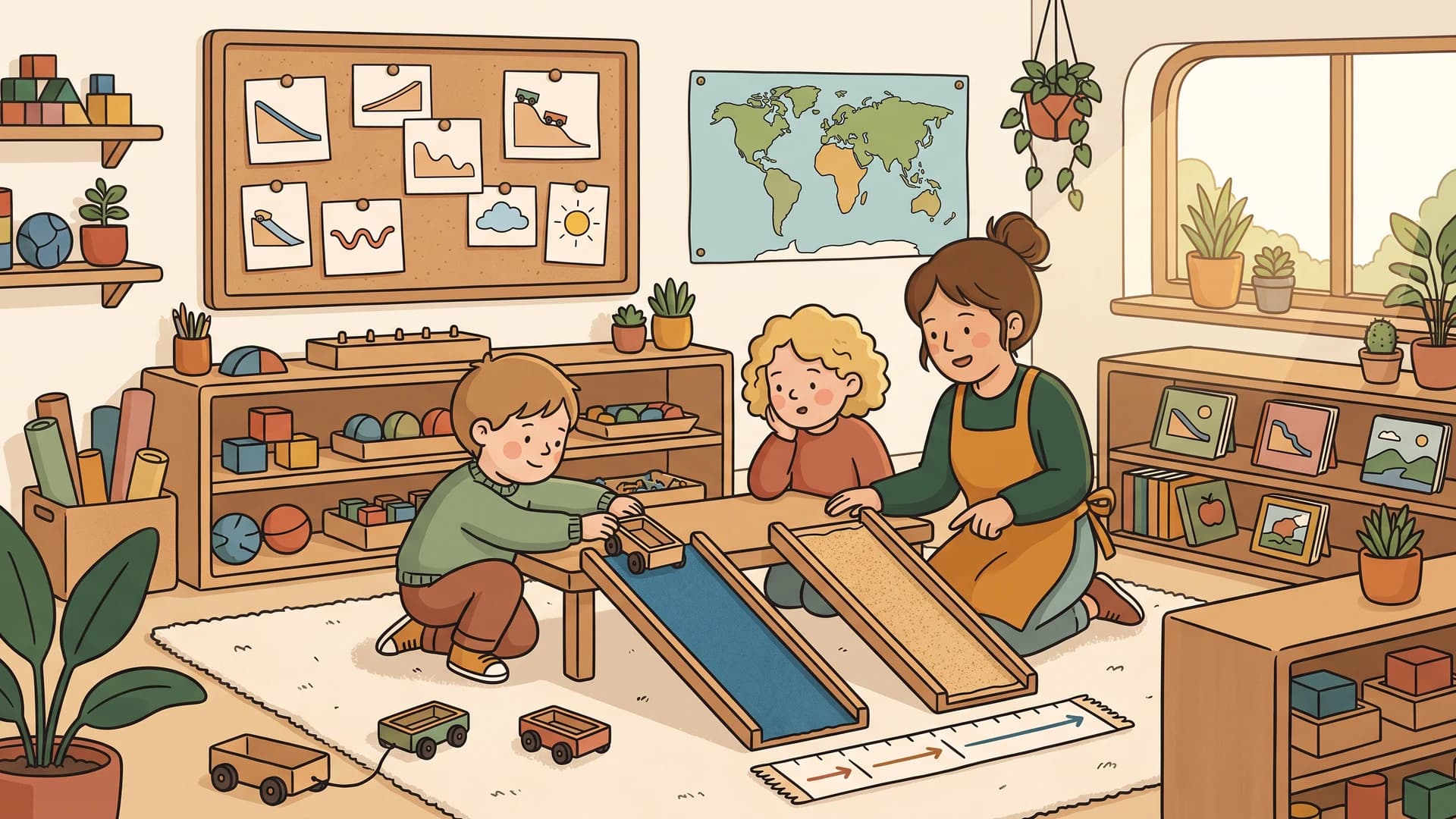
If you teach elementary or middle school science in the US, you have almost certainly been asked to write a 5E lesson plan. Maybe your district adopted it after switching to NGSS. Maybe your university methods class drilled it into you. Maybe a curriculum coach handed you a blank template last week and said "fill this in by Friday."
The 5E model was developed in the late 1980s by the Biological Sciences Curriculum Study (BSCS) under the leadership of Rodger Bybee. It was designed to give science teachers a structured way to run lessons that start with student curiosity rather than with a teacher lecture. BSCS reports widespread use in science curriculum materials, professional learning, and state frameworks, and teachers also adapt the sequence to other subjects.
This guide explains what each of the five Es actually means in practice, where the model genuinely helps, where it gets forced into shapes it does not fit, and how to write one without staring at a blank template for an hour. Two full worked lessons are included at the end so you can see the structure on a real topic.
Key takeaways
- The 5E model is an inquiry framework: Engage, Explore, Explain, Elaborate, Evaluate. It is designed to put student investigation before teacher explanation.
- It originated in science education (BSCS, 1987) and works best for conceptual science topics with a phenomenon students can poke at.
- The Explore phase is the one most teachers shortchange. It is also the one that makes the model work.
- 5E can be adapted to math and ELA, but it is a poor fit for pure skill drills, procedural fluency, or content that requires direct instruction first.
Free 5E lesson plan template (Word, PDF and Google Docs)
Download the blank template, or start from the filled-in example and replace the content with your own topic. No account is needed.
- 5E lesson plan template in Word (editable) or as a PDF (print and write). Two landscape pages: lesson details, objective, phenomenon and materials, then one row per phase with columns for time, what the teacher does, what students do, and the evidence you will look for. Page 2 holds vocabulary, misconceptions, support, extension and reflection.
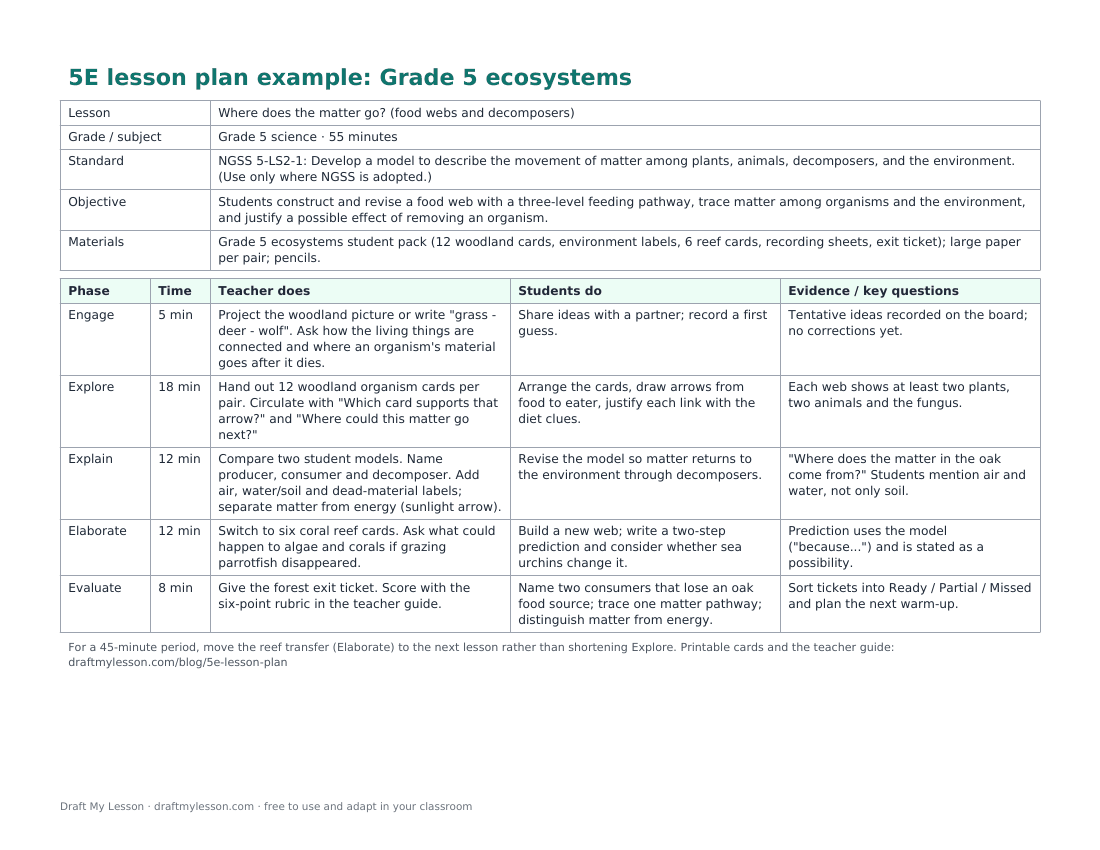
- Filled-in 5E lesson plan example in Word or as a PDF: the Grade 5 ecosystems lesson described below, condensed onto one page.
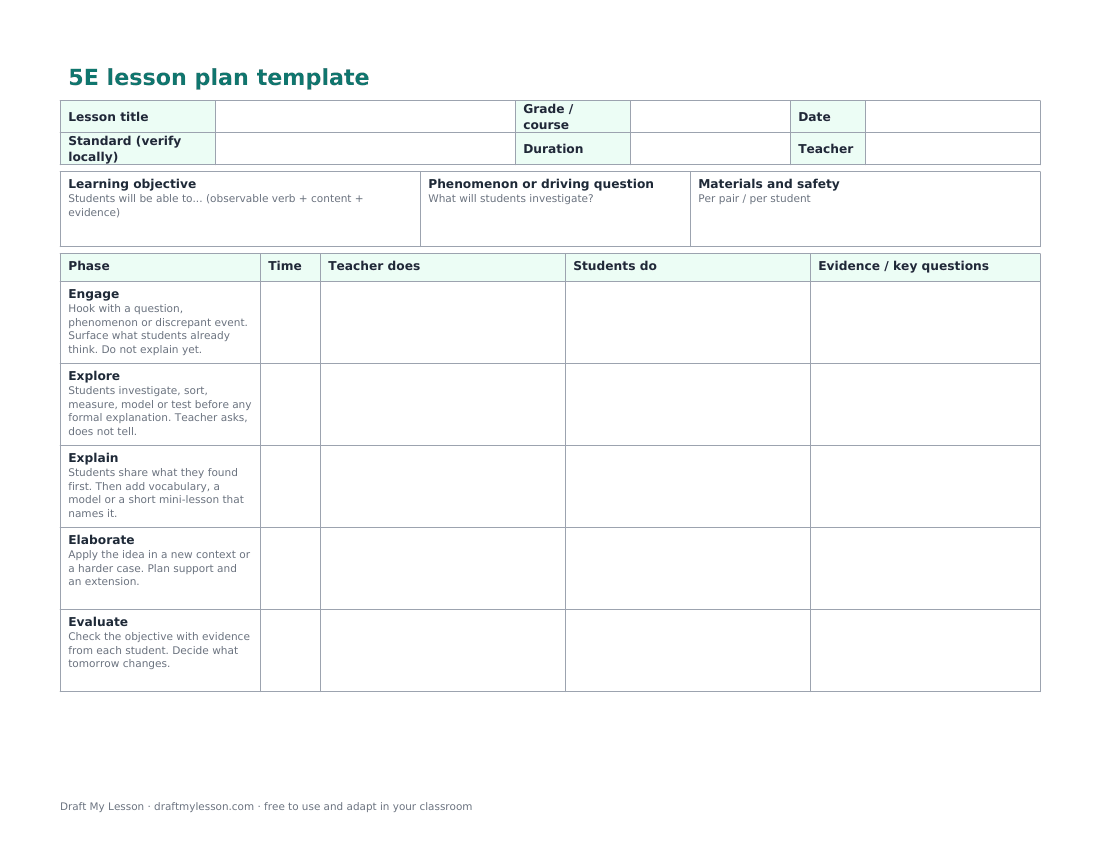
Using Google Docs? Upload the Word file to Google Drive, then open it with Google Docs. The tables stay editable, so you can type in each phase and share the plan with a coach or co-teacher. The same file opens in Word, Pages and LibreOffice.
Each row of the template asks for two columns that districts often merge: Teacher does and Students do. Keeping them separate is the quickest way to check that Explore really is student investigation and not a teacher demonstration with a new label.

Print the four Explore tables and the answer key
The ratios lesson now has a classroom handout containing all four tables, working space, the truck transfer problem and the pay-rate exit ticket.
Download the ratios investigation and separate teacher key (PDF, 2 pages)
Print the updated classroom layout (PDF, 2 pages) · Teacher sequence and assessment rubric (PDF, 2 pages)
Both investigation editions contain the same four tables and answers. Print only page 1 for students; page 2 is the teacher key. The supplementary guide provides the 45-minute sequence, adaptations and an eight-point assessment rubric.
| Table | Milk (cups) | Cocoa (tablespoons) | Check |
|---|---|---|---|
| A | 2, 4, 6 | 3, 6, 9 | Constant ratio: 1.5 |
| B | 2, 4, 6 | 3, 5, 7 | Ratios change |
| C | 1, 3, 5 | 2, 6, 10 | Constant ratio: 2 |
| D | 1, 2, 4 | 2, 4, 7 | Last pair breaks the pattern |
Teaching distinction: A and C each describe a constant recipe, but they are different recipes. Ask “Does this table keep its own recipe constant?” rather than implying that A and C have the same flavor. Print only page 1 for students so the answers remain on your copy.
If students say “both numbers go up,” use B as the counterexample. If they identify the correct tables without explaining, ask them to compare cocoa per cup in every row.
What the 5E model is and where it comes from
The 5E instructional model is a five-phase lesson structure built on constructivist learning theory. The idea is simple: students learn more deeply when they encounter a phenomenon, wrestle with it, and then receive vocabulary and explanations that help them make sense of what they already noticed. Direct instruction comes after exploration, not before.
The model was formalized by BSCS Science Learning in the late 1980s. BSCS traces it to earlier science learning cycles and still publishes its report on the model's origins, phases, and uses.
The model is widely used in US science teaching. The official NGSS overview describes three-dimensional learning through science and engineering practices, disciplinary core ideas, and crosscutting concepts. A 5E sequence can support that work, but the framework is not a substitute for checking the standard adopted by your state or district.
Outside of science, the model has been adopted in some math and ELA settings, usually for conceptual lessons rather than procedural ones. Edutopia has a helpful overview of how teachers use 5E in mixed-subject classrooms.
The five Es, explained
Each E is a distinct phase with a specific job. The phases are not interchangeable, and skipping or reordering them usually breaks the model. Here is what each one looks like in a real classroom.
Engage (5-10 minutes)
The goal of the Engage phase is to surface what students already think and to spark a question they want to answer. This is not a "do now" worksheet. It is a moment of curiosity.
Good Engage activities share three features: they are short, they are concrete, and they leave students with a question they want to investigate. A demo, a short video clip, a discrepant event, a photo prompt, or a quick discussion all work. The teacher's job is to listen and to write down what students notice and wonder. Resist the urge to correct misconceptions here. You want them on the table where exploration can address them.
Common pitfall: turning Engage into a mini-lecture or a vocabulary preview. If you are doing most of the talking, you are not engaging students, you are introducing the lesson.
Explore (15-25 minutes)
Explore is where students interact with materials, data, or a phenomenon. They are doing the science, not watching it. This is the phase most teachers shortchange, usually because it is the messiest and least predictable.
A strong Explore has students working in pairs or small groups with a guiding question and minimal scaffolding. They might run a hands-on investigation, sort cards, analyze a data set, or build something. The teacher circulates, asks probing questions, and notes which groups are stuck and on what.
Common pitfall: giving students a step-by-step recipe with predicted outcomes. That is a lab activity, not exploration. Real exploration has at least one open question students must resolve on their own.
Explain (10-15 minutes)
Explain is where the formal vocabulary, definitions, and explanations enter the lesson. Crucially, this happens after students have something concrete to attach the vocabulary to.
The Explain phase can be teacher-led (a short direct instruction segment), student-led (groups present what they found and you label it), or a mix. Either way, the goal is to connect the new terms to what students just experienced. "What you just observed when the water rose in the tube is called capillary action. Here is why it happens."
Common pitfall: ignoring what students actually noticed and delivering a generic lecture. The Explain phase is most effective when it explicitly references group observations from Explore.
Elaborate (10-20 minutes)
Elaborate, sometimes called Extend, asks students to apply the new concept in a different context. This is where understanding gets tested and deepened.
A strong Elaborate uses a fresh example or a transfer problem. If Explore looked at plant growth, Elaborate might ask about coral bleaching. If Explore taught place value with base-ten blocks, Elaborate might ask students to estimate large quantities in a real-world setting. The point is to move beyond the original example.
Common pitfall: assigning more of the same. If Elaborate looks identical to Explore, students are practicing, not elaborating.
Evaluate (5-10 minutes, plus ongoing)
Evaluate is where you check what students learned. It happens at the end of the cycle, but in good 5E practice, it is also happening continuously through observation, questioning, and formative checks during the other phases.
Summative Evaluate tasks should ask students to explain their thinking, not just to recall facts. Exit tickets that ask "explain what caused X" or "predict what would happen if Y" tell you more than multiple choice. For more on assessment options, see our guide on assessment types every teacher should know.
Common pitfall: treating Evaluate as the only assessment moment. If you only check understanding at the end, you cannot adjust in the moment.
A 5E lesson plan example: 5th grade ecosystems
Build a woodland food web, trace matter through living things and the environment, then transfer the model to a reef. The printable pack supplies the materials for this 55-minute lesson. Use the NGSS reference only where it has been adopted for your class.
Print the Grade 5 ecosystem lesson pack
- Student cards, worksheets and observation plates (PDF, 9 pages)
- Teacher guide, model answers and assessment criteria (PDF, 3 pages)
The student pack includes 12 woodland organism cards, environment and decomposer labels, six reef cards, recording sheets and an exit ticket. The final two pages are optional illustrated observation plates for projection. Print pages 1-3 and 5 per pair, and pages 4, 6 and 7 per student. Precut the cards and provide pencils and a large sheet of paper for each pair.
Standard: NGSS 5-LS2-1. Develop a model to describe the movement of matter among plants, animals, decomposers, and the environment.
Objective: Students construct and revise a food web with a three-level feeding pathway, trace matter among organisms and the environment, and justify a possible effect of removing an organism.
Engage (5 min): Project the woodland observation plate (student page 8), or write "grass - deer - wolf" on the board. Ask how the living things might be connected and where an organism's material goes after it dies. Record tentative ideas. The illustration starts a discussion; the cards provide evidence for the model.
Explore (18 min): Give each pair the 12 woodland cards. Students arrange the cards, draw arrows from food to eater, and use the diet clues to justify each link. They record a web containing at least two plants, two animals and the fungus. Ask "Which card supports that arrow?" and "Where could this matter go next?" This is a simplified woodland-edge model, not an inventory of a particular local ecosystem.
Explain (12 min): Compare two models before naming producers, consumers and decomposers. Add the environment labels, including air, water/soil, dead material and bacteria. Students revise their models to trace matter through feeding and decomposition back to the environment. Plants make food using matter from air and water with energy from light; soil minerals also enter plants. Distinguish cycling matter from transferred energy, and use a different arrow for sunlight. A food web showing energy alone is not sufficient evidence for this standard.
Elaborate (12 min): Switch to the six reef cards and, optionally, the observation plate on student page 9. Students build a new model, then predict what could happen to algae and corals if grazing parrotfish disappeared. They explain both steps and consider whether sea-urchin grazing could change the outcome. Treat the prediction as a possibility supported by the model, not a certainty about every reef.
Evaluate (8 min): Use the forest exit ticket on student page 7. Students identify two consumers that lose an oak food source, trace a matter pathway including decomposition, and distinguish matter from the energy supplied by sunlight. The teacher guide provides answers, a six-point rubric and next-step activities. Assess their recorded models as well as the exit ticket.
For a 45-minute period, carry the reef transfer into the next lesson. Keep the matter-modeling work and individual assessment rather than compressing every phase.
This lesson maps cleanly onto the 5E phases because ecosystems are conceptual content that students can model with manipulatives before they have the vocabulary. For more on writing the objective itself, see writing strong lesson plan objectives.
A 5E lesson plan example: 7th grade ratios and proportions
5E is harder to apply in math, but it works for conceptual lessons where students can discover a relationship before it is named. Here is one on proportional reasoning.
Standard: CCSS.MATH.7.RP.A.2. Recognize and represent proportional relationships between quantities. Use this reference only where the Common Core standard applies.
Objective: Students will be able to determine whether two quantities are in a proportional relationship by examining a table of values and explaining their reasoning.
The tables directly address 7.RP.A.2a and 2b. The teacher guide offers an optional equation task for 2c; this lesson does not assess the graph interpretation in 2d.
Engage (5 min): Show two recipes for hot chocolate. Recipe A: 2 cups milk, 3 tablespoons cocoa. Recipe B: 4 cups milk, 5 tablespoons cocoa. Ask: "If I double Recipe A, will it taste the same as Recipe B? Predict before calculating."
Explore (15 min): Pairs receive four tables of values. Two represent proportional relationships, two do not. Pairs decide whether each table keeps its own cocoa-to-milk ratio constant and justify with calculations. Then they compare the constants of Tables A and C: both are proportional, but they describe different recipes. No definition of proportionality has been given yet. Students often invent ratio comparisons on their own.
Explain (10 min): Bring the class together. Have two groups share their reasoning. Formalize what they noticed: a proportional relationship has a constant ratio between the two quantities. Introduce the term "constant of proportionality" and show how to compute it from each table.
Elaborate (12 min): Switch to a real-world prompt. A pickup truck travels 90 miles on 4 gallons of gas, and 135 miles on 6 gallons. Is this proportional? At that rate, how far can it go on 10 gallons? Students work individually, then compare with a neighbor.
Evaluate (3 min): Exit ticket. A table shows: 1 hour worked = $12 earned, 3 hours = $36, 5 hours = $65. Ask: "Is this pay rate proportional? Justify in one sentence." Students who explain that $65 breaks the pattern of $12 per hour have grasped the concept.
For another subject and method, use the Grade 3 main-idea passages and teacher guide. Grade identifies the US school level; 5E identifies the teaching method.
Notice that in math, the 5E cycle works because there is a phenomenon to explore (the pattern in the tables) and a generalization to discover (constant ratio). For procedural lessons such as long division algorithms, 5E adds friction without benefit.
5E lesson plan examples by grade and subject
The two full lessons above show the model in depth. The table below gives a one-line plan for each phase across grade levels, so you can see how the same structure changes from kindergarten to high school. Standard codes are examples from NGSS and the Common Core; use them only where your state has adopted them.
| Grade and subject | Engage | Explore | Explain | Elaborate | Evaluate |
|---|---|---|---|---|---|
| Kindergarten science, pushes and pulls (K-PS2-1) | Roll a ball gently into a block tower, then harder. What changed? | Pairs push toy cars with a straw, softly and strongly, and mark how far they go. | Name push, pull, stronger and farther from what children saw. | Make a ball reach a target on the floor by choosing how hard to push. | Draw how to make the car go farther and tell a partner why. |
| Grade 2 science, properties of materials (2-PS1-1) | A mystery bag: which object would make the best umbrella? | Test six materials for bendy, hard, waterproof and see-through, and record results. | Sort the results into property words as a class. | Choose a material for a lunchbox and justify it with two properties. | Sort two new objects by property and explain one choice. |
| Grade 3 math, area by tiling (3.MD.C.6) | Two rugs that look the same size: which covers more floor? | Cover shapes with square tiles and count; compare two strategies. | Introduce square units and area; connect counting rows to multiplication. | Find the area of an L-shaped room by splitting it. | Exit ticket: find the area of a new rectangle two ways. |
| Grade 6 science, moon phases (MS-ESS1-1) | Photos of the moon over one month. Why does it change shape? | In a darkened room, students hold a ball at arm's length around a lamp and record what they see. | Model the Sun, Earth and Moon; name the phases from the observations. | Predict the phase seen from the opposite side of the room, then test it. | Draw the Moon's position for a given phase and explain the lit half. |
| Grade 8 social studies, colonial boycotts | A tea crate from 1773 in a picture: why would people refuse to buy tea? | Groups analyze three short primary sources from different colonists. | Name boycott, taxation without representation and point of view. | Compare with a modern consumer boycott students know. | Short claim-evidence paragraph on one cause of the boycotts. |
| High school chemistry, reaction rates (HS-PS1-5) | Two antacid tablets fizz at different speeds. Why? | Time tablets dissolving in cold, room-temperature and warm water, and in whole versus crushed form. | Collision theory: temperature and surface area change how often particles collide. | Predict the effect of concentration and design a fair test. | Explain a new graph of reaction time using particle collisions. |
| High school algebra, linear versus exponential (HSF-LE.A.1) | Would you rather take $1,000 a day for 30 days or a penny that doubles daily? | Fold paper and record layers; compare with stacking one sheet per step. | Define constant difference versus constant ratio. | Classify six real situations as linear or exponential. | Given two tables, identify each model and justify with differences or ratios. |
Notice the pattern in every row: students handle evidence before the teacher names the idea. If you reorder the Explain and Explore cells in your own plan, you are writing a direct-instruction lesson with 5E headings.
See your next lesson take shape.
You have seen the ratios example. Now see how to prepare, review and export an editable lesson with Draft My Lesson.
Optional tour. Subtitles available.
When 5E works and when it doesn't
The 5E model is not a universal lesson template. It works for some content and not others. Be honest about the difference, especially when you are required to write lesson plans in the 5E format for content that does not fit.
5E works well for:
- Conceptual science topics with a physical phenomenon (forces, weather, ecosystems, chemistry of solutions)
- Math concepts where a pattern can be discovered before it is named (proportionality, function families, geometric properties)
- ELA lessons that ask students to discover a pattern in mentor texts (sentence structure, narrative arcs, persuasive devices)
- Social studies lessons that use primary sources to surface a historical question
5E works poorly for:
- Pure skill drills (handwriting, multiplication facts, decoding)
- Highly procedural content where exploration without prior instruction would lead to entrenched errors
- Lessons under 30 minutes total (you cannot do five phases justice in 25 minutes)
- Foundational vocabulary lessons where students need the term defined before they can investigate anything
When 5E does not fit, use a different structure. Backward design, direct instruction, gradual release, and Madeline Hunter's seven-step lesson plan are all defensible alternatives. If your school requires 5E templates for every lesson, you can usually map a non-inquiry lesson onto the template without losing pedagogical integrity, but recognize that you are doing paperwork compliance rather than 5E pedagogy.
For lessons that are not a clean fit, our guide on how to write a lesson plan walks through several formats so you can choose the right one for the content.

Copyable 5E lesson plan template
Prefer plain text? Copy this into your planner or a Google Doc. It mirrors the downloadable Word and PDF template. Keep student actions and evidence explicit so the five labels do not become five paragraphs of teacher activity.
Copyable text
Copy includes the complete text. No signup needed.
Grade / course:
Topic or phenomenon:
Standard or curriculum reference (verify locally):
Learning objective:
Materials and safety notes:
ENGAGE (___ min)
Prompt, phenomenon, or problem:
What students say, notice, or predict:
Show full textShow less
EXPLORE (___ min)
Investigation or task:
What students manipulate, compare, or test:
Teacher questions that do not give away the explanation:
EXPLAIN (___ min)
Student explanations to surface:
Vocabulary, model, or mini-lesson to add:
Quick check for understanding:
ELABORATE (___ min)
New context or transfer task:
Support and extension:
EVALUATE (___ min)
Prompt or performance:
Success criteria:
What tomorrow changes if students miss it:
For an all-purpose version, use a lesson plan template. To draft a 5E version in the product, open the lesson generator, choose the relevant profile, and verify every curriculum reference before teaching.
Frequently asked questions
What are the 5 steps of the 5E model?
The five phases of the 5E model are Engage, Explore, Explain, Elaborate, and Evaluate. They are designed to be used in sequence. Engage surfaces curiosity and prior knowledge, Explore lets students investigate a phenomenon with minimal scaffolding, Explain introduces formal vocabulary and concepts after exploration, Elaborate applies the concept in a new context, and Evaluate checks what students learned. The order matters because the model is built on the principle that exploration should precede explanation.
How do you write a 5E lesson plan?
Start with a clear, measurable objective and a relevant standard. Then design the Explore phase first: what will students actually do with materials, data, or a phenomenon? Once Explore is solid, build Engage around it (a short hook that points students toward what they will investigate). Then plan Explain to formalize what Explore surfaced, write an Elaborate task in a different context, and finish with an Evaluate task that asks students to explain their reasoning. Most teachers find that planning Explore first, then working outward, produces a tighter lesson than going in 1-2-3-4-5 order.
What is the format of a 5E lesson plan?
A 5E lesson plan template typically includes the standard, objective, vocabulary, materials, and time estimates, followed by a section for each phase. Each phase section describes what the teacher does, what students do, and the expected duration. Many districts provide their own 5E template, but the underlying structure is the same. You can adapt any lesson plan format to the 5E phases as long as the five sections are clearly labeled and follow the prescribed sequence.
What are the 5E learning strategies?
Each phase has its own characteristic strategies. Engage often uses discrepant events, photo prompts, quick discussions, or short video clips. Explore typically uses hands-on investigations, card sorts, data analysis, or modeling activities. Explain can be teacher-led mini-lectures, student presentations, or reading and annotation. Elaborate often involves transfer tasks, real-world applications, or design challenges. Evaluate uses exit tickets, written explanations, performance tasks, and ongoing formative checks. The strategies are not fixed, but they should fit the cognitive job of the phase.
Who created the 5E model?
The 5E instructional model was developed by BSCS (Biological Sciences Curriculum Study, now BSCS Science Learning) in the late 1980s, in a project led by Rodger Bybee. It built on earlier learning-cycle models used in science education and was first used in an elementary science and health curriculum before spreading to science programs, teacher education and state frameworks.
What are the disadvantages of the 5E model?
The main drawbacks are time and fit. A full cycle rarely fits in a 30-minute period, Explore needs materials and careful questioning, and unguided exploration can reinforce misconceptions if the Explain phase does not address them directly. It is also a weak structure for procedural fluency, foundational vocabulary or skills that students need to see modeled first. Many teachers solve this by running one 5E cycle across two or three lessons and using direct instruction for the skill practice that follows.
Is there a free 5E lesson plan template in Word or Google Docs?
Yes. The 5E lesson plan template on this page is free to download as an editable Word file or a printable PDF, with a filled-in Grade 5 example. To use it in Google Docs, upload the Word file to Google Drive and open it with Google Docs; the tables stay editable.
Is 5E a pedagogy?
5E is best described as an instructional model rather than a full pedagogy. It is grounded in constructivist learning theory, which is the underlying pedagogy, and it operationalizes that theory into a five-phase lesson structure. A pedagogy is a broader set of beliefs about how learning happens; an instructional model is a concrete way to translate those beliefs into classroom practice. Teachers who use 5E well typically also embrace inquiry-based teaching, formative assessment, and student discourse as core practices, which together form their pedagogical stance.
Continue your lesson planning toolkit
The 5E model is one of several lesson structures worth knowing. If you teach across subjects, having two or three formats in your toolkit lets you match the structure to the content rather than forcing every lesson into the same mold.
If you are early in your planning practice, start with how to write a lesson plan and the parts of a lesson plan for the foundations. Then work through lesson plan objectives and Bloom's taxonomy for lesson planning to sharpen the part most teachers shortchange. When you are ready to design whole units rather than single lessons, backward design is the natural next step.
For day-to-day planning across many lessons per week, creating effective lesson plans with AI shows how to keep the structure tight while cutting prep time. And when you have a 5E lesson ready, differentiating it for every student is what takes a good lesson plan to a great one.
Related articles
I Do, We Do, You Do: The Gradual Release Model With a Template and Example
How the "I do, we do, you do" gradual release model works, where it comes from, when to move to the next phase, a free lesson plan template and a complete Grade 7 math example.
Read articleBloom's Taxonomy Verbs: 150 Action Verbs by Level, With Question Stems
A complete list of Bloom's taxonomy verbs for the six revised levels, with question stems, sample objectives and a free printable verb chart.
Read articleMadeline Hunter Lesson Plan: The 7 Steps, a Free Template and Two Examples
The seven elements of Madeline Hunter's lesson design explained step by step, with a free Word and PDF template and two complete K-12 examples.
Read articleDaily Lesson Log Template: Format, Parts and a Filled Sample
An editable daily lesson log (DLL) template with the six parts, a filled weekly sample and tips to fill it in less time.
Read article