Bloom's Taxonomy Verbs: 150 Action Verbs by Level, With Question Stems
A complete list of Bloom's taxonomy verbs for the six revised levels, with question stems, sample objectives and a free printable verb chart.
Draft My Lesson Team

The short answer: Bloom's taxonomy verbs are measurable action verbs grouped by the six levels of the revised taxonomy (2001). Use Remember verbs such as define, list, recall; Understand verbs such as explain, summarize, classify; Apply verbs such as solve, use, demonstrate; Analyze verbs such as compare, differentiate, organize; Evaluate verbs such as judge, justify, critique; and Create verbs such as design, compose, construct. Pick the level first, then the verb that produces evidence you can check.
This page lists 25 verbs for each level, the question stems that go with them, and an example objective per level. Everything fits on the free chart below, so you can keep it next to your planner.
Key takeaways
- The revised taxonomy (Anderson and Krathwohl, 2001) uses six verbs as level names: Remember, Understand, Apply, Analyze, Evaluate, Create.
- A verb does not fix the level on its own. "Compare two definitions" is Understand; "compare two arguments and decide which is stronger" is Evaluate.
- Avoid verbs you cannot observe, such as understand, know and appreciate, in the objective itself.
- Match the assessment to the verb: you cannot check design with a multiple-choice quiz.
Free Bloom's taxonomy verbs chart (PDF and Word)
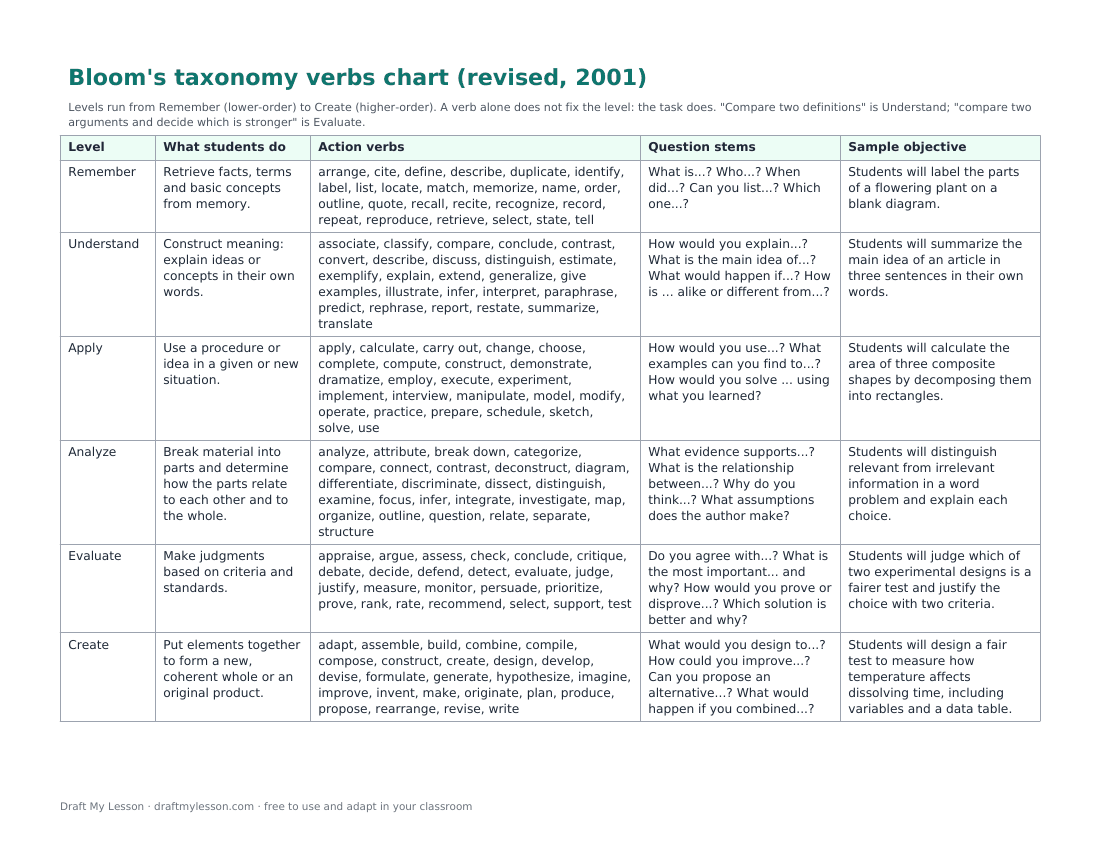
Download the chart as a printable PDF or an editable Word file. Page 1 is the six levels with what students do, 25 action verbs, question stems and a sample objective. Page 2 covers the knowledge dimension and the verbs to avoid. No account is needed. In Google Docs, upload the Word file to Drive and open it with Google Docs.

Bloom's taxonomy verbs list by level
The levels run from lower-order thinking (Remember) to higher-order thinking (Create). Higher levels usually build on lower ones, but a lesson does not have to start at the bottom: if students already know the facts, open at Apply or Analyze.
Remember: retrieve facts and basic concepts
Verbs: arrange, cite, define, describe, duplicate, identify, label, list, locate, match, memorize, name, order, outline, quote, recall, recite, recognize, record, repeat, reproduce, retrieve, select, state, tell.
Question stems: What is...? Who...? When did...? Can you list...? Which one...? Where is...?
Example objective: Students will label the parts of a flowering plant on a blank diagram with at least five of six parts correct.
Good evidence: labeled diagrams, matching tasks, short retrieval quizzes, flashcards.
Understand: explain ideas in your own words
Verbs: associate, classify, compare, conclude, contrast, convert, describe, discuss, distinguish, estimate, exemplify, explain, extend, generalize, give examples, illustrate, infer, interpret, paraphrase, predict, rephrase, report, restate, summarize, translate.
Question stems: How would you explain...? What is the main idea of...? What would happen if...? How is ... alike or different from...? Can you give an example of...?
Example objective: After reading a two-page article, students will summarize its main idea in three sentences in their own words.
Good evidence: summaries, explanations, concept sorts, a prediction with a reason.
Apply: use a procedure or idea in a situation
Verbs: apply, calculate, carry out, change, choose, complete, compute, construct, demonstrate, dramatize, employ, execute, experiment, implement, interview, manipulate, model, modify, operate, practice, prepare, schedule, sketch, solve, use.
Question stems: How would you use...? What examples can you find to...? How would you solve ... using what you learned? What would you change to...?
Example objective: Students will calculate the area of three composite shapes by decomposing them into rectangles.
Good evidence: worked problems, demonstrations, a completed procedure, a model applied to a new case.
Analyze: break material into parts and find relationships
Verbs: analyze, attribute, break down, categorize, compare, connect, contrast, deconstruct, diagram, differentiate, discriminate, dissect, distinguish, examine, focus, infer, integrate, investigate, map, organize, outline, question, relate, separate, structure.
Question stems: What evidence supports...? What is the relationship between...? Why do you think...? What assumptions does the author make? What is the function of...?
Example objective: Given a word problem with extra information, students will distinguish relevant from irrelevant numbers and explain each choice.
Good evidence: annotated texts, cause-and-effect diagrams, categorizations with reasons, comparisons of sources.
Evaluate: make judgments using criteria
Verbs: appraise, argue, assess, check, conclude, critique, debate, decide, defend, detect, evaluate, judge, justify, measure, monitor, persuade, prioritize, prove, rank, rate, recommend, select, support, test, weigh.
Question stems: Do you agree with...? What is the most important ... and why? How would you prove or disprove...? Which solution is better, and why? What criteria would you use to...?
Example objective: Students will judge which of two experimental designs is a fairer test and justify the choice with two criteria.
Good evidence: a reasoned judgment against stated criteria, peer reviews, debates, ranked choices with justification.
Create: put elements together into something new
Verbs: adapt, assemble, build, combine, compile, compose, construct, create, design, develop, devise, formulate, generate, hypothesize, imagine, improve, invent, make, originate, plan, produce, propose, rearrange, revise, write.
Question stems: What would you design to...? How could you improve...? Can you propose an alternative...? What would happen if you combined...? How would you test...?
Example objective: Students will design a fair test to measure how temperature affects dissolving time, including variables and a data table.
Good evidence: an original product, plan, experiment, story or solution checked against a rubric.
Bloom's verbs by subject: sample objectives
The same level looks different in each subject. These examples use one verb per level so you can see the change in cognitive demand.
| Level | Math | ELA | Science | Social studies |
|---|---|---|---|---|
| Remember | State the order of operations. | Identify the narrator of the story. | Label the stages of the water cycle. | Locate the 13 colonies on a map. |
| Understand | Explain why a fraction with a larger denominator can be smaller. | Summarize chapter 3 in five sentences. | Describe how a seed becomes a plant. | Explain one cause of the American Revolution. |
| Apply | Solve two-step equations. | Use dialogue tags correctly in a narrative. | Measure the mass of three objects with a balance. | Use a timeline to sequence five events. |
| Analyze | Compare two solution strategies and identify where they differ. | Analyze how word choice creates mood. | Differentiate between physical and chemical changes in five examples. | Contrast two primary sources about the same event. |
| Evaluate | Justify which estimate is more reasonable. | Critique a thesis statement against the rubric. | Evaluate whether the data support the hypothesis. | Defend a position on a historical decision with evidence. |
| Create | Design a survey and a graph to answer a class question. | Compose an alternative ending that keeps the theme. | Design an experiment to test plant growth under different light. | Propose a solution to a local community problem. |
Original (1956) versus revised (2001) Bloom's taxonomy
Benjamin Bloom and colleagues published the original Taxonomy of Educational Objectives in 1956. In 2001, a team led by Lorin Anderson, a former student of Bloom, and David Krathwohl, a co-author of the original handbook, published a revision. Most US teacher-preparation programs and district templates now use the revised levels.
| Original (1956), nouns | Revised (2001), verbs | What changed |
|---|---|---|
| Knowledge | Remember | Renamed as a cognitive process |
| Comprehension | Understand | Renamed |
| Application | Apply | Renamed |
| Analysis | Analyze | Renamed |
| Synthesis | Create | Renamed and moved to the top level |
| Evaluation | Evaluate | Moved below Create |
The revision also added a knowledge dimension, so an objective can be placed on a grid of six processes and four types of knowledge: factual (terms and details), conceptual (categories, principles, models), procedural (how to do something) and metacognitive (awareness of one's own thinking). "Recall the symbols for the first ten elements" is Remember with factual knowledge; "choose a reading strategy for a difficult text and explain why it helped" is Evaluate with metacognitive knowledge.
Verbs to avoid, and verbs that sit at two levels
Not observable. Understand, know, learn, appreciate, be aware of, be familiar with, grasp, realize, comprehend, believe and internalize describe what happens inside a student's head. They are fine in a unit goal or an essential question, but not in a lesson objective. Ask "what would a student do to show it?" and use that verb instead. "Understand photosynthesis" becomes "explain how a plant uses light, water and carbon dioxide to make sugar, using a labeled diagram."
Verbs at more than one level. Compare, describe, infer, choose, construct and estimate appear on several published lists, including ours. The level depends on the task:
- "Describe the setting" is Remember; "describe how the setting shapes the conflict" is Analyze.
- "Choose the correct formula" is Apply; "choose the best of three proposals and justify it" is Evaluate.
- "Construct a bar graph from the table" is Apply; "construct an original argument" is Create.
If an objective could fit two levels, look at the evidence: what will students actually produce, and how much new thinking does it require?
How to choose the right Bloom's verb in three steps
- Start from the standard or unit goal. Many standards already contain a verb (for example, "explain", "compare", "construct an argument"). Keep it if it is observable.
- Decide the level this lesson needs. Early in a unit, Remember and Understand are often appropriate. Later lessons should reach Analyze, Evaluate or Create. Not every lesson needs a higher-order objective, but every unit should.
- Check the verb against the assessment. If the verb is design, the evidence must be a design. If the evidence is a multiple-choice quiz, the honest verb is probably identify or select.
Then write the full objective with the ABCD model (audience, behavior, condition, degree). Our guide to lesson plan objectives has a builder, a worksheet and 24 examples by grade.
Verbs for the affective and psychomotor domains
Bloom's revised taxonomy covers the cognitive domain only. Attitudes, participation and values belong to the affective domain (Krathwohl, Bloom and Masia, 1964), and physical skills to the psychomotor domain, for which Simpson (1972), Dave (1970) and Harrow (1972) proposed the best-known hierarchies.
- Affective verbs: accept, attend, choose, comply, contribute, cooperate, defend, follow, help, initiate, join, participate, propose, question, respond, revise, share, support.
- Psychomotor verbs: adjust, align, assemble, calibrate, construct, dismantle, execute, grip, manipulate, measure, mix, operate, perform, sketch, trace.
As with cognitive verbs, describe something you can see: "will participate respectfully" is vague; "will contribute one comment that builds on a peer's idea" is observable.

Turn the verb into a full lesson
Once the objective is clear, the rest of the plan follows from it. Our Bloom's taxonomy lesson plan guide shows how to scaffold one period from lower to higher levels. If you want a first draft to edit, the Draft My Lesson lesson generator turns your topic, grade and objective into an editable lesson plan with activities and an assessment. Review every draft against your curriculum and class before teaching.
Frequently asked questions
What are Bloom's taxonomy verbs?
Bloom's taxonomy verbs are observable action verbs organized by the six levels of the revised taxonomy: Remember, Understand, Apply, Analyze, Evaluate and Create. Teachers use them to write measurable learning objectives and to design questions and assessments at the intended level of thinking.
What are the six levels of Bloom's taxonomy in order?
From lower to higher: Remember, Understand, Apply, Analyze, Evaluate, Create. This is the revised order published by Anderson, Krathwohl and colleagues in 2001. The original 1956 version used nouns and placed Evaluation above Synthesis.
Which verbs should you avoid in learning objectives?
Avoid verbs that describe internal states you cannot observe: understand, know, learn, appreciate, be aware of, be familiar with, grasp, realize, comprehend and believe. Replace them with what students will do to show the learning, such as explain, solve, compare or design.
Is "understand" a Bloom's taxonomy verb?
Understand is the name of the second level, not a good objective verb. To write an objective at that level, use a verb that shows understanding, such as explain, summarize, classify, paraphrase or predict.
Can the same verb belong to more than one level?
Yes. Verbs such as compare, describe, choose and construct appear at different levels depending on the task. The level is set by the thinking the task requires, not by the verb alone. Check what students will produce and how much new reasoning it demands.
What is the highest level of Bloom's taxonomy?
In the revised taxonomy, Create is the highest level: putting elements together into a new, coherent product such as a design, plan, experiment or original piece of writing. In the original 1956 version, Evaluation was the highest level.
Continue your lesson planning toolkit
- Lesson plan objectives: the ABCD model, the three domains and 24 examples by grade.
- Bloom's taxonomy lesson plan: scaffold thinking across one class period.
- How to write a lesson plan: the full process from objective to assessment.
- Exit ticket examples: quick checks at the level your objective names.
- Backward design: plan the evidence before the activities.
Related articles
Bloom's Taxonomy Lesson Plan: How to Scaffold Thinking in One Period
Use Bloom's revised taxonomy to plan a single lesson that climbs from recall to higher-order thinking. Includes a verb table and a full worked example.
Read articleLesson Plan Objectives: 3 Types, Bloom's Verbs, and ABCD Examples
The 3 objective types are cognitive, affective, and psychomotor. Use the free builder, Bloom's verb bank, and ABCD examples to write your own.
Read articleHow to Write a Lesson Plan: A 7-Step Guide for Teachers
A step-by-step method for writing a classroom-ready lesson plan in under 30 minutes, with three real K-12 examples and the components every plan needs.
Read articleI Do, We Do, You Do: The Gradual Release Model With a Template and Example
How the "I do, we do, you do" gradual release model works, where it comes from, when to move to the next phase, a free lesson plan template and a complete Grade 7 math example.
Read article