I Do, We Do, You Do: The Gradual Release Model With a Template and Example
How the "I do, we do, you do" gradual release model works, where it comes from, when to move to the next phase, a free lesson plan template and a complete Grade 7 math example.
Draft My Lesson Team
The short answer: "I do, we do, you do" is the everyday name for the gradual release of responsibility model. The teacher first models a skill (I do), then students practice it with the teacher's guidance (we do), then students do it on their own (you do). Responsibility for the thinking shifts from teacher to students across the lesson. Many teachers add a fourth phase, you do together, where students practice in pairs or groups before working alone.
Key takeaways
- The model was described by P. David Pearson and Margaret Gallagher in 1983; Douglas Fisher and Nancy Frey later popularized a four-phase version.
- Move to the next phase when you have evidence, not when the clock says so. Plan a check at the end of each phase.
- Keep "I do" short and make the thinking visible. The longest phase should be practice, not explanation.
- The release is not always linear. Go back to "we do" when the evidence says students are not ready.
Free I do, we do, you do lesson plan template
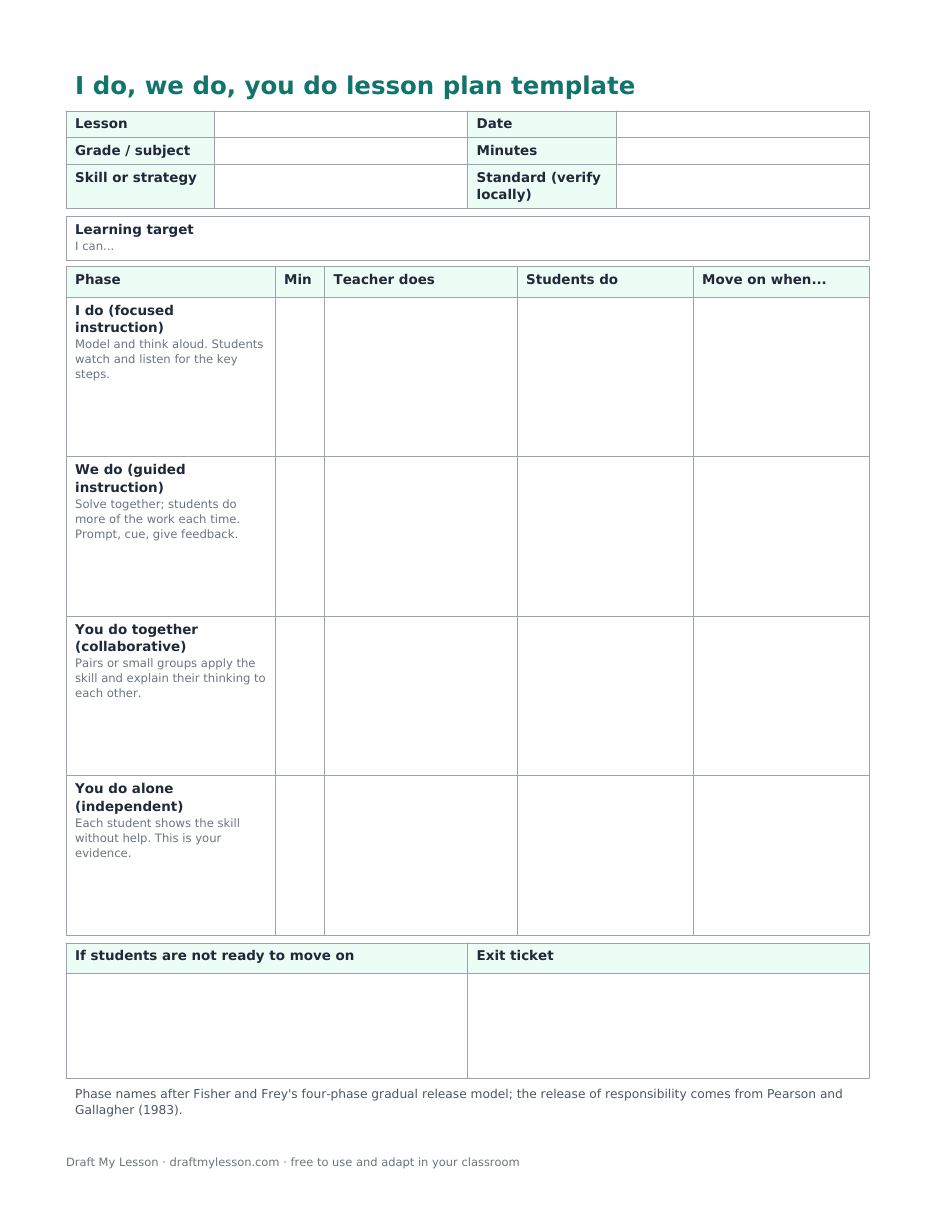
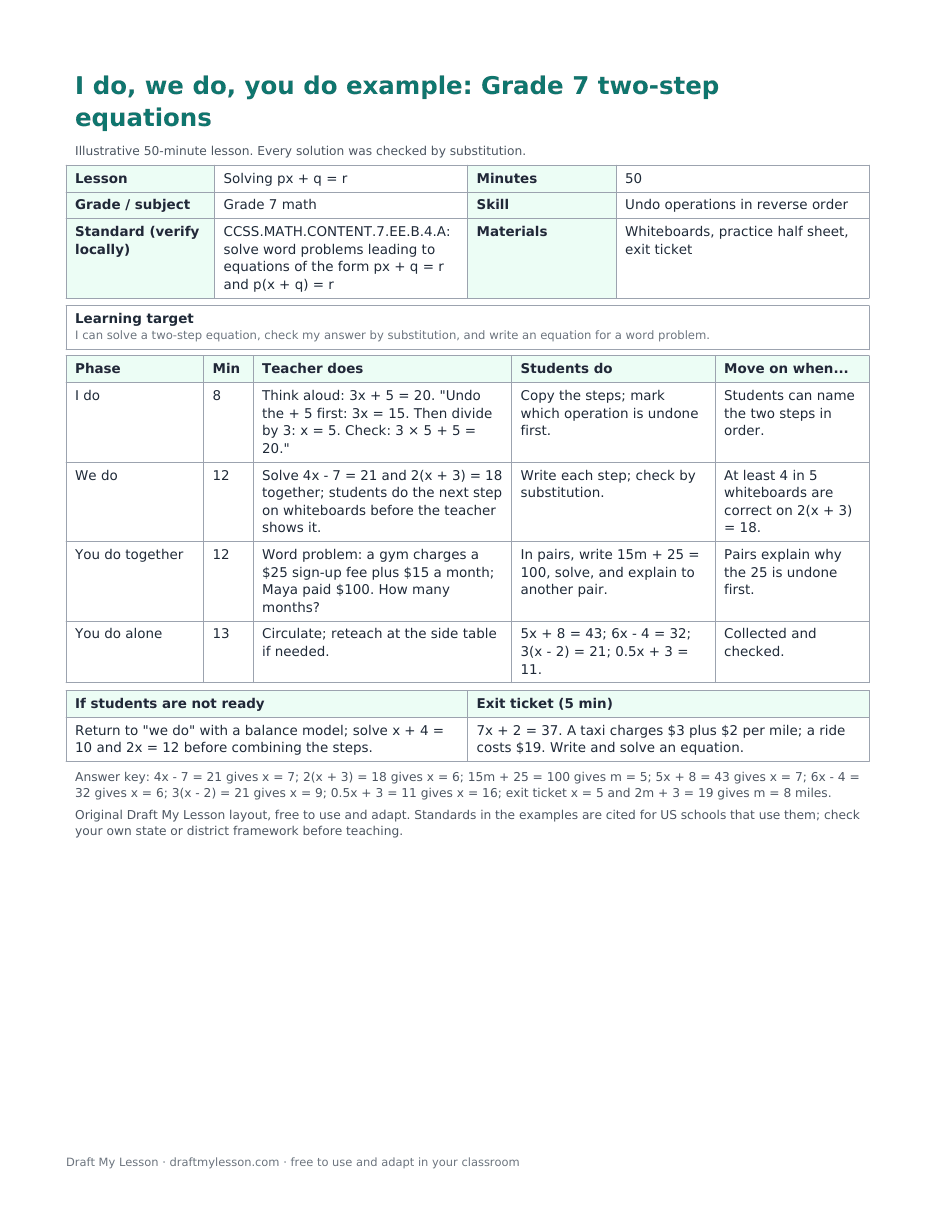
Download the lesson plan template (PDF) or the editable Word file. Page 1 is a blank plan with one row per phase and a "Move on when..." column. Page 2 is the complete Grade 7 math example described below, with an answer key. No account is needed. In Google Docs, upload the Word file to Drive and open it with Google Docs.
Where the model comes from
P. David Pearson and Margaret Gallagher described the gradual release of responsibility in "The Instruction of Reading Comprehension" (Contemporary Educational Psychology, 1983). Their model showed a lesson moving from all teacher responsibility, through shared responsibility, to all student responsibility. It is often linked to earlier ideas about learning with support, such as Lev Vygotsky's zone of proximal development and the "scaffolding" described by David Wood, Jerome Bruner and Gail Ross in 1976.
Douglas Fisher and Nancy Frey expanded the model into four phases in Better Learning Through Structured Teaching (ASCD, first edition 2008). Their phases are the ones used in the template:
| Phase | Short name | Who does the thinking | What it looks like |
|---|---|---|---|
| Focused instruction | I do | Teacher | Modeling and thinking aloud, setting the purpose |
| Guided instruction | We do | Teacher and students | Prompts, cues and questions while students try |
| Collaborative learning | You do together | Students with peers | Pairs or groups apply the skill and explain it to each other |
| Independent learning | You do alone | Each student | Practice that produces individual evidence |
Fisher and Frey stress that the phases are not a fixed linear sequence: a lesson can, for example, open with a collaborative task and bring in focused instruction afterwards.
How to plan each phase
I do: model and think aloud
Show the skill once or twice with your reasoning out loud: what you notice, what you decide, how you check. Students should hear why each step happens, not only see the steps. Keep it short, often 5 to 10 minutes, and end with a quick check: can students name the steps?
We do: guided practice
Work through new examples together, and hand over more of each one as you go. On the first example you ask questions; by the third, students do each step on whiteboards before you show it. This is where you catch errors early, so plan the questions and cues you will use.
You do together: collaborative practice
Pairs or small groups solve a task and explain their reasoning to each other. Talking through the steps helps students notice their own errors, and it frees you to listen and confer.
You do alone: independent practice
Each student practices without help. The work is your evidence for the lesson objective. An exit ticket at the end gives a clean check for tomorrow's plan.
Plan the "move on" checks
Write in the plan what you need to see before the next phase. For example: "At least 4 in 5 whiteboards correct on the last we-do problem." If the check fails, go back to the previous phase with a different example instead of releasing students to fail alone.
I do, we do, you do example: Grade 7 two-step equations
Objective: Students will solve two-step equations of the form px + q = r and p(x + q) = r, check their answer by substitution, and write an equation for a word problem (CCSS 7.EE.B.4a, where the Common Core applies). Time: 50 minutes.
| Phase | Min | Teacher | Students | Move on when... |
|---|---|---|---|---|
| I do | 8 | Think aloud on 3x + 5 = 20: "Undo the + 5 first, so 3x = 15. Then divide by 3: x = 5. Check: 3 × 5 + 5 = 20." | Copy the steps and mark which operation is undone first. | Students can name the two steps in order. |
| We do | 12 | Solve 4x − 7 = 21 and 2(x + 3) = 18 together; students write each next step on whiteboards before the teacher shows it. | Write each step, check by substitution. | At least 4 in 5 whiteboards are correct on 2(x + 3) = 18. |
| You do together | 12 | Word problem: a gym charges a $25 sign-up fee plus $15 a month. Maya paid $100. How many months? | In pairs, write 15m + 25 = 100, solve it and explain to another pair. | Pairs can explain why the 25 is undone first. |
| You do alone | 13 | Circulate; reteach at a side table if needed. | Solve 5x + 8 = 43, 6x − 4 = 32, 3(x − 2) = 21 and 0.5x + 3 = 11. | Work collected. |
| Exit ticket | 5 | Give two problems. | 7x + 2 = 37; a taxi charges $3 plus $2 per mile and a ride costs $19: write and solve an equation. | Sorted into ready / partly / not yet. |
Answer key: 4x − 7 = 21 gives x = 7; 2(x + 3) = 18 gives x = 6; 15m + 25 = 100 gives m = 5 months; 5x + 8 = 43 gives x = 7; 6x − 4 = 32 gives x = 6; 3(x − 2) = 21 gives x = 9; 0.5x + 3 = 11 gives x = 16; 7x + 2 = 37 gives x = 5; 2m + 3 = 19 gives m = 8 miles.
If students are not ready: go back to "we do" with a balance model and solve one-step equations (x + 4 = 10, then 2x = 12) before combining the two steps.
The same model in other subjects
| Subject | I do | We do | You do |
|---|---|---|---|
| Grade 2 reading | Model finding the main idea of a short paragraph, thinking aloud about which sentence the others support | Class finds the main idea of a second paragraph with sentence choices | Students find the main idea of a new paragraph and underline one supporting detail |
| Grade 5 writing | Revise a weak topic sentence in front of the class | Revise two more together | Students revise the topic sentence of their own draft |
| High school science | Model reading a distance-time graph, describing each segment | Pairs describe a second graph; class compares | Each student sketches a graph from a written description |
When the model does not fit
Gradual release is a model for teaching a skill or strategy students cannot yet do. It fits less well when the goal is for students to discover a pattern or build an explanation from evidence; then an inquiry structure such as a 5E lesson may be better. Some teachers deliberately reverse the order ("you do, we do, I do") so students struggle with a problem before instruction. That can work for problem solving when students have enough background knowledge to make progress.
The model also overlaps with the Madeline Hunter lesson plan: Hunter's input and modeling are "I do", guided practice is "we do" and independent practice is "you do". Hunter adds an anticipatory set and an explicit check for understanding.
Draft a gradual release lesson
If you want a first draft instead of a blank template, the Draft My Lesson lesson generator drafts an editable lesson plan with objectives, activities, practice and an assessment from your topic, grade and duration. Map its sections onto the four phases and review the content, timing and curriculum references before teaching. Your free account includes two complete lessons.
Frequently asked questions
What is the I do, we do, you do method?
It is a way of structuring a lesson so responsibility moves from teacher to students. The teacher models a skill (I do), the class practices it together with guidance (we do), and students then practice independently (you do). It is the common name for the gradual release of responsibility model.
What are the four stages of gradual release of responsibility?
In Fisher and Frey's version, the four stages are focused instruction (I do), guided instruction (we do), collaborative learning (you do together) and independent learning (you do alone). The original 1983 model by Pearson and Gallagher described a continuous shift from teacher to student rather than named stages.
Who came up with "I do, we do, you do"?
The underlying model was described by P. David Pearson and Margaret Gallagher in 1983. The short phrase "I do, we do, you do" became popular in teacher education afterwards, and Douglas Fisher and Nancy Frey added "you do it together" as a separate phase. No single author is credited with the phrase itself.
Is "I do, we do, you do" the same as explicit instruction?
They overlap. Explicit instruction is a broader approach to teaching skills directly, with clear modeling, guided practice with feedback, and independent practice. "I do, we do, you do" is a simple way to sequence those parts within one lesson.
How long should each phase be?
There is no fixed ratio. A common guideline is to keep "I do" short and give most of the time to practice. In the 50-minute example above, modeling takes 8 minutes and practice in its three forms takes 37.
More lesson planning tools
- Madeline Hunter lesson plan: a seven-step version of explicit teaching.
- Lesson plan format: gradual release compared with other formats.
- Lesson plan template: daily, elementary, secondary and subject templates in Word and PDF.
Related articles
Madeline Hunter Lesson Plan: The 7 Steps, a Free Template and Two Examples
The seven elements of Madeline Hunter's lesson design explained step by step, with a free Word and PDF template and two complete K-12 examples.
Read article6 Lesson Plan Formats Compared (And When to Use Each)
A side-by-side comparison of the six lesson plan formats teachers actually use: Madeline Hunter, 5E, Workshop, Backward Design, SIOP, and the daily one-pager. Honest tradeoffs and a decision matrix.
Read articleHow to Write a Lesson Plan: A 7-Step Guide for Teachers
A step-by-step method for writing a classroom-ready lesson plan in under 30 minutes, with three real K-12 examples and the components every plan needs.
Read articleFrayer Model: Free Template, 4 Filled Examples and How to Teach It
What the Frayer model is, how to teach it in four steps, a free printable and editable template, and filled examples for math, science, ELA and geography.
Read article