Scope and Sequence Template: Build a Course in the Right Order
Copy a scope and sequence template, see a nine-week algebra example, and check prerequisites, pacing, assessment, and gaps before lessons begin.
Draft My Lesson Team
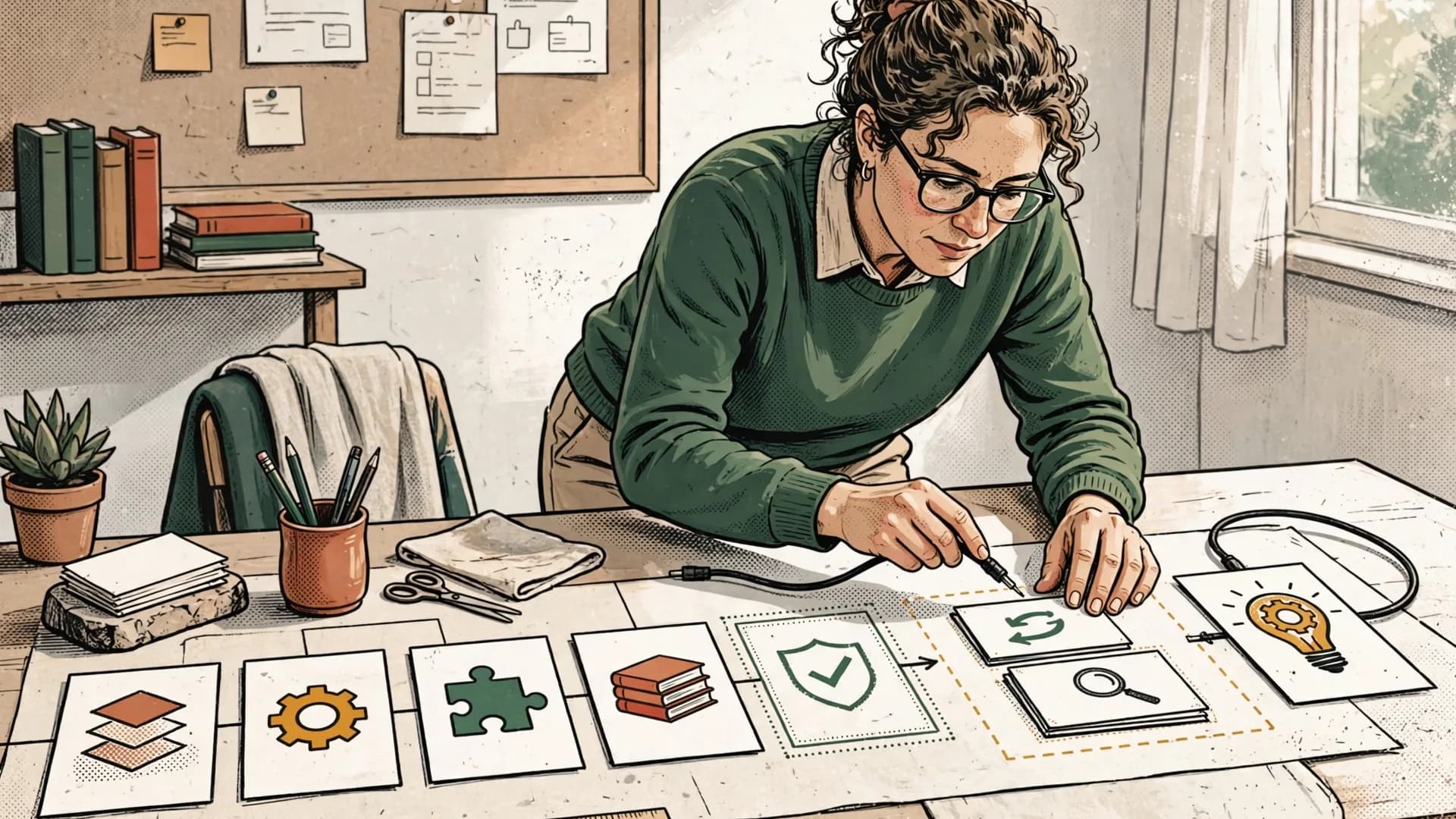
A scope and sequence answers two questions before daily planning begins: what learning belongs in the course, and in what order should students meet it?
The scope is the promised learning. The sequence is the progression that makes later work possible. A strong document also makes prerequisites, assessment points, and pacing assumptions visible, so you can find a gap before students find it for you.
This template is neutral by design. Use the official or locally required framework that applies to your course, and record its exact references. The worked example demonstrates planning logic rather than alignment to a particular jurisdiction.
Check the current source before building the sequence. Official structures differ: Florida directs educators to its standards and CPALMS catalogue, Scotland plans Broad General Education with experiences, outcomes, and benchmarks, and Wales requires schools to design within the Curriculum for Wales framework. Do not translate one structure into another merely to reuse a template.
Copyable scope and sequence template
Start with the course contract:
Course / grade / subject:
Time span and number of teaching weeks:
Required framework, syllabus, or local references:
End-of-course knowledge and performance:
Known calendar constraints:
Assumed prerequisite learning:
Then build the sequence:
| Unit or phase | Time | Required reference | Knowledge and concepts | Skills and student performance | Prerequisites | Core evidence or assessment | Review, reteaching, and extension | Notes and resources |
|---|---|---|---|---|---|---|---|---|
| 1. | ||||||||
| 2. | ||||||||
| 3. | ||||||||
| 4. | ||||||||
| Cumulative checkpoint | Adjust the next phase |
Finish with a quick audit:
Required learning not yet placed:
Repeated learning that deepens rather than duplicates:
Skills students use in more than one unit:
Longest stretch without cumulative evidence:
Weeks protected for review, interruption, or reteaching:
Sequence decision that still needs evidence:

What “scope” needs to show
Scope is more than a topic list. It should include the knowledge students need, the work they must be able to do, and the level of performance you expect by the end.
For each unit or phase, record:
- Required reference. The exact standard, programme, syllabus, or school requirement that applies.
- Knowledge and concepts. The ideas, vocabulary, facts, principles, texts, or procedures students need.
- Skills and performance. What students will do with that knowledge, using observable verbs.
- Evidence. The product, performance, problem, explanation, or assessment that demonstrates the intended learning.
“Linear equations” is not enough scope. “Interpret, represent, and solve linear relationships; explain the meaning of rate of change and initial value; use tables, graphs, and equations as evidence” makes the expected learning visible.
What makes a sequence defensible
Chronology is not the same as progression. A textbook chapter order may be convenient, but a defensible sequence can explain why Unit 2 follows Unit 1.
Use four checks.
Prerequisite check
Name the knowledge or skill students need before the unit begins. If it was never taught in this course, decide whether to diagnose it, teach it, or coordinate with an earlier course.
Cognitive-demand check
Look for progression in the work, not only new content. Students may first identify a pattern, then represent it, apply it, compare methods, justify a choice, and create a model. The sequence should make more complex performance possible.
Spacing check
Important knowledge should return in a new context. Repetition earns its place when students retrieve, connect, or apply learning at a deeper level. Copying the same worksheet into three units is duplication, not spiraling.
Evidence check
Place low-stakes checks before major assessments. A cumulative task should not be the first time students connect two units. Ask what evidence will let you adjust the next phase while there is still time.
Nine-week algebra example
This shortened sequence focuses on linear relationships. It assumes students have prior experience with numerical patterns, integer operations, the coordinate plane, and basic equation solving. Diagnose those assumptions rather than treating them as facts.
| Week | Focus and performance | Prerequisite connection | Core evidence | Planned response |
|---|---|---|---|---|
| 1 | Recognize linear and non-linear patterns in tables and contexts | Numerical patterns and operations | Sort, annotate, and explain six examples | Small-group work on constant change versus constant value |
| 2 | Plot ordered pairs and describe change across a graph | Coordinate plane | Accurate graph plus written observations | Reteach scale, axes, or ordered-pair placement separately |
| 3 | Calculate and interpret rate of change from tables | Integer operations and ratios | Three calculations with contextual explanations | Use visual rise-and-run model or extend to negative rates |
| 4 | Identify initial value and connect it to context | Substitution and graph reading | Match tables, graphs, and situation cards | Conference on confusing starting value with first listed value |
| 5 | Write an equation from a table or situation | Rate and initial value | Equation with labels and explanation | Add structured equation frame or non-routine examples |
| 6 | Move among table, graph, equation, and context | Units 1 through 5 | Representation-matching task with justification | Reteach one conversion path before cumulative application |
| 7 | Solve contextual problems with a linear model | Equation solving and interpretation | Multi-step problem set with written conclusions | Separate algebra error from interpretation error |
| 8 | Compare two linear models and justify a choice | Rate, initial value, representations | Written recommendation using both models | Model how criteria affect the better choice |
| 9 | Build, test, and explain a linear model | Full sequence | Cumulative modeling task and reflection | Record next-course needs and targeted review |
The sequence does not save “review” for the final week. Earlier learning returns in new representations and decisions. Week 6 is a checkpoint before students solve and compare more complex models.
Scope and sequence versus curriculum map
The documents often share a table, but their main jobs differ.
| Document | Primary job | Key fields |
|---|---|---|
| Scope and sequence | Define included learning and its order | Content, skills, prerequisites, progression, pacing |
| Curriculum map | Connect required learning to instruction, evidence, and response over time | Outcomes, experiences, assessment, resources, reteaching |
| Unit plan | Design one connected body of learning | End goal, lessons, assessments, resources |
| Weekly lesson plan | Organize the next set of teaching days | Daily objectives, checks, materials, follow-up |
Use the curriculum map template when you need a richer view of learning experiences and instructional response. Use the weekly lesson plan template when the course sequence is set and you are planning the next week.
Build yours without copying a textbook table of contents
- Collect the real requirements. Use the current framework, syllabus, course agreement, or school requirements that govern the class.
- Separate knowledge from performance. List what students need to know and what they need to do with it.
- Group connected learning. Build units around ideas and performance, not an arbitrary number of chapters.
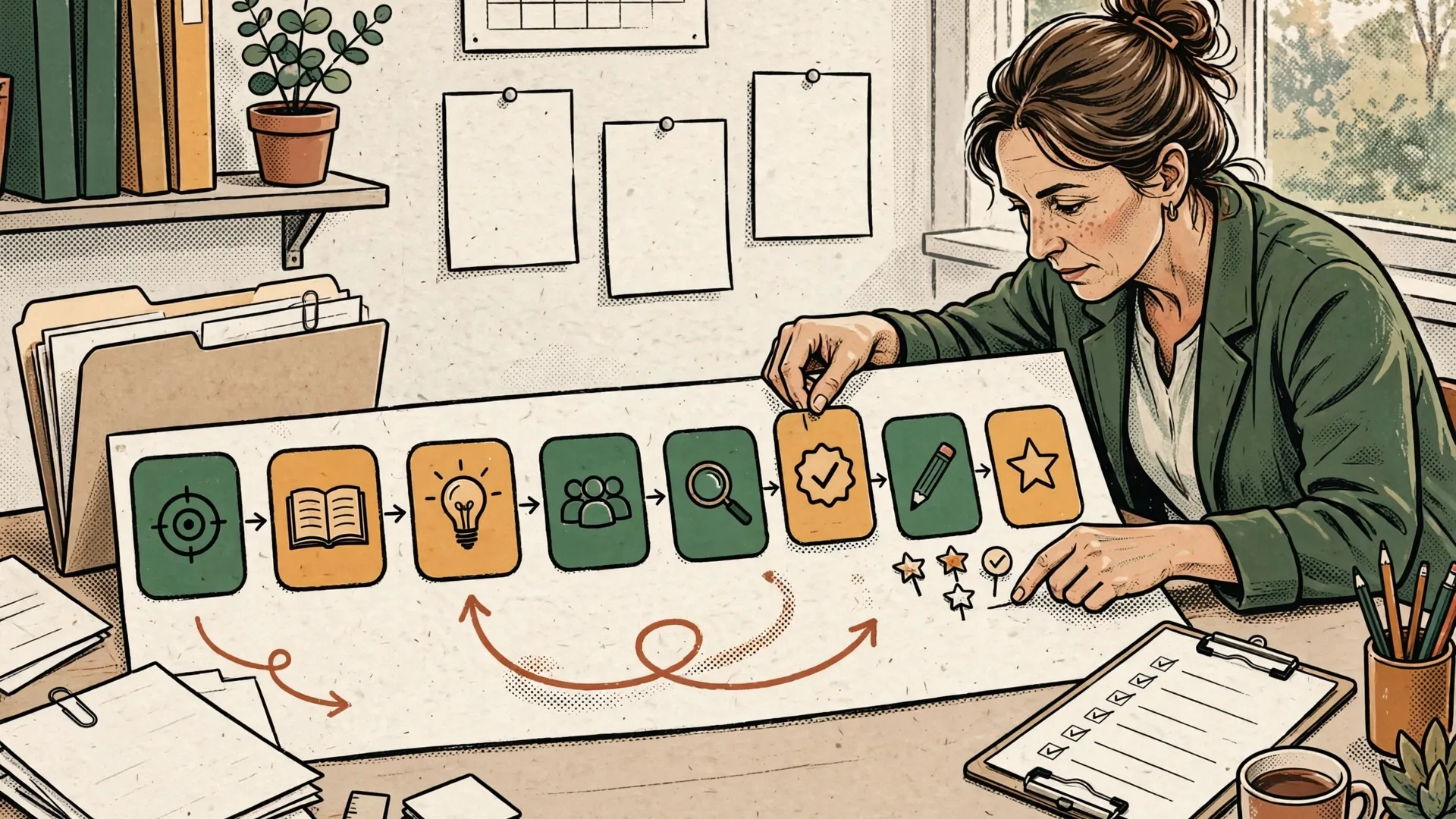
- Draw prerequisite arrows. Ask what must be secure before each unit can work.
- Place evidence. Add formative checks, cumulative applications, and major assessments.
- Assign time last. Estimate weeks after the learning progression makes sense. Protect review and interruption space.
- Audit for gaps and overload. Check unplaced requirements, long assessment gaps, duplicated work, and weeks with impossible scope.
The “assign time last” step matters. When dates lead, teachers often force complex learning into one week and give a familiar topic three weeks because the textbook does.

Turn a course sequence into teachable plans
A scope and sequence should guide planning without becoming a script. Keep it stable enough to coordinate a course, but revise when evidence shows that prerequisites, pacing, or progression assumptions were wrong.
Use your current planning system to organize the units, weeks, classes, and teaching content that sit under the course sequence. For one class period, copy the lesson plan template. If you want Draft My Lesson to create an editable lesson draft, start with the topic, duration, level, teaching direction, and selected school-system profile, then review the output against your sequence.
Frequently asked questions
How many units should a scope and sequence include?
Use the number the learning requires. A year may have a few long units, many short phases, or a mixture. Check whether each unit has a coherent outcome and whether the full set covers the promised learning without impossible pacing.
Should assessments appear in a scope and sequence?
Yes. At least name the core evidence and cumulative checkpoints. Without them, the sequence shows planned coverage but not how you will know students are ready to continue.
How often should the document be revised?
Review it after major checkpoints and at the end of the course. During the term, record evidence-based changes without erasing the original assumption. That history makes the next version better.
Can different teachers share one scope and sequence?
Yes. Agree on required learning, progression, core evidence, and any fixed dates. Leave room for teachers to choose examples, learning experiences, supports, and day-to-day pacing for their classes.
Related articles
Backward Design Lesson Plan: A Practical Guide for K-12 Teachers
Backward design flips traditional lesson planning on its head. Start with the results you want, work backward to the assessment, then plan the activities. Here is how to do it without burning a weekend.
Read articleHow to Write a Lesson Plan: A 7-Step Guide for Teachers
A step-by-step method for writing a classroom-ready lesson plan in under 30 minutes, with three real K-12 examples and the components every plan needs.
Read articleLesson Plan Objectives: 3 Types, Bloom's Verbs, and ABCD Examples
The 3 objective types are cognitive, affective, and psychomotor. Use the free builder, Bloom's verb bank, and ABCD examples to write your own.
Read articleCurriculum Map Template: Plan a Term That Holds Together
Copy a practical curriculum map template, see an eight-week example, and connect outcomes, evidence, lessons, and reteaching across a term.
Read article