How to Write a Lesson Plan: A 7-Step Guide for Teachers
A step-by-step method for writing a classroom-ready lesson plan in under 30 minutes, with three real K-12 examples and the components every plan needs.
Draft My Lesson Team
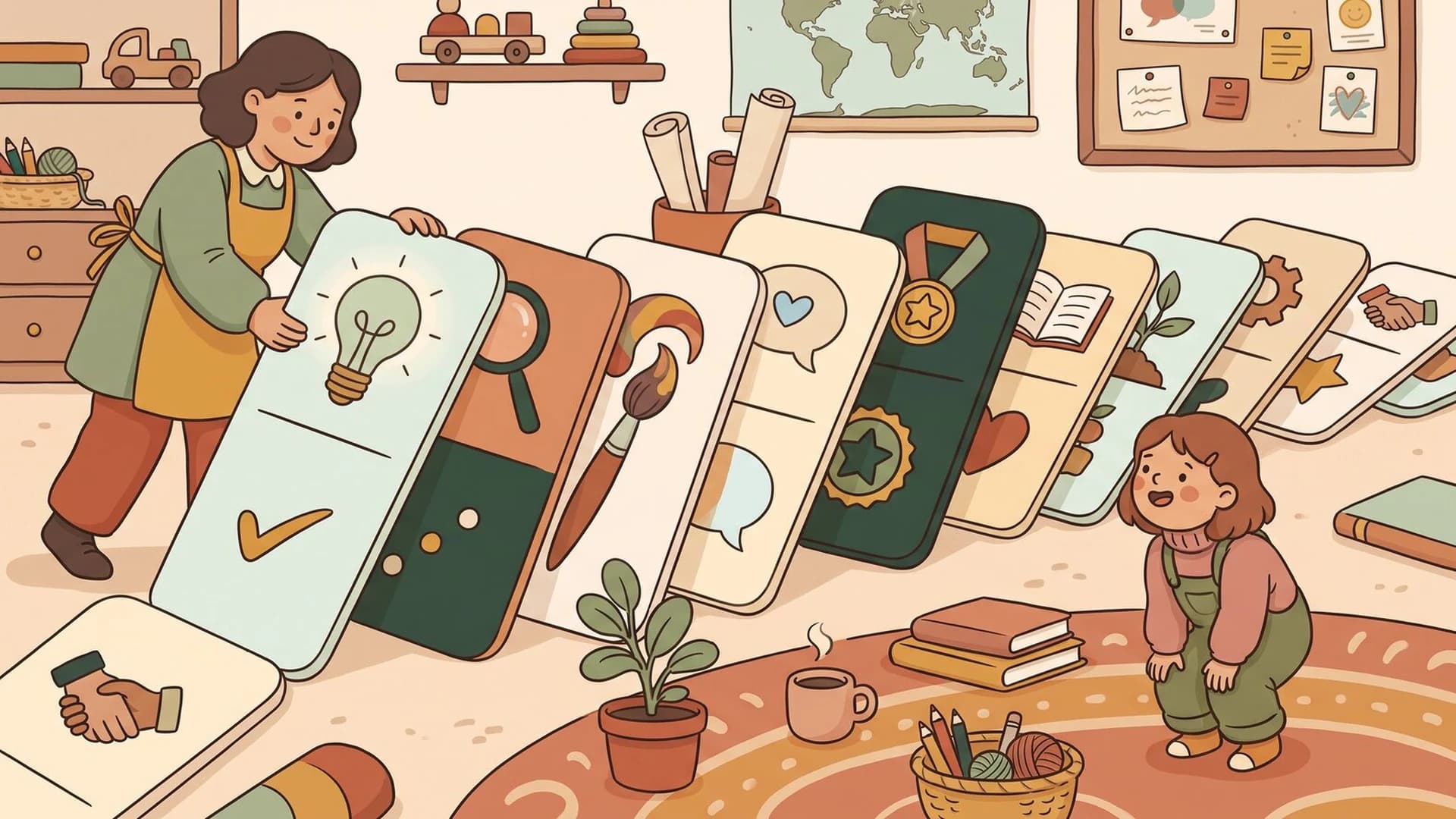
A planning template can look more like a compliance form than a teaching tool. The fields are abstract, the verbs are bureaucratic, and by the time you fill in "anticipatory set" and "Bloom's taxonomy level," you may have spent more energy formatting than thinking about your students.
This guide takes the opposite approach. A lesson plan is the script you teach from. It exists to help your students learn something specific by the end of the period, and to help you make decisions when the lesson does not go as expected. Everything else is paperwork.
Just need the blank form? Download a free lesson plan template in Word or PDF (daily, detailed, elementary, middle and high school, math, reading and science versions, each with a filled example) and open it in Google Docs if you plan there.
Below is the 7-step method to write one in under 30 minutes. You will see three real examples (3rd grade math, 7th grade writing, 10th grade biology) and the most common mistakes that make plans useless in practice.
Key takeaways
- A usable lesson plan has 7 components: objective, standards, materials, hook, instruction, practice, and assessment.
- The objective is the lever. If you cannot measure it in a single sentence, the rest of the plan will drift.
- Backward design (start with the assessment, then plan backward) is the single most reliable way to keep lessons coherent.
- Most planning failures come from loading too many activities into one period, not from picking the wrong model.
What a lesson plan actually is
A lesson plan is a roadmap from where your students are now to where you want them to be in 45 to 90 minutes. It answers four questions in writing: what will they learn, how will they learn it, how will I know they learned it, and what will I do if they do not.
The mistake most new teachers make is treating the lesson plan as a document for an administrator. It is not. It is a tool for you. If a substitute could pick it up and teach it in your absence, you have written a good one. If you cannot teach from it yourself, you have written paperwork.
The University of Michigan Center for Research on Learning and Teaching recommends defining learning objectives, sequencing activities, and checking understanding as connected planning decisions. That line of sight matters more than how polished the form looks.
The 7 components every lesson plan needs
A complete lesson plan has seven parts. Not five, not nine. Five is what generic templates show; nine is what teacher prep programs add to look thorough. Seven is the working minimum that holds up in real classrooms.
1. Learning objective
One sentence, measurable, written from the student's perspective. The standard form is "Students will be able to..." followed by a specific, observable action.
Bad: "Students will understand fractions." Good: "Students will be able to compare two fractions with different denominators and explain which is larger using a number line."
The verb matters. "Understand" and "appreciate" are not measurable. "Identify," "explain," "solve," "compare," "construct," and "predict" are. If you cannot picture how you would check whether a student met the objective, rewrite it. For the ABCD model, a full keyword verb bank, and a copy-paste template, see our deep dive on writing lesson plan objectives.
2. Standards alignment
When your school requires standards alignment, map the objective to the framework actually adopted in your jurisdiction. The United States does not use one national K-12 curriculum: states and districts may use Common Core for ELA or math, Next Generation Science Standards for science, state-specific standards, or local alternatives. England, Scotland, Wales, and Northern Ireland also use distinct curriculum frameworks. Check the official source for your jurisdiction rather than copying a code from a generic example.
Draft My Lesson offers curriculum-aware profiles for supported jurisdictions, but the teacher remains responsible for checking the selected standard and local requirements. The account setup shows the current product coverage for the confirmed jurisdiction.
Why bother? Two reasons. First, alignment forces you to teach what is actually expected at this grade level, which protects you when families or administrators ask. Second, standards are written more carefully than most lesson titles, so they often sharpen a fuzzy objective.
3. Materials and preparation
A bulleted list of everything you need: handouts, manipulatives, slides, technology, classroom setup. Include the prep time required outside the period itself. If you need 20 minutes to set up stations the morning of, write it down. Future-you will thank present-you.
4. Hook (the first 5 minutes)
The hook is what makes students care. It is not a warm-up math problem or a vocabulary review. It is a question, an image, a short video, a demonstration, or a story that creates a small itch the lesson will scratch.
A good hook is short (3 to 7 minutes), connected to the objective, and answerable. Students should not just watch it; they should respond, predict, or argue.
5. Direct instruction or modeling
This is where you teach the new concept. Depending on your instructional model, it can be a mini-lecture, a worked example, a read-aloud, or a guided discovery activity. The format is less important than the principle: students should be cognitively active, not just listening.
Plan for 10 to 20 minutes here. Anything longer and you will lose attention; anything shorter and you have probably not given the concept enough scaffolding.
6. Guided and independent practice
After modeling, students need to do the thing themselves. Guided practice happens with you nearby (working in pairs, you circulating). Independent practice happens silently, with each student producing their own work.
This is the longest section of most lessons: 20 to 30 minutes. It is also where differentiation lives. Plan for at least two versions of the task: a standard version and a stretch version for students who finish early or need a challenge.
7. Formative assessment
How do you know they learned it? An exit ticket, a one-sentence summary, a thumbs-up vote, a quick problem on a whiteboard. The format matters less than the fact that every student produces an observable answer before they leave. If you need a prompt you can use immediately, start with these exit ticket templates and subject examples.
If you skip this step, you are guessing about whether the lesson worked. Most teachers who say "the lesson went well" did not have a measurement; they had a feeling. Both matter, but only one helps you plan tomorrow.
How to write each section, step by step
The components above describe what a finished plan looks like. The order in which you write them matters too. Most teachers start with the activity and work backward, which is exactly the wrong direction.
Step 1: Start with the standard, not the activity
Open your curriculum. Find the standard you are teaching this week. Read it twice. Notice the specific verbs and content nouns. Those will become your objective.
Step 2: Write the objective in "Students will be able to..." form
Take the verb and content from the standard and rewrite it as a single sentence about what students will produce or demonstrate by the end of the period. If your sentence has the word "and" twice, you have two objectives. Split them into two lessons.
Step 3: Design the assessment before the activity
This is the heart of backward design, and it is the single most reliable upgrade to your planning. Before deciding how you will teach the concept, decide how you will measure it. Write the exit ticket question first. If you can write a clear exit ticket, your objective is sharp. If you cannot, your objective is fuzzy and the lesson will drift.
Step 4: Pick a model
There are dozens of named instructional models. In practice, three cover most lessons:
- 5E model (engage, explore, explain, elaborate, evaluate) for inquiry-based science and math.
- Madeline Hunter model (objective, anticipatory set, input, modeling, checking for understanding, guided practice, independent practice, closure) for direct instruction.
- Workshop model (mini-lesson, work time, share-out) for reading and writing.
Pick one based on the content, not on which one you learned most recently in graduate school.
Step 5: Add the hook last
Counterintuitive but reliable: write the hook after you know the rest of the lesson. Once you can see the whole arc, the right hook usually becomes obvious. Trying to design the hook first leads to clever openings that have nothing to do with the objective.
Copyable lesson plan writing order
The order you write a plan does not have to match the order students experience it. Copy this sequence and fill it from top to bottom:
Copyable text
Copy includes the complete text. No signup needed.
1. Jurisdiction / standard to verify:
2. Student starting point:
3. Measurable objective:
4. Exit ticket or performance evidence:
5. Success criteria:
6. Guided practice that rehearses the evidence:
7. Independent practice with support and extension:
8. Instruction or model students need first:
9. Hook that points at the objective:
10. Materials, timing, and contingency:
A free lesson plan template turns that writing order into a classroom-facing plan. If you want a generated first draft, try the real lesson generator and review the curriculum reference, level, timing, and materials before use.
Three real lesson plan examples you can copy
Below are three complete lesson plans across grade bands and subjects. Each follows the 7-component structure above. Treat them as starting points, not as templates to fill in.
Elementary: 3rd grade math, comparing fractions
Standard: CCSS.MATH.CONTENT.3.NF.A.3.D Objective: Students will be able to compare two fractions with the same numerator or denominator using visual fraction models, and explain which is larger in a complete sentence. Materials: Fraction strips (one set per pair), whiteboards, exit ticket slips. Hook (5 min): Show two pizzas cut into different numbers of slices. Ask: "If you ate one slice from each pizza, which slice was bigger? How do you know?" Direct instruction (12 min): Model comparing 1/3 and 1/6 with fraction strips on the document camera. Walk through 1/4 vs 1/3, then 2/5 vs 3/5. Make the rule explicit: same denominator, bigger numerator wins; same numerator, smaller denominator wins. Guided practice (15 min): Pairs work through five comparisons using fraction strips. Circulate. When a pair finishes correctly, ask them to explain their reasoning out loud. Independent practice (8 min): Students complete a six-question worksheet on their own. Exit ticket (3 min): "Which is larger, 2/5 or 2/7? Explain in one sentence."
Middle school: 7th grade writing, narrative leads
Standard: CCSS.ELA-LITERACY.W.7.3.A Objective: Students will be able to write three distinct opening sentences for a personal narrative, each using a different technique (action, dialogue, sensory detail), and identify which technique creates the strongest hook. Materials: Mentor text excerpts (three printed leads from published memoirs), notebooks, exit ticket slips. Hook (4 min): Read three published opening sentences out loud without naming the books. Students vote on which makes them want to keep reading. Discuss why. Direct instruction (10 min): Name the three techniques (action, dialogue, sensory detail) and label which mentor text uses which. Display side-by-side examples. Guided practice (12 min): Students draft three leads about the same personal moment, one per technique. Share with a partner. Partner identifies the technique used in each. Independent practice (15 min): Students pick their strongest lead and draft the next two paragraphs. Exit ticket (4 min): "Which technique did you pick and why? One sentence."
High school: 10th grade biology, photosynthesis equation
Standard: NGSS HS-LS1-5 Objective: Students will be able to write the balanced chemical equation for photosynthesis and explain how each input (light, water, carbon dioxide) is transformed into glucose and oxygen. Materials: Slide deck, whiteboards, model leaf diagrams, exit ticket slips. Hook (5 min): Show two time-lapse videos: a houseplant near a window over a week, and the same plant in a closet. Ask: "Same water, same soil. Why did one survive and one die?" Direct instruction (18 min): Build the equation piece by piece on the board. Inputs first (CO2 + H2O), then the energy source (light), then the products (C6H12O6 + O2). Explicitly balance the atoms. Use the leaf diagram to show where each step happens inside the chloroplast. Guided practice (12 min): Students work in pairs to label a blank diagram, then explain each arrow to their partner. Circulate and listen for misconceptions. Independent practice (12 min): Students answer two short-response prompts: one factual, one applied ("What happens if a plant has water but no light for two weeks?"). Exit ticket (3 min): "Write the photosynthesis equation. Underline the input that comes from the air."
Common mistakes that make lesson plans useless
Most lesson plans that fail in the classroom fail for the same handful of reasons. Knowing them in advance is the cheapest way to improve.
Writing fuzzy objectives. "Students will explore...", "Students will appreciate...", "Students will be exposed to...". These cannot be measured, so they cannot be taught toward. Rewrite with a measurable verb.
Loading too many activities into one period. Plans with five activities for a 45-minute class are aspirational, not actionable. Aim for one direct instruction segment plus one practice segment, with a hook and an exit ticket. Three activities total, not five.
Forgetting differentiation. If you have not planned for the student who finishes in 8 minutes and the student who is still on question 1 after 30, you have planned for the middle and the middle alone.
Skipping the exit ticket. Without a measurement, you cannot plan tomorrow. The exit ticket takes 3 minutes and tells you whether to reteach, move on, or accelerate.
Designing the hook first. As mentioned above, this leads to clever openings that have nothing to do with the objective. Write the hook last, once you can see the whole arc.
Research from the Education Endowment Foundation consistently identifies clarity of explanation and formative assessment as two of the highest-impact teaching practices. Both live in your lesson plan, or they do not happen.
Frequently asked questions
How do you write a lesson plan step by step? Start with the standard you are teaching. Write a measurable objective in "Students will be able to..." form. Design the assessment next (exit ticket question). Pick an instructional model. Outline the direct instruction, then the practice. Add the hook last. Total time: 20 to 30 minutes for a teacher who knows the content.
What are the 5 basic parts of a lesson plan? Objective, materials, instruction, practice, and assessment. Most effective teachers add two more in real classrooms: a hook to create engagement at the start, and a formative check (exit ticket) at the end. That gives you the 7-component structure described above.
What is the format for a lesson plan? There is no single format. The three most common are the 5E model (engage, explore, explain, elaborate, evaluate), the Madeline Hunter model (7 sequential steps for direct instruction), and the workshop model (mini-lesson, work time, share-out). Pick one based on your subject and stick with it.
What are the 7 parts of a lesson plan? Learning objective, standards alignment, materials and prep, hook, direct instruction or modeling, guided and independent practice, and formative assessment. Together they give you a teachable script from start to exit ticket.
What is a lesson plan format? The layout you use to write the lesson on paper. A good format makes the lesson teachable by a substitute who has never met your class. If a colleague could pick it up and run it tomorrow, your format works. If they cannot, your format is too sparse or too cluttered.
What are common mistakes in lesson plans? Writing fuzzy objectives, loading too many activities into one period, ignoring differentiation, skipping the exit ticket, and designing the hook before the rest of the lesson. See the "Common mistakes" section above for fixes.
Continue your lesson planning toolkit
This guide covers the full method. If you want to go deeper on specific pieces, these related articles cover them in detail:
- How to create effective lesson plans with AI for cutting prep time without losing instructional quality.
- Differentiated instruction: adapting lessons for every student for the practice-and-assessment piece.
- Assessment types every teacher should know for picking the right exit ticket or formative check.
Lesson planning is a craft. The first hundred plans you write will take longer than they should. The next thousand will take a fraction of the time, and they will be better because you have a working method instead of a blank page.
Related articles
Backward Design Lesson Plan: A Practical Guide for K-12 Teachers
Backward design flips traditional lesson planning on its head. Start with the results you want, work backward to the assessment, then plan the activities. Here is how to do it without burning a weekend.
Read articleThe 8 Parts of a Lesson Plan (With Examples for Each)
A deep reference guide to the 8 parts of a lesson plan. Worked examples, common mistakes, and what good looks like for objectives, hook, instruction, practice, assessment, and closure.
Read articleI Do, We Do, You Do: The Gradual Release Model With a Template and Example
How the "I do, we do, you do" gradual release model works, where it comes from, when to move to the next phase, a free lesson plan template and a complete Grade 7 math example.
Read articleBloom's Taxonomy Verbs: 150 Action Verbs by Level, With Question Stems
A complete list of Bloom's taxonomy verbs for the six revised levels, with question stems, sample objectives and a free printable verb chart.
Read article