Unit Plan Template: Free Editable Word and PDF, Plus a Filled-In Example
A free unit plan template in Word and PDF, with a complete Grade 5 science example: standards, big ideas, assessment evidence, an 8-lesson sequence and a rubric.
Three complete unit plan examples (Grade 3 math, Grade 5 science and Grade 8 ELA) with standards, big ideas, assessment evidence and a lesson-by-lesson sequence, each free to download in PDF and Word.
A blank unit plan template tells you which boxes to fill. A finished example shows what a good answer in each box looks like: how specific the big ideas are, how the final task connects to the standards, and how each lesson feeds that task. This page gives you three complete unit plan examples from three grade bands, each free to download.
No account is needed. To start your own from a blank page, use our unit plan template in Word and PDF, which explains each section in six steps.
The examples are illustrations of teacher-made plans: no classroom results are claimed. Their standards are quoted from the Common Core and NGSS for states that use them. Replace them with the framework adopted by your state, district or country.
All three examples follow the same order, the one most districts and teacher-preparation programs ask for:
| Section | What the examples show |
|---|---|
| Unit overview | Title, grade, subject and number of lessons on one line |
| Standards | Two or three standards, quoted with their codes |
| Big ideas and essential questions | Ideas a student could explain months later, and two or three open questions |
| Learning objectives | “I can” statements you could check in five minutes |
| Assessment evidence | A pre-assessment, quick checks during the unit and a final performance task with its criteria |
| Lesson sequence | One row per lesson: focus, main activity and check for understanding |
| Differentiation | Support, language support and extension for the final task |
| Reflection | Prompts to fill after teaching |
Unit overview. Ten lessons of about 50 minutes, from equal parts to comparing fractions.
Standards (Common Core).
Big ideas. A fraction is a number made of equal parts of a whole. Its place on the number line depends on the size and the number of the parts. Different fractions can name the same amount.
Final task. Students plan how 3 groups share 2 sandwiches and 4 pizzas at a class picnic, show each share with a model and on a number line, and compare two shares. The rubric has four criteria: equal parts, correct fraction, number line and explanation.
| # | Focus | Check for understanding |
|---|---|---|
| 1 | Sharing brownies among 2, 3 and 4 friends | Pre-assessment quick draw |
| 2 to 4 | Unit fractions, fractions a/b, why parts must be equal | Exit tickets, partner explanation |
| 5 and 6 | Fractions on a number line, up to and beyond 1 | Number line check |
| 7 and 8 | Equivalent fractions, comparing with the same numerator or denominator | Three-item quiz, exit ticket |
| 9 and 10 | Draft, peer feedback, final task | Feedback form, performance task |
Why it works: the brownie quick draw in lesson 1 comes back in lesson 10, so students and the teacher can both see the progress. The number line arrives in lesson 5, after students have folded and named enough fractions to place them with confidence.
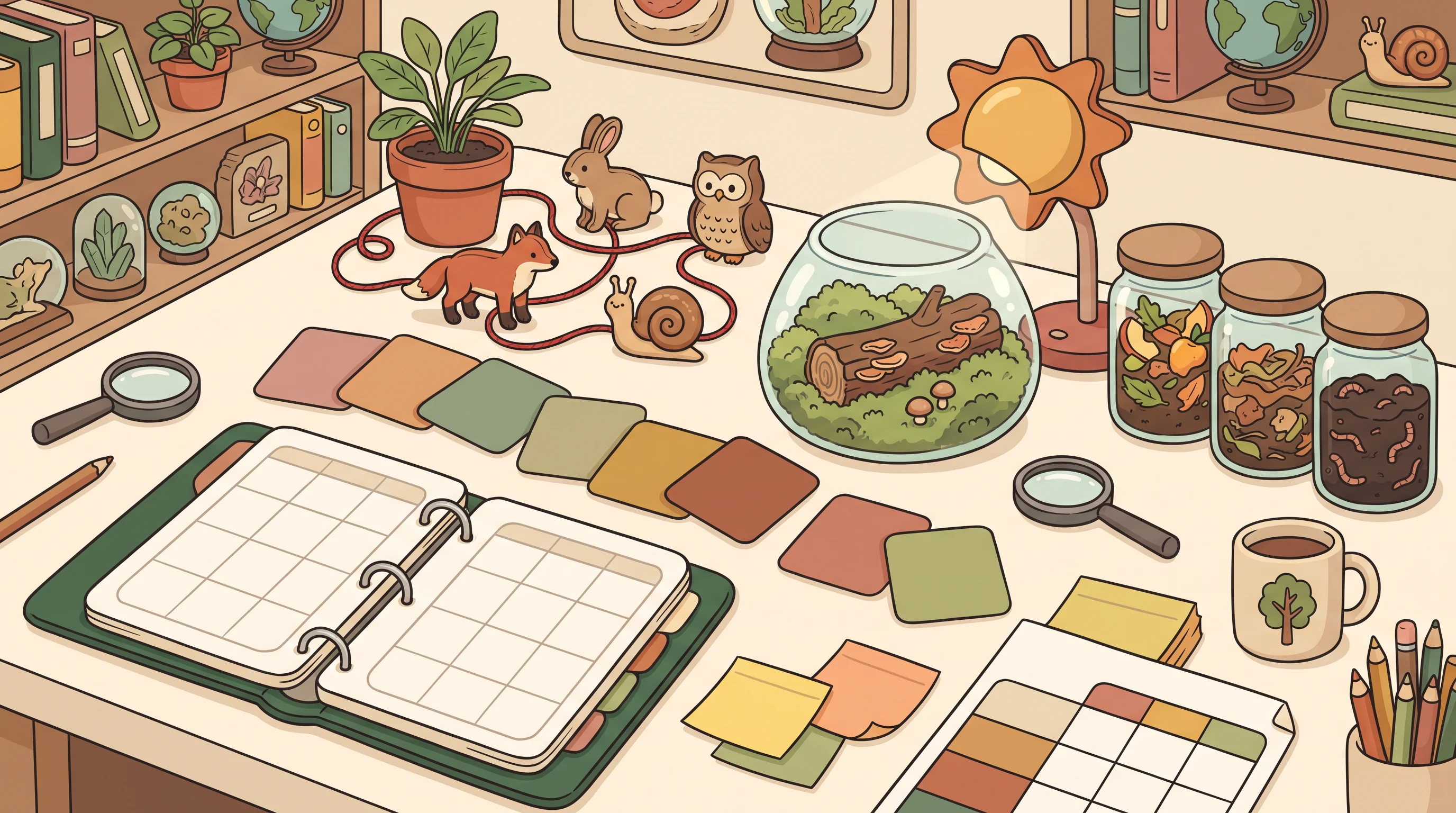
Unit overview. Eight lessons of about 45 minutes on food webs, decomposers and energy from the sun.
Standards (NGSS). 5-LS2-1 (develop a model of the movement of matter among plants, animals, decomposers and the environment) and 5-PS3-1 (use models to describe that energy in animals’ food was once energy from the sun).
Final task. A labeled model of matter moving in a local ecosystem with a written explanation, scored on four criteria.
The full walk-through of this unit (essential questions, assessment evidence and all eight lessons) is on our unit plan template page. The downloadable example adds the rubric, differentiation ideas and a safety note for the decomposition jars.
Unit overview. Twelve lessons of about 50 minutes built around one question: should our school day start later?
Standards (Common Core).
Big ideas. A strong argument is a claim that others could dispute, backed by reasons and evidence a reader can check. Good writers answer the other side instead of ignoring it.
Final task. A 600 to 800 word argument essay with at least two cited sources and a counterclaim, scored on four criteria: claim, evidence, counterclaim and rebuttal, organization and style.
| # | Focus | Check for understanding |
|---|---|---|
| 1 | Four-corners debate and a one-paragraph opinion | Pre-assessment |
| 2 to 5 | Claim, reason and evidence; read and evaluate two editorials | Annotation checks, T-chart |
| 6 to 8 | Research, a debatable claim, a counterclaim and rebuttal | Note catcher, claim check, exit ticket |
| 9 to 11 | Outline, draft with conferences, peer revision | Outline, conference, feedback form |
| 12 | Final essay and class panel | Performance task |
Why it works: students read and judge two arguments (RI.8.8) before they write their own (W.8.1), so the criteria they use on the editorials become the criteria of their essay.
This is the logic of backward design: the evidence first, then the lessons. Our backward design guide explains the three stages.
If you would rather edit a draft than adapt someone else’s unit, Draft My Lesson can draft a unit plan for your grade, subject and topic, then generate each lesson of the unit as a full lesson plan with a student handout. Every draft is a starting point to review and adapt before teaching. Draft a unit plan for your class. Your free account includes two complete lessons and one unit plan after you verify your email.
What is an example of a unit plan?
A unit plan covers two to six weeks of teaching on one topic. For example, a Grade 3 fractions unit names its standards, the big ideas students should keep, a final task (sharing food fairly at a class picnic, shown on a number line), and a sequence of ten lessons that prepares students for that task.
What are the parts of a unit plan?
A unit overview, standards, big ideas and essential questions, learning objectives, assessment evidence, a lesson sequence, differentiation and a reflection. The three examples on this page use all eight parts.
How many lessons should a unit plan have?
Most units run from about 6 to 15 lessons. The examples here have 8, 10 and 12. Plan enough lessons to teach, practice, draft and get feedback before the final task.
What is the difference between a unit plan and a lesson plan?
A unit plan sets the goals, evidence and sequence for several weeks. A lesson plan details one class period inside that sequence. See how to write a lesson plan for a single lesson.
Blog