Lesson Plan Objectives: 3 Types, Bloom's Verbs, and ABCD Examples
The 3 objective types are cognitive, affective, and psychomotor. Use the free builder, Bloom's verb bank, and ABCD examples to write your own.
Draft My Lesson Team
The short answer: The "3 objectives in a lesson plan" usually means the three learning domains: cognitive (thinking), affective (attitudes and values), and psychomotor (physical skills). They are categories, not a rule that every lesson must contain exactly three objectives.
What are the 3 objectives in a lesson plan?
The three types describe different kinds of learning:
- Cognitive objectives cover knowledge and thinking. Example: "Given two primary sources, students will be able to compare the authors' claims and cite one supporting detail from each source."
- Affective objectives cover participation, attitudes, and values. Use an observable action rather than trying to measure a feeling. Example: "During a small-group discussion, students will respond to a disagreement using one perspective-taking sentence frame."
- Psychomotor objectives cover physical or procedural skills. Example: "Students will execute a forearm pass toward a marked target in 4 of 5 attempts."
Most academic lessons need one focused cognitive objective. A PE, art, music, lab, career and technical education, or social-emotional learning lesson may add an affective or psychomotor objective when that domain is part of the intended learning.
Key takeaways
- A lesson objective is observable and measurable. If you cannot see it or score it, rewrite it.
- The ABCD model checks four useful parts: Audience, Behavior, Condition, and Degree.
- Replace "understand," "know," and "learn" with the action students will use to show their learning.
- The assessment should collect the evidence named in the objective.
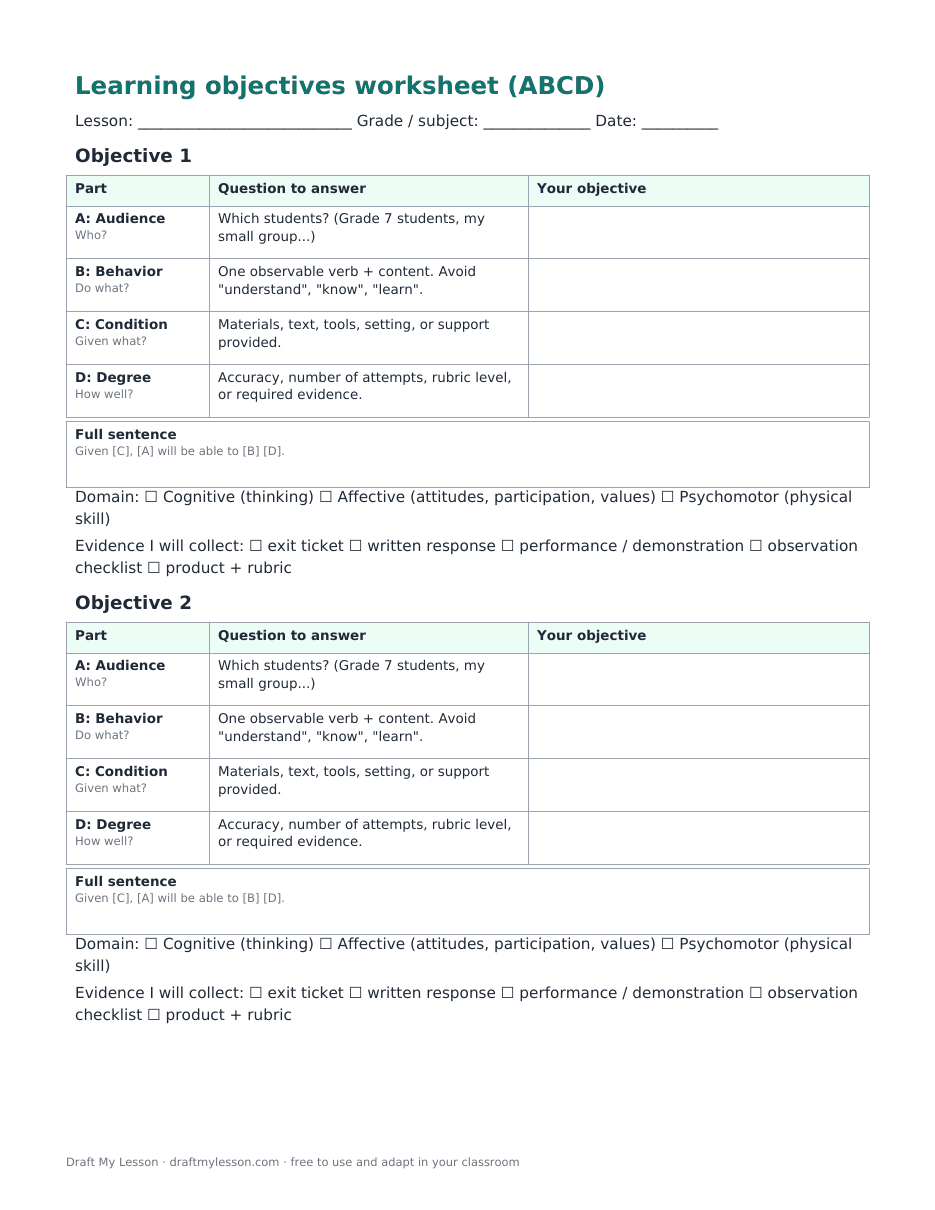
Free downloads: an ABCD learning objectives worksheet in Word or PDF, with a verb bank on page 2, and 24 learning objective examples by grade and subject in Word or PDF. No account needed. In Google Docs, upload the Word file to Drive and open it with Google Docs.
Free objective builder
Build a measurable lesson objective
Choose one Bloom's verb, fill the ABCD fields, then copy the finished objective into your plan.
Your objective
Given five practice problems, students will be able to solve two-step equations, with at least 4 of 5 correct.
Keep the criterion tied to the task and your students' starting point. Do not add an accuracy percentage just to fill the field.

What a lesson plan objective is (and isn't)
A learning objective is a single sentence that describes what a student will be able to do by the end of the lesson. The key word is "do." It has to be visible. If you cannot watch a student perform it or read it on a page, it is not an objective, it is a hope.
The Boston College Center for Teaching Excellence resource on learning objectives makes the distinction sharp: objectives describe student behavior, not teacher behavior. "I will teach the water cycle" is not an objective. "Students will be able to label the four stages of the water cycle on a blank diagram with 100% accuracy" is.
There are three traps to avoid right away:
- Verbs you cannot measure. "Understand," "know," "appreciate," "be aware of," "be familiar with." These describe internal states. You cannot grade them.
- Confusing objectives with activities. "Students will read chapter 4" is an activity. The objective is what students should be able to do after reading chapter 4.
- Confusing objectives with topics. "The Civil War" is a topic. "Explain three economic causes of the Civil War in a paragraph with evidence from primary sources" is an objective.
If you want a refresher on where objectives sit inside the broader plan, see our walkthrough of the parts of a lesson plan and the step-by-step guide to writing a lesson plan.
If you need the complete document rather than the objective alone, start with a free lesson plan template. This page owns objective writing; a full template gives you the fields to copy and fill.
The ABCD model for writing objectives
The ABCD model is a practical framework for turning a broad goal into a usable objective. Objectives written this way are sometimes called ABCD objectives. The University of New Hampshire Pressbooks chapter on measurable goals and objectives summarizes the four parts:
- A is for Audience. Who is doing the thing? Usually "students" or a specific subgroup ("ELL students," "students in tier 2 intervention").
- B is for Behavior. What observable action will they perform? This is your verb plus its object. "Solve a two-step equation." "Cite three textual examples."
- C is for Condition. Under what circumstances? "Given a word problem with extraneous information." "Using a calculator." "Without notes." "After a 10-minute mini-lesson."
- D is for Degree. How well? The accuracy or quality bar. "With 80% accuracy." "In a complete paragraph with two pieces of evidence." "Within three minutes."
Here is one objective, separated into its four parts:
| ABCD part | Example |
|---|---|
| Audience | Grade 8 students |
| Behavior | compare photosynthesis and cellular respiration |
| Condition | given a labeled cell diagram and a blank Venn diagram |
| Degree | include at least four accurate points of comparison |
Put together in natural sentence order: Given a labeled cell diagram and a blank Venn diagram, Grade 8 students will compare photosynthesis and cellular respiration, including at least four accurate points of comparison.
You do not have to force all four parts into every sentence. Name the learner and observable behavior. Add the condition and degree when they clarify the task or the evidence you will accept. The American Association of Medical Colleges guide to writing learning objectives offers another concise ABCD explanation and examples.
Picking the right verb (Bloom's taxonomy in practice)
The verb is the engine of the objective. It tells you, your students, and your assessment exactly what cognitive work is happening. Most weak objectives are weak because of a weak verb.
The revised Bloom's taxonomy by Anderson and Krathwohl, maintained by the University of Arkansas Teaching Innovation and Pedagogical Support team, organizes cognitive verbs into six levels:
- Remember. Define, list, recall, identify, label, name.
- Understand. Explain, summarize, paraphrase, classify, compare.
- Apply. Solve, demonstrate, use, execute, implement.
- Analyze. Differentiate, organize, attribute, deconstruct, examine.
- Evaluate. Critique, judge, defend, justify, argue.
- Create. Design, compose, construct, plan, produce.
A few practical rules:
- Never use "understand" or "know." These map to the second level but are not observable. Replace them with what understanding looks like: explain, summarize, classify, predict.
- Keep the scope teachable. If one objective asks students to list, analyze, evaluate, and create, split it or decide which action the lesson will assess.
- Match the verb to the assessment. If the verb is "design," a multiple-choice quiz will not measure it. If the verb is "identify," a multiple-choice quiz is perfect.
Bloom's revised taxonomy describes the cognitive domain. Affective and psychomotor learning use related domain taxonomies and different evidence. For the full cognitive hierarchy, see our Bloom's taxonomy in lesson planning article.
Keywords for objectives in a lesson plan (the verb bank)
When teachers search for "keywords for objectives in a lesson plan," they usually want action verbs for the behavior slot of the ABCD model. Choose the level that matches the lesson, then choose a verb that produces evidence you can collect.
- Remember (recall facts): define, list, recall, identify, label, name, state, match, recognize, locate.
- Understand (explain ideas): explain, summarize, paraphrase, classify, compare, describe, interpret, illustrate, predict, restate.
- Apply (use in a new situation): solve, demonstrate, use, execute, implement, calculate, apply, complete, construct, model.
- Analyze (draw connections): differentiate, organize, attribute, deconstruct, examine, categorize, contrast, distinguish, outline, diagram.
- Evaluate (justify a decision): critique, judge, defend, justify, argue, appraise, prioritize, rank, assess, recommend.
- Create (produce new work): design, compose, construct, plan, produce, develop, formulate, generate, write, invent.
For the affective and psychomotor domains, the keywords change with the target:
- Affective (participation, attitudes, values): respond, participate, choose, contribute, reflect, defend, revise, cooperate, question.
- Psychomotor (physical skills): execute, assemble, manipulate, calibrate, perform, sketch, measure, operate, demonstrate.
Use the planned evidence to check the verb:
| Bloom's level | Useful evidence |
|---|---|
| Remember | a labeled diagram, retrieval check, list, or matching task |
| Understand | an explanation, summary, classification, or comparison |
| Apply | a worked problem, demonstration, model, or completed procedure |
| Analyze | an annotation, diagram, categorization, or evidence-based contrast |
| Evaluate | a judgment defended with criteria and evidence |
| Create | a product, plan, performance, or solution checked against criteria |
Keywords to replace. Understand, know, learn, appreciate, be aware of, be familiar with, grasp, realize, and comprehend name internal states. Ask "what would a student do to show it?" and use the verb for that action. For example, replace "understand equivalent fractions" with "model two equivalent fractions on number lines and explain why they represent the same value."
A copyable ABCD objective template
Use the objective builder above, or paste this template into the top of any lesson plan and fill the brackets. The audience and behavior identify the learner and action. The condition and degree define the task and success evidence when needed.
Copyable text
Copy includes the complete text. No signup needed.
[Condition: Given / Using / After ...],
[audience] will be able to [measurable verb + content],
[degree: with supporting evidence / against rubric criteria / in 4 of 5 attempts].
Filled examples across subjects:
- Math: Students will be able to solve two-step equations, given a word problem with one extraneous number, with 80% accuracy.
- ELA: Students will be able to cite two pieces of textual evidence for a character's motivation, after reading the assigned chapter, in a complete paragraph.
- Science: Students will be able to classify three unknown substances as acids or bases, using litmus paper and a pH chart, correctly labeling at least 4 of 5.
Keep the template to one sentence per objective. If a bracket forces you into a second sentence, you probably have two objectives, and each deserves its own line.
Do you need all three objective types in every lesson?
No. Cognitive, affective, and psychomotor are three domains of learning, not a required three-line lesson-plan format. Start with the learning your assessment must reveal.
Cognitive objectives (thinking)
Use a cognitive objective when students need to recall, explain, apply, analyze, evaluate, or create. This is the main domain in lessons such as reading comprehension, algebra, and historical analysis. Example: "Given a labeled cell diagram, students will compare cellular respiration and photosynthesis in a Venn diagram with at least four accurate points of comparison."
Affective objectives (attitudes and values)
Use an affective objective when participation, attitudes, motivation, or values are part of the learning. Feelings are not directly visible, so name the action that will provide evidence. Example: "During a small-group debate, students will respond to a peer's disagreement using one perspective-taking sentence frame from the class norms."
Psychomotor objectives (physical skills)
Use a psychomotor objective when students must perform a movement or procedure. These objectives are common in PE, art, music, lab science, and career and technical education. Example: "Students will execute a forearm pass in volleyball, contacting the ball with both forearms and directing it to a target three meters away in 4 of 5 attempts."
Write the fewest objectives that accurately describe what students should learn and what you will assess. If the lesson teaches both conceptual knowledge and a physical procedure, two objectives may be clearer than one overloaded sentence.
Where the three domains come from, and their levels
The three domains come from a project led by Benjamin Bloom and colleagues to classify educational objectives. Each domain has its own hierarchy, from simple to complex, which helps you pick a verb at the right level.
Cognitive domain. The original handbook (Bloom and colleagues, 1956) described six levels. The revised version by Lorin Anderson, David Krathwohl and colleagues (2001) uses verbs: remember, understand, apply, analyze, evaluate, create. See our Bloom's taxonomy verbs list for 150 action verbs by level.
Affective domain. Krathwohl, Bloom and Masia published the affective handbook in 1964. Its five levels describe how deeply a value is held:
| Level | What it looks like | Example objective |
|---|---|---|
| Receiving | Attends, listens, is willing to notice | Students will listen to a classmate's presentation without interrupting and note one question. |
| Responding | Participates, complies, responds willingly | Students will contribute at least one comment in a small-group discussion. |
| Valuing | Shows commitment through consistent choices | Students will choose to use a peer-review checklist on their draft without a reminder. |
| Organization | Compares and prioritizes values | Students will explain how they balanced fairness and speed when assigning group roles. |
| Characterization | Acts consistently on a value system | Students will apply the class discussion norms across a unit, as recorded on a weekly checklist. |
Psychomotor domain. The original group did not publish a psychomotor handbook. The most cited versions are by Elizabeth Simpson (1972), Ravindrakumar Dave (1970) and Anita Harrow (1972). Simpson's seven levels are perception, set, guided response, mechanism, complex overt response, adaptation and origination. In practice, most lesson objectives sit at guided response (performing with a model or cues) or mechanism (performing independently with some confidence). Example: "After the demonstration, students will light a Bunsen burner following the five safety steps, with the teacher observing" is guided response; "Students will light and adjust the burner to a blue flame without prompts" is mechanism.
You do not need to name the level in your lesson plan. The levels are a check: if every objective in a unit sits at the lowest level of its domain, the unit probably asks too little.
Learning objectives examples by grade and subject
These 24 examples cover kindergarten to Grade 12 and all three domains. Each one names an observable behavior, the condition, and the evidence a teacher would collect. The same list is in the downloadable examples file.
| Grade | Subject | Domain | Example objective |
|---|---|---|---|
| K-2 | Math | Cognitive | Using ten frames and counters, students will compose and decompose numbers to 10 in two different ways and record each with an equation. |
| K-2 | ELA | Cognitive | After a read-aloud, students will retell the beginning, middle and end of the story in order, using three picture cards. |
| K-2 | Science | Cognitive | After observing three seedlings for a week, students will describe one thing plants need to grow, citing their drawings as evidence. |
| K-2 | Social studies | Affective | During morning meeting, students will take turns sharing one class job they can do to help the community and listen without interrupting. |
| K-2 | PE | Psychomotor | Students will hop on one foot for five consecutive hops on each side without losing balance. |
| K-2 | Art | Psychomotor | Using scissors and glue, students will cut and assemble three shapes to make a collage animal with no gaps at the joins. |
| 3-5 | Math | Cognitive | Given four fraction pairs, students will compare each pair using >, = or < and justify two comparisons with a number line or visual model. |
| 3-5 | ELA | Cognitive | After reading an informational article, students will state its main idea and support it with two key details in a short paragraph. |
| 3-5 | Science | Cognitive | Using a model of the Sun, Earth and a flashlight, students will explain why shadows change length during the day in two to three sentences. |
| 3-5 | Social studies | Cognitive | Using a map of their state, students will locate three regions and describe one natural resource found in each. |
| 3-5 | Health / SEL | Affective | During a cooperative task, students will use one calm-down strategy from the class chart when they disagree and describe which one they chose. |
| 3-5 | Music | Psychomotor | Students will clap a four-measure rhythm in 4/4 time containing quarter notes, eighth notes and rests, matching the teacher model in 3 of 4 attempts. |
| 6-8 | Math | Cognitive | Given a table of values, students will determine whether the relationship is proportional and justify the answer by finding the constant of proportionality. |
| 6-8 | ELA | Cognitive | Students will analyze how a character changes across a short story, citing two pieces of textual evidence in a paragraph scored with the class rubric. |
| 6-8 | Science | Cognitive | Using data from a pulse-rate investigation, students will construct a claim about the effect of exercise on heart rate with evidence and reasoning. |
| 6-8 | Social studies | Cognitive | Given two primary sources, students will compare the authors' points of view on the same event and identify one reason the accounts differ. |
| 6-8 | Science lab | Psychomotor | Students will measure 25 mL of water with a graduated cylinder, reading the meniscus at eye level, within 1 mL of the teacher check. |
| 6-8 | Advisory / SEL | Affective | During a structured discussion, students will respond to a peer's differing opinion by paraphrasing it before giving their own view. |
| 9-12 | Math | Cognitive | Students will solve quadratic equations by factoring, completing the square and the quadratic formula, and choose the most efficient method for each of three equations with a one-line justification. |
| 9-12 | ELA | Cognitive | Students will write a thesis statement for a literary analysis that makes an arguable claim about theme and previews two lines of reasoning. |
| 9-12 | Biology | Cognitive | Given a diagram of a cell, students will compare photosynthesis and cellular respiration in a Venn diagram with at least four accurate points of comparison. |
| 9-12 | History | Cognitive | Students will evaluate which of three causes contributed most to the outbreak of World War I, defending their ranking with evidence from two sources. |
| 9-12 | Civics | Affective | During a structured debate, students will support a position they do not personally hold using two credible sources, and reflect in writing on one argument that challenged their view. |
| 9-12 | CTE / culinary | Psychomotor | Students will dice an onion into 1/4-inch cubes using the claw grip, completing the task in under four minutes with consistent sizing. |
To adapt one, keep the structure and change three things: the content, the condition (what students are given) and the degree (what counts as success for your class). If you teach to state standards, copy the verb from the standard when it is observable.

Eight bad-to-good objective rewrites
Each example turns a broad topic or activity into a student action with evidence you could assess. Adapt the content, condition, and criterion to your class.
1. Elementary math (Grade 3)
- Bad: Students will understand fractions.
- Good: Students will be able to compare two fractions with unlike denominators using a common denominator, and justify in a complete sentence which fraction is larger.
- Why: "Understand" became "compare" and "justify," both observable. The condition (unlike denominators) names the exact skill. The degree (complete sentence) sets a quality bar you can grade.
2. Elementary ELA (Grade 4)
- Bad: Students will read the story and answer questions.
- Good: After reading "The Hundred Dresses," students will be able to identify the protagonist's central conflict and cite two pieces of textual evidence that show how she changes.
- Why: "Read and answer questions" is an activity. The rewrite specifies the cognitive work (identify, cite) and the evidence threshold (two pieces).
3. Middle school science (Grade 7)
- Bad: Students will learn about Newton's laws.
- Good: Given three real-world scenarios (a car braking, a rocket launching, a book on a desk), students will be able to identify which of Newton's three laws is illustrated and explain their reasoning in one or two sentences each.
- Why: "Learn about" is invisible. The rewrite gives a specific condition (three scenarios), a clear behavior (identify and explain), and a quality bar (one or two sentences each).
4. Middle school ELA (Grade 8)
- Bad: Students will appreciate poetry.
- Good: Students will be able to analyze how a poet's use of one specific sound device (alliteration, assonance, or consonance) reinforces the poem's mood, citing at least three lines from the text.
- Why: "Appreciate" is an affective verb dressed up as a cognitive one. The rewrite picks a real cognitive skill (analyze), narrows the scope (one device, three lines), and stays measurable.
5. High school history (Grade 10)
- Bad: Students will know the causes of World War I.
- Good: Students will be able to rank the four main causes of World War I (militarism, alliances, imperialism, nationalism) by impact, defending their ranking in a five-sentence paragraph that references at least one primary source.
- Why: "Know" became "rank" and "defend," which sit at Bloom's evaluate level. The condition (four causes by name) keeps everyone working from the same set. The degree (five sentences, primary source) makes it gradable.
6. High school science (Grade 11)
- Bad: Students will understand stoichiometry.
- Good: Given a balanced chemical equation and a starting mass of one reactant, students will be able to calculate the mass of a product produced in grams, with correct units and sig figs, on 4 of 5 problems.
- Why: Stoichiometry is a process. The objective names the inputs (balanced equation, starting mass), the output (mass in grams), the technical bar (units, sig figs), and the accuracy threshold (4 of 5).
7. Electives - Visual Art (Grade 9)
- Bad: Students will create art using color theory.
- Good: Students will be able to compose a one-page acrylic study using a split-complementary color scheme, identifying their chosen scheme in a written caption and explaining how it creates contrast.
- Why: Art objectives often skip the cognitive layer. The rewrite pairs the psychomotor task (compose a study) with a cognitive task (identify and explain), so you can assess both technique and intention.
8. Special education / IEP-aligned
- Bad: Student will improve reading comprehension.
- Good: Given a 200-word grade-2 leveled passage, the student will be able to answer 4 of 5 literal comprehension questions in writing across 3 consecutive sessions.
- Why: The rewrite names the passage level, response format, accuracy threshold, and number of sessions. For an IEP, align every target and measurement method with the student's current plan and baseline data.
Use these as patterns rather than fixed standards. If you want more examples paired with full lesson templates, browse our lesson plan examples library.
Already have the objective? Open the interactive lesson generator to draft a complete plan and review the suggested student materials and exercises before you use them.
Common mistakes when writing objectives
A few patterns show up over and over in classroom observations. Each one is fixable in seconds once you spot it.
Stacking too many verbs. "Students will analyze, evaluate, and create." That is three lessons, not one. Pick one verb per objective. If you have three things to teach, you have three objectives, or a unit.
Writing the objective from the teacher's perspective. "I will introduce the quadratic formula." Your audience is the student. Rewrite from their angle. The PMC review of writing and using learning objectives flags this as one of the top errors across teacher-prepared plans.
Naming the activity instead of the learning. "Students will complete a worksheet on commas." The worksheet is the vehicle. The learning is "Students will be able to correctly use commas in compound sentences in 8 of 10 trials." Write the destination, not the route.
Skipping useful success evidence. "Students will be able to solve linear equations." Which equations, and what will count as success? Add a criterion that fits the task, curriculum standard, and students' starting point. Do not default to 80% when a rubric, explanation, completed procedure, or different threshold would give better evidence.
Confusing affective and cognitive objectives. "Students will value diversity" is not measurable on a quiz. If you want it in the lesson, write it as an affective objective with an observable proxy: "Students will be able to respond to three short scenarios about cultural difference using at least one perspective-taking sentence frame."
Writing objectives after the lesson is built. Objectives drive the lesson, not the other way around. If you find yourself drafting objectives to match activities you already chose, flip the order. Backward design is built for exactly this problem: start with the objective, then design backward to the assessment and the activities.
Frequently asked questions
What are the objectives on a lesson plan?
Lesson plan objectives are short, measurable statements describing what students will be able to do by the end of the period. A lesson may use a cognitive objective (thinking), an affective objective (participation, attitudes, or values), or a psychomotor objective (physical skill). The objective should guide the instruction, practice, and assessment.
What are examples of lesson objectives?
Strong examples follow the ABCD model. A few across grades: "Students will be able to identify the main idea of a 300-word passage in one sentence, with 80% accuracy." "Given a circle's radius, students will be able to calculate its area to one decimal place." "Students will be able to compare two characters from the novel using a T-chart with at least four points of comparison." Each names the audience, the behavior, the condition, and the degree.
What are the three objectives in a lesson plan?
The "three objectives" usually means three learning domains: cognitive (thinking), affective (participation, attitudes, and values), and psychomotor (physical or procedural skills). These are categories, not a requirement to write exactly three objectives. Choose the domain or domains the lesson actually teaches and assesses.
What are the top 3 learning objectives?
There is no universal set of three objectives. Bloom's revised cognitive taxonomy has six levels: remember, understand, apply, analyze, evaluate, and create. Choose the level that matches the intended learning, then use an observable verb and an assessment that can show that action.
What are examples of objectives outside the cognitive domain?
Affective example: "Students will respond to a peer's disagreement using one of three sentence frames from our class discussion norms." Psychomotor example: "Students will execute a forearm pass in volleyball, contacting the ball with both forearms and directing it to a target three meters away in 4 of 5 attempts." Both name evidence a teacher can observe.
What are SMART objectives in a lesson plan?
SMART stands for Specific, Measurable, Achievable, Relevant and Time-bound. It is a checklist rather than a writing formula: a SMART lesson objective names one clear outcome, says how it will be measured, is realistic for this class, connects to the standard or unit goal, and is achievable by the end of the lesson. An ABCD objective usually meets the SMART test once you add the degree and keep it to one lesson.
What is the difference between a learning goal and a learning objective?
A goal is broad and long-term, such as "students will become confident readers of informational text." An objective is a specific, measurable step toward it for one lesson: "after reading a two-page article, students will state the main idea and two supporting details in writing." Units usually have a few goals and each lesson one or two objectives.
How long should a lesson objective be?
Aim for one clear sentence. There is no required word count. If the objective contains several actions, assessment methods, or unrelated criteria, split it or decide which outcome the lesson will assess.
Continue your lesson planning toolkit
Sharp objectives are the foundation. The next pieces of the toolkit:
- How to write a lesson plan, the full step-by-step from objective to closing reflection.
- Parts of a lesson plan, every section explained with examples.
- Bloom's taxonomy in lesson planning, a deeper look at the verb hierarchy.
- Backward design lesson plan, how to start from the assessment and work backward.
- Lesson plan format and lesson plan ideas to keep the rest of the structure fresh.
- Differentiated instruction, so the same objective lands for every learner in the room.
- Assessment types every teacher should know, to pair each objective with the right measurement.
Write the objective first. Build the rest of the lesson to serve it. Your students, your sub plans, and your principal observations will all get easier.
Related articles
Bloom's Taxonomy Verbs: 150 Action Verbs by Level, With Question Stems
A complete list of Bloom's taxonomy verbs for the six revised levels, with question stems, sample objectives and a free printable verb chart.
Read articleBloom's Taxonomy Lesson Plan: How to Scaffold Thinking in One Period
Use Bloom's revised taxonomy to plan a single lesson that climbs from recall to higher-order thinking. Includes a verb table and a full worked example.
Read articleUnit Plan Template: Free Editable Word and PDF, Plus a Filled-In Example
A free unit plan template in Word and PDF, with a complete Grade 5 science example: standards, big ideas, assessment evidence, an 8-lesson sequence and a rubric.
Read articleBackward Design Lesson Plan: A Practical Guide for K-12 Teachers
Backward design flips traditional lesson planning on its head. Start with the results you want, work backward to the assessment, then plan the activities. Here is how to do it without burning a weekend.
Read article