Unit Plan Template: Free Editable Word and PDF, Plus a Filled-In Example
A free unit plan template in Word and PDF, with a complete Grade 5 science example: standards, big ideas, assessment evidence, an 8-lesson sequence and a rubric.
A copyable unit planner and lesson plan template built on Australian Curriculum Version 9.0 achievement standards and content descriptions, plus a complete Year 4 science unit on the water cycle.
A unit planner turns the Australian Curriculum into four to ten weeks of teaching. It starts from what the achievement standard says students should be able to do, picks the content descriptions that build towards it, and then sequences lessons, assessment and support. Australian teachers write one every term, and pre-service teachers are often asked to submit one alongside individual lesson plans.
This page gives you a copyable unit planner aligned with Australian Curriculum Version 9.0, a matching single lesson plan template, and a complete worked Year 4 science unit on the water cycle, with real Version 9.0 codes. If you want the general structure of a unit plan first, our unit plan template guide explains each section with a US example; this page is the Australian version.
The Australian Curriculum describes itself as three-dimensional: learning areas, general capabilities and cross-curriculum priorities. Version 9.0 is dated 10 May 2022 in the version history.
Eight learning areas. English, Mathematics, Science, Health and Physical Education, Humanities and Social Sciences, The Arts, Technologies and Languages.
Inside each learning area and year level, the pieces a unit planner uses are:
| Element | What it tells you | Where it goes in your planner |
|---|---|---|
| Level description | The focus of learning for that year | Unit rationale |
| Achievement standard | The expected quality of learning by the end of the year or band | Assessment criteria |
| Content descriptions | What students are to be taught, each with a code such as AC9S4U02 | Learning goals and lesson sequence |
| Content elaborations | Optional examples and suggestions for teaching a content description | Activity ideas |
| Strands and sub-strands | How content is grouped | Balance check across the year |
The codes are worth reading carefully. In Year 4 Science, for example, AC9S4U02 sits under Science understanding, AC9S4H01 under Science as a human endeavour and AC9S4I01 under Science inquiry. Writing the full code and wording in your planner makes it easy to check coverage later in your scope and sequence.
Seven general capabilities. The general capabilities are Critical and Creative Thinking, Digital Literacy, Ethical Understanding, Intercultural Understanding, Literacy, Numeracy, and Personal and Social capability. ACARA states that they are developed through the content of the learning areas, not taught as separate subjects.
Three cross-curriculum priorities. Aboriginal and Torres Strait Islander Histories and Cultures, Asia and Australia’s Engagement with Asia, and Sustainability, described on the cross-curriculum priorities page. Like the capabilities, they are addressed through learning area content.
Who decides when and how. ACARA’s F to 10 overview says state and territory education authorities and non-government sectors determine the timeline and approach for implementing Version 9.0. Before you plan, check whether your state or sector uses the national curriculum directly or publishes its own syllabus or adapted version, and use the reference your school is required to use.
A common mistake is to start from a fun activity and look for codes afterwards. Version 9.0 makes it easier to work the other way round, which is the logic of backward design:
Copy this block into your planning document. Replace the bracketed prompts with your own text.
Copyable text
Copy includes the complete text. No signup needed.
UNIT PLANNER: AUSTRALIAN CURRICULUM VERSION 9.0
Unit title: Year level: Term/weeks:
Learning area(s): Lessons: Teacher(s):
State/sector reference used (if different from v9):
1. ACHIEVEMENT STANDARD FOCUS
Sentences from the Year __ achievement standard this unit builds towards:
-
-
2. CONTENT DESCRIPTIONS
Code | Content description (exact wording)
AC9 |
AC9 |
Elaborations used (optional):
3. GENERAL CAPABILITIES AND CROSS-CURRICULUM PRIORITIES
Capability or priority | How it shows up in this unit (one line)
4. PRIOR KNOWLEDGE AND PRE-ASSESSMENT
What students already know:
Pre-assessment task:
5. ASSESSMENT
Formative checks (lesson numbers):
Summative task:
Criteria (linked to achievement standard sentences):
6. LESSON SEQUENCE
# | Learning intention | Main activity | Check for understanding | Code(s)
7. DIFFERENTIATION
Support: Extension: EAL/D: Adjustments:
8. RESOURCES, SAFETY AND COMMUNITY LINKS
9. EVALUATION (complete after the unit)
What the assessment showed:
What to change next time:
Many teachers searching for an “Australian Curriculum lesson plan template” need a single-lesson page that plugs into the unit. Keep it short and use the same codes:
Copyable text
Copy includes the complete text. No signup needed.
LESSON PLAN (part of unit: ________)
Year: Learning area: Lesson __ of __ Duration:
Content description code(s):
Learning intention:
Success criteria (2 to 3):
Introduction (time):
Explicit teaching or modelling (time):
Guided practice and check for understanding (time):
Independent or group task, with support and extension (time):
Review and exit ticket (time):
Resources:
Notes for next lesson:
For a ready-made single lesson layout you can edit online, use our free lesson plan template.
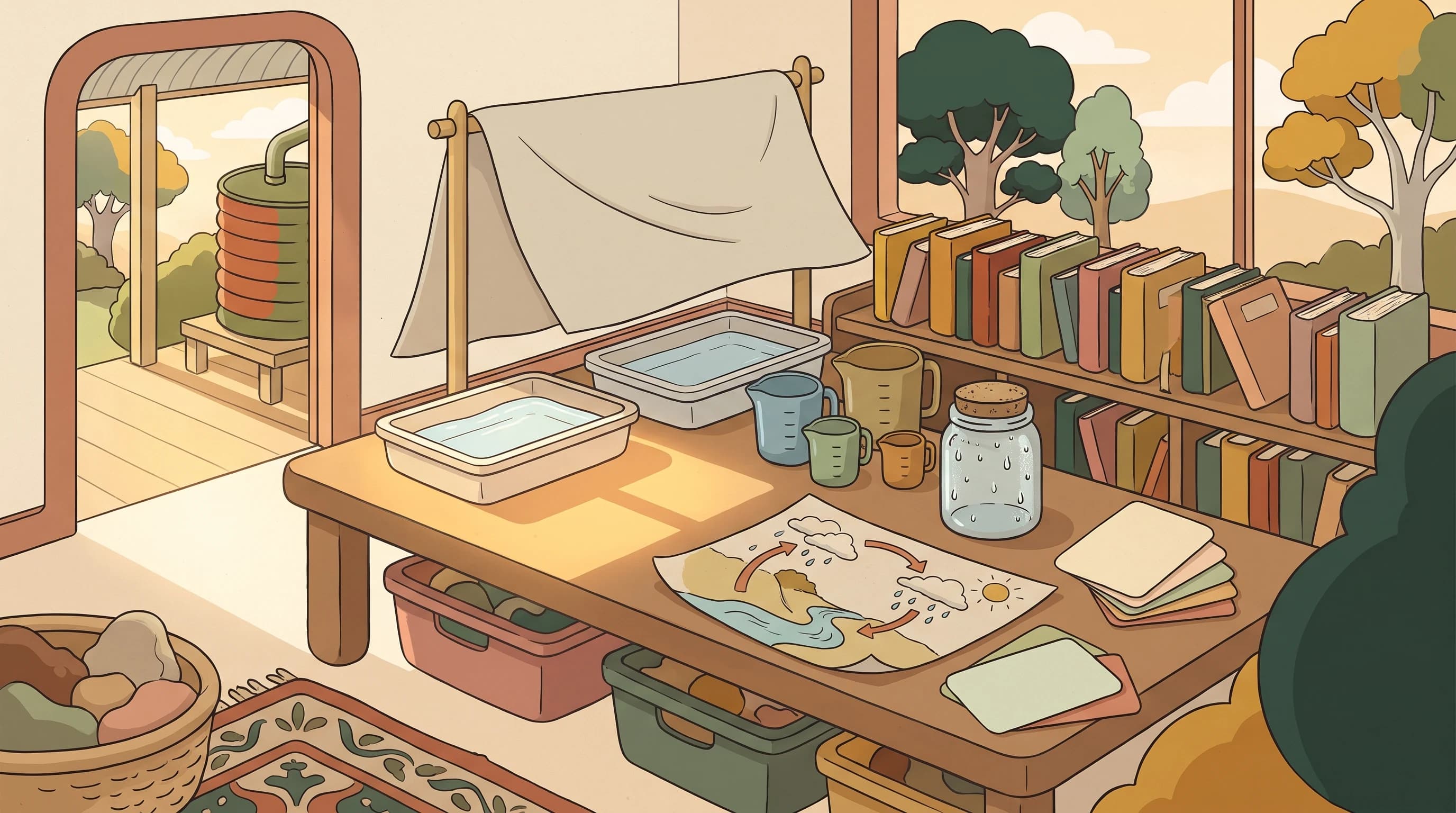
Overview. Year 4, 8 lessons of about 50 minutes across four weeks. Students investigate where water comes from and how it moves through the environment, then explain the water cycle for a real audience.
From the Year 4 Science achievement standard, this unit builds towards these sentences:
| Code | Content description |
|---|---|
| AC9S4U02 | identify sources of water and describe key processes in the water cycle, including movement of water through the sky, landscape and ocean; precipitation; evaporation; and condensation |
| AC9S4I02 | use provided scaffolds to plan and conduct investigations to answer questions or test predictions, including identifying the elements of fair tests, and considering the safe use of materials and equipment |
| AC9S4I04 | construct and use representations, including tables, simple column graphs and visual or physical models, to organise data and information, show simple relationships and identify patterns |
| AC9S4I06 | write and create texts to communicate findings and ideas for identified purposes and audiences, using scientific vocabulary and digital tools as appropriate |
Elaboration used. One of the elaborations for AC9S4U02 is about exploring First Nations Australians’ connections with and valuing of water and water resource management. If you include it, plan it with your school’s Aboriginal and Torres Strait Islander education officer or local community contacts, and use local, permitted knowledge rather than generic sources.
| Capability or priority | How it shows up |
|---|---|
| Numeracy | Measuring water loss in millilitres and building a column graph |
| Literacy | Writing an explanation with sequence words and science vocabulary |
| Critical and Creative Thinking | Planning a fair test and judging whether it was fair |
| Sustainability | Discussing where the school’s water comes from and how it is used |
| # | Learning intention | Main activity | Check | Code(s) |
|---|---|---|---|---|
| 1 | Notice that water moves | Puddle drawing; question wall; walk to find water sources at school | Question wall | AC9S4U02 |
| 2 | Identify sources of water | Sort photos: rain, rivers, groundwater, ocean, tanks; map the school’s water | Exit ticket | AC9S4U02 |
| 3 | Plan a fair test | Predict which tray loses water fastest (sun, shade, covered); plan with a scaffold | Fair-test checklist | AC9S4I02 |
| 4 | Measure and record | Measure water loss each day in millilitres; record in a table | Table check | AC9S4I02, AC9S4I04 |
| 5 | Explain evaporation and condensation | Cold cup demonstration; link to clouds | Exit ticket | AC9S4U02 |
| 6 | Show the pattern | Build a column graph of the tray results; explain the pattern | Graph check | AC9S4I04 |
| 7 | Model the whole cycle | Build a labelled diagram showing sky, landscape and ocean; peer feedback | Peer check | AC9S4U02 |
| 8 | Communicate for an audience | Write the explanation for Year 2; revise the lesson 1 drawing | Summative task | AC9S4I06 |
Trays, measuring jugs, cups, ice. Keep water away from power points, wipe spills straight away, and follow your school’s procedures for outdoor investigations.
After the unit, record how many students reached each criterion, which lesson needs more time next year, and what you will move in your curriculum map.
Is there an official Australian Curriculum unit planner template? ACARA publishes the curriculum content. Your school, sector or state may have its own planner format, so check that first and use this template where you have a choice.
What is the difference between a content description and an achievement standard? Content descriptions say what students are to be taught. The achievement standard describes the expected quality of learning by the end of the year or band. Plan lessons from content descriptions and assessment from the achievement standard.
Do I have to use the content elaborations? No. Elaborations are examples and suggestions for teaching a content description. Use them for ideas.
Can I use this template for a lesson plan aligned to the Australian Curriculum? Yes. Use the matching lesson plan template above for each lesson and keep the same codes so the unit and lessons line up.
Should I use Version 9.0 or my state syllabus? Use what your state or sector requires. ACARA states that each jurisdiction determines the timeline and approach for implementing Version 9.0.
Blog