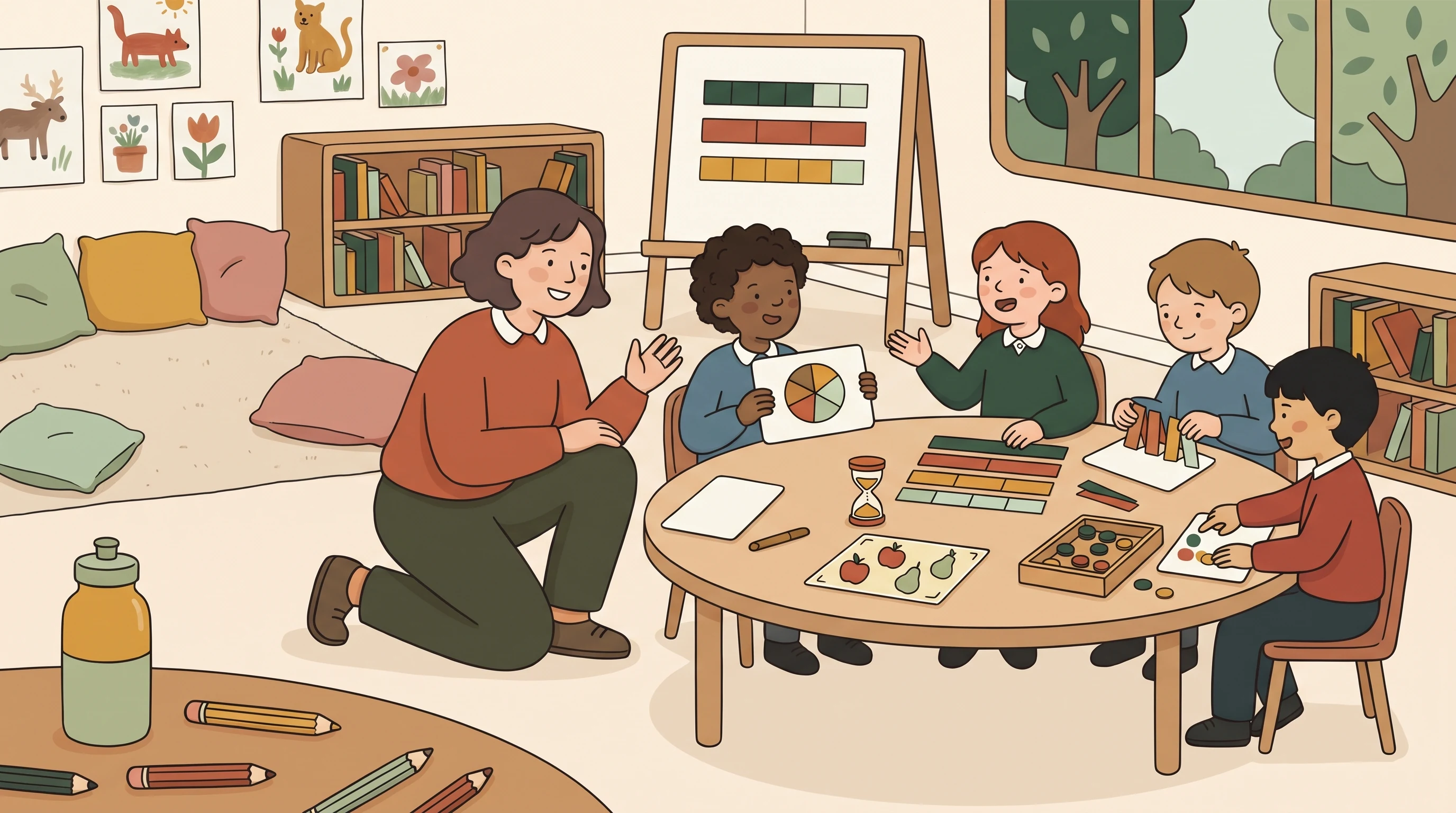
The Early Years Foundation Stage (EYFS) has seven areas of learning and development: three prime areas (communication and language; physical development; personal, social and emotional development) and four specific areas (literacy; mathematics; understanding the world; expressive arts and design). Together they set out what early years providers in England must teach children from birth to the end of the Reception year.
This page is for Reception teachers, nursery practitioners and early years leaders. It explains the seven areas as the current statutory framework describes them, how the prime and specific areas relate, how the early learning goals fit (and how they should not be used), and then shows how to plan across the areas with a copyable weekly planning frame and one complete weekly plan for a Reception class.
Which framework is current?
The Department for Education publishes two versions of the EYFS statutory framework: one for group and school-based providers and one for childminders. The current versions took effect on 1 September 2026, according to the GOV.UK page; the group and school-based version is dated 13 July 2026. The change notes for that update list safeguarding and welfare changes (for example safer sleep and screen use); check the page for the full list.
Everything below is taken from the framework for group and school-based providers, which covers school Reception classes, nurseries and pre-schools in England. Childminders should read their own version. Both are statutory: the learning and development requirements are given legal force by an order made under the Childcare Act 2006.
The 7 areas of learning in the EYFS
The framework says all seven areas are important and inter-connected, and that they set out what providers must teach.
The three prime areas
The prime areas are described as particularly important for learning and forming relationships, and as the basis for learning in all areas.
| Prime area | What the educational programme emphasises (paraphrased) |
|---|
| Communication and language | Spoken language underpins all seven areas. Back-and-forth conversation, reading frequently to children, rhymes and stories, and many chances to use new words. |
| Personal, social and emotional development (PSED) | Warm, supportive relationships; managing emotions; a positive sense of self; looking after their bodies and personal needs; making friends and resolving conflicts. |
| Physical development | Gross and fine motor skills built up through play indoors and outdoors; core strength, balance and co-ordination; small tools and fine motor control linked to early literacy. |
The four specific areas
The specific areas strengthen and develop the prime areas. The framework says that as children move into the Reception year there should be a greater focus on teaching the essential skills and knowledge in these areas, to prepare for Key Stage 1.
| Specific area | What the educational programme emphasises (paraphrased) |
|---|
| Literacy | A love of reading; language comprehension and word reading (decoding and recognising familiar words); writing as transcription and composition. |
| Mathematics | A strong grounding in number, including a deep understanding of numbers to 10; manipulatives such as tens frames; spatial reasoning across shape, space and measures; positive attitudes. |
| Understanding the world | Making sense of the physical world and the community through first-hand experiences and a broad range of stories, non-fiction, rhymes and poems; building vocabulary. |
| Expressive arts and design | Regular engagement with the arts; exploring a wide range of media and materials; frequency, repetition and depth of experience. |
The early learning goals
The framework sets 17 early learning goals (ELGs) across the seven areas. They define the level of development children are expected to reach by the end of the EYFS.
| Area | ELGs |
|---|
| Communication and language | Listening, Attention and Understanding; Speaking |
| PSED | Self-Regulation; Managing Self; Building Relationships |
| Physical development | Gross Motor Skills; Fine Motor Skills |
| Literacy | Comprehension; Word Reading; Writing |
| Mathematics | Number; Numerical Patterns |
| Understanding the world | Past and Present; People, Culture and Communities; The Natural World |
| Expressive arts and design | Creating with Materials; Being Imaginative and Expressive |
Two points matter for planning. First, the framework states that the ELGs should not be used as a curriculum or to limit the rich experiences children need. Second, they support a holistic, best-fit judgement at the end of the EYFS, recorded in the EYFS Profile, which must be completed in the final term of the Reception year and no later than 30 June. Plan from the educational programmes and your own curriculum; use the ELGs as an end-of-year reference, not a weekly checklist.
How the framework says to teach
Before you plan, note what the framework leaves to you and what it requires.
- No prescribed teaching approach. The framework says play is essential and that children learn both by leading their own play and through play and learning guided by adults. Practitioners decide what they want children to learn and the most effective ways to teach it.
- Three characteristics of effective teaching and learning: playing and exploring, active learning, and creating and thinking critically. Practitioners must reflect on the different rates at which children develop and adjust their practice.
- Ambition for all children. Practitioners must consider each child’s needs, interests and development and use this to plan a challenging and enjoyable experience in all areas.
- Light assessment. Assessment should not involve long breaks from interaction or excessive paperwork, and there is no requirement to keep written records for ongoing (formative) assessment.
- Reception Baseline Assessment. In school-based provision, a short baseline assessment is taken within the first six weeks of a child starting Reception.
The DfE also publishes Development Matters, which is non-statutory curriculum guidance. The framework says Ofsted will not take it into account at inspection and that it is up to providers how they deliver the requirements.
How to plan across the seven areas
A Reception week is not seven separate subjects. Good planning connects the areas through shared experiences while making sure each area gets explicit teaching over time.
- Start from your long and medium term curriculum. Decide what children should know and be able to do by the end of each half-term in each area. The medium term plan template works for an EYFS half-term if you replace subject rows with the seven areas.
- Plan the prime areas into every day. Communication and language, PSED and physical development run through routines, play and every adult interaction, not just one session.
- Schedule direct teaching for the specific areas. Timetable regular teaching of literacy (including phonics, following your school’s programme), mathematics and shared reading. This reflects the framework’s call for a greater focus on the specific areas in Reception.
- Choose one or two shared experiences per week. A story, a visit, a seasonal change or an object can link several areas naturally.
- Plan continuous provision with intent. For each area of the classroom and outdoors, note what children might practise and what vocabulary adults will model.
- Decide who adults will observe and why. Not every child every day; a few focus children and one or two learning questions.
- Adapt from what you see. Use what you notice to change next week’s plan, groups and provision. The principles of adaptive teaching apply in Reception too: same ambition, different support.
Copyable weekly planning frame
Copy includes the complete text. No signup needed.
Week and dates:
Shared experience or focus text:
Key vocabulary for the week:
Show full textShow less
PRIME AREAS
Communication and language - teaching focus / adult role in play:
PSED - teaching focus / routine to practise:
Physical development - gross motor / fine motor:
SPECIFIC AREAS
Literacy - phonics (programme and unit) / reading / writing:
Mathematics - daily focus / continuous provision:
Understanding the world - experience or enquiry:
Expressive arts and design - media, music, role play:
CONTINUOUS PROVISION (indoor and outdoor)
Area / enhancement / what children may practise / vocabulary:
ASSESSMENT
Focus children this week:
What adults are noticing:
Next steps for next week's plan:
ADAPTATIONS
SEND support plan actions:
EAL (home language, visual support):
Worked example: a Reception weekly plan
Class: Reception, 28 children, one teacher and one teaching assistant, in the second week of January.
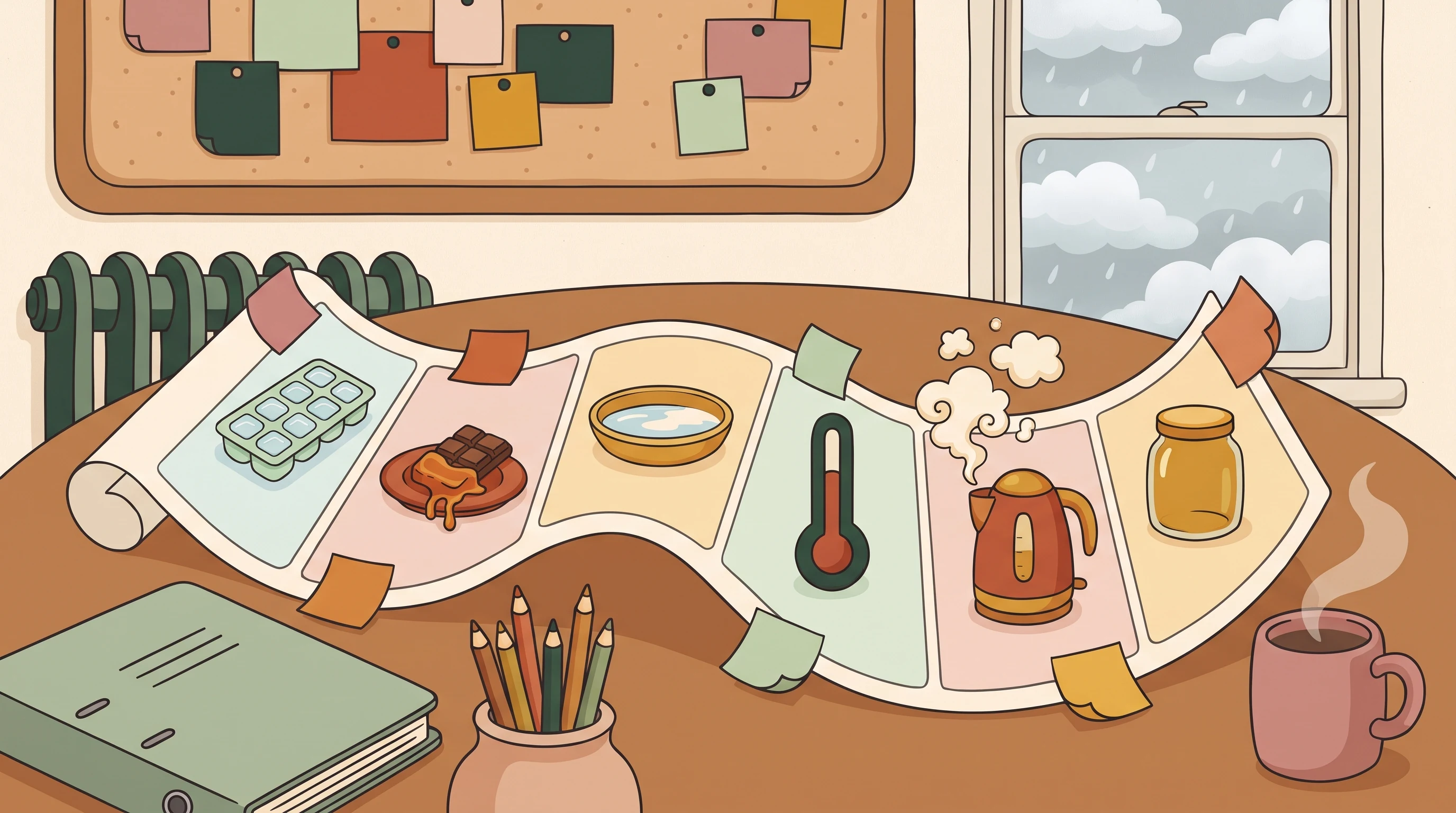
Shared experience: Ice and cold weather. Children find ice in the outdoor area and explore what happens to it indoors. A non-fiction book about animals in winter is the focus text.
Key vocabulary: frozen, melt, freeze, cold, warm, slippery, shiny, hibernate, burrow, nest.
| Area | Adult-guided teaching | Continuous provision and enhancements |
|---|
| Communication and language | Daily shared reading of the focus text with talk about new words; “describe it” game with a block of ice | Small world winter scene with animals; adults model full sentences using the week’s vocabulary |
| PSED | Circle time: how do we keep warm and safe outside in cold weather? Turn-taking game with a sand timer | Self-service snack with gloves and coats routine practised before outdoor time |
| Physical development | Gross motor: animal movements (waddle, slide, burrow) in the hall; fine motor: tweezers to rescue small animals from melting ice | Playdough with rolling and cutting tools; chunky chalk on the playground |
| Literacy | Daily phonics session from the school’s programme; shared writing of a label “Do not touch, it is melting” | Writing area with winter word cards and clipboards outdoors |
| Mathematics | Daily session on numbers to 10: composition of 6 using a tens frame and ice cube counters | Ice blocks of different sizes to compare and order; “how many penguins?” counting baskets |
| Understanding the world | Predict and check: where does ice melt fastest, inside or outside? Look again after lunch | Magnifiers and trays of ice with salt and water (adult supervised) |
| Expressive arts and design | Paint with coloured ice cubes; sing a winter song with actions | Small world role play as animals finding a place to sleep for winter |
Daily rhythm (example): arrival and self-registration; phonics; continuous provision indoors and outdoors with adults teaching in play; snack; maths; outdoor time; lunch; story and shared reading; afternoon provision with a focus group; end-of-day story and song.
Assessment for the week: Adults observe six focus children, noticing two things: who uses comparative words (bigger, smaller, faster) when talking about the ice, and who can show 6 in more than one way on a tens frame. Notes are brief and only kept if they change what happens next. No photo evidence is collected for its own sake.
Adaptations: one child with speech and language support has a picture sequence for the ice investigation and a daily short session with the TA using the same vocabulary. Two children who speak Polish at home are invited to share their words for “ice” and “cold”, and their parents are asked to read the focus book with them in their home language.
Next steps feeding next week’s plan: if several children could not yet explain why the ice melted, repeat the investigation with a warm and a cold place and use a simple KWL chart on the wall to record what the class now knows.
Common planning mistakes
- Planning from the ELGs. Using the goals as weekly objectives narrows the curriculum, which the framework warns against.
- Seven separate activities a day. One rich shared experience can teach several areas; use continuous provision to revisit them.
- Neglecting the prime areas once phonics and maths start. Communication, PSED and physical development remain the foundation in Reception.
- Paperwork for its own sake. The framework does not require written records for ongoing assessment. Record what changes your teaching.
- Provision without a teaching intent. Enhancements need a purpose, vocabulary and an adult role.
Frequently asked questions
What are the 7 areas of learning in the EYFS?
Three prime areas (communication and language; personal, social and emotional development; physical development) and four specific areas (literacy; mathematics; understanding the world; expressive arts and design).
What is the difference between the prime and specific areas?
The prime areas are particularly important for learning and forming relationships and build the foundation for everything else. The specific areas strengthen and apply the prime areas and give children a broad curriculum.
How many early learning goals are there?
The current framework sets 17 early learning goals across the seven areas. They support the end-of-EYFS judgement and should not be used as a curriculum.
Is Development Matters statutory?
No. Development Matters is non-statutory curriculum guidance from the DfE. The EYFS statutory framework is the document providers must follow.
How do you plan across the EYFS areas of learning?
Start from your curriculum for each area, build the prime areas into every day, schedule direct teaching for the specific areas, link areas through one or two shared experiences each week, and adapt next week’s plan from what adults notice.