KWL Chart: Free Template, a Filled Example and How to Use It Well
What a KWL chart is, how to run each column so it actually drives learning, free KWL, KWHL and KWL+ templates, and a filled science example.
Draft My Lesson Team
The short answer: A KWL chart is a three-column organizer students complete before, during and after a unit or a reading: K – what I know, W – what I want to know, L – what I learned. It was introduced by Donna Ogle in 1986 to help students read informational text actively. It works when the questions in the W column guide the reading and the L column is checked against the K column. It fails when it becomes a worksheet filled in once and forgotten.
Key takeaways
- K and W are filled before learning, L during and after. Keep the chart visible for the whole unit.
- Students' first ideas in the K column may be wrong. Leave them, then correct them in L. That correction is the point.
- KWHL adds "How will I find out?", and KWL+ adds a written summary.
- It suits informational topics (animals, weather, history, careers) better than skills practice.
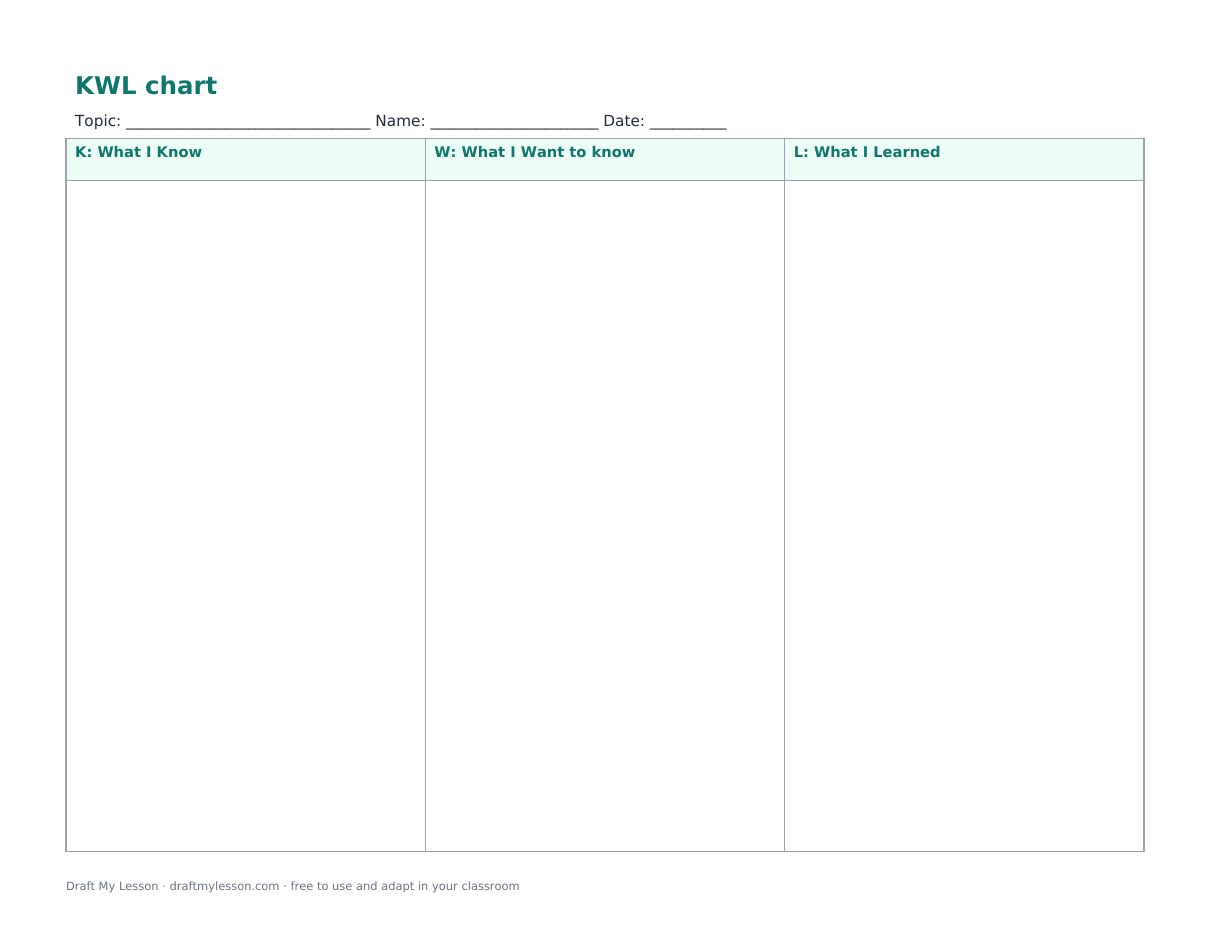
Free KWL chart templates (PDF and Word)
Download the printable KWL chart templates (PDF) or the editable Word file. The landscape file has three pages: a classic KWL chart, a KWHL chart with a "How I will find out" column, and a KWL+ chart with a summary box. The filled monarch butterfly example (Word) shows a completed class chart. No account is needed.
For Google Docs or Google Classroom, upload the Word file to Google Drive, open it with Google Docs, and assign it with "Make a copy for each student".
Where the KWL chart comes from
Donna Ogle, a reading educator at the National College of Education in Illinois (now National Louis University), described the strategy in "K-W-L: A Teaching Model That Develops Active Reading of Expository Text", published in The Reading Teacher in 1986. Her aim was to get students to bring what they already know to a nonfiction text, set their own questions, and read to answer them. In 1987, Eileen Carr and Ogle published KWL Plus, which adds two steps after reading: organizing what was learned (often as a concept map) and writing a summary.
How to use a KWL chart, column by column
K: What I know (before)
Ask students what they know or think they know about the topic. Write every idea, including wrong ones, and do not correct anything yet. With younger students, do this as a class chart; older students can brainstorm alone and then share. Group the ideas into categories if there are many.
Tip: Phrase the column as "What I think I know." Students offer more ideas, and nobody feels singled out later when an idea is corrected.
W: What I want to know (before)
Turn gaps and disagreements from the K column into questions. "Some of us think monarchs fly south, some think they hibernate. How could we find out?" Push for questions the coming reading or unit can actually answer. These questions become the purpose for reading.
L: What I learned (during and after)
Students add what they learned, with the source when possible. Then return to the first two columns:
- Which K ideas were confirmed? Which were wrong? Correct them in L.
- Which W questions are answered? Which are still open, and where could we look next?
That return to K and W is the step most often skipped, and it is the one that makes the chart a learning tool rather than a list.
KWL chart example: monarch butterflies (grades 2-3)
| K: What I know | W: What I want to know | L: What I learned |
|---|---|---|
| Monarchs are orange and black. They start as caterpillars. They fly south for winter. I think the same butterfly flies there and back. | What do monarch caterpillars eat? How far do they fly? Why don't birds eat them? How long does a monarch live? | A monarch has four life stages: egg, larva (caterpillar), pupa (chrysalis) and adult. Monarch caterpillars eat only milkweed leaves. Milkweed makes many monarchs taste bad to birds. Eastern monarchs fly to forests in central Mexico for the winter. Correction: no single butterfly makes the whole round trip; the return north takes several generations. |
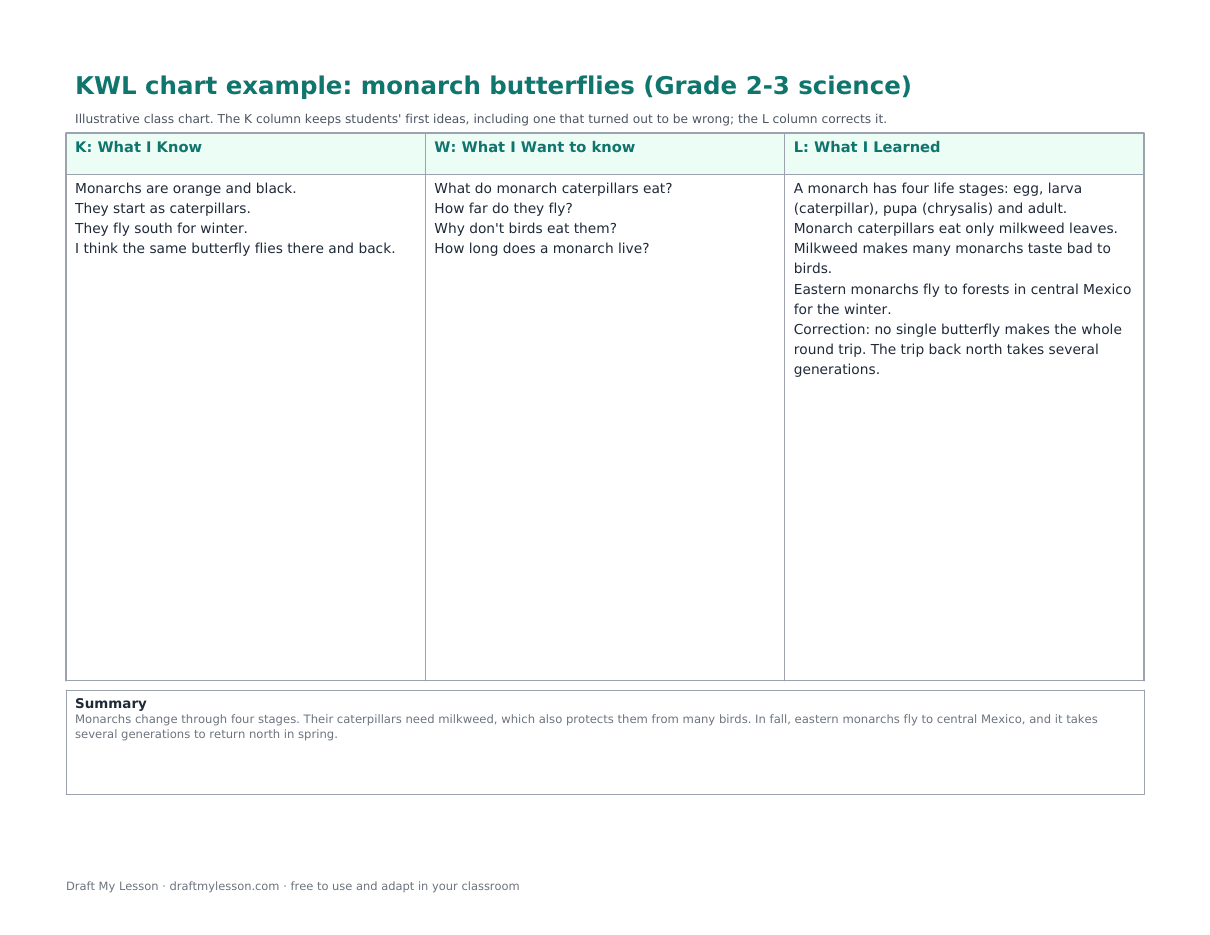
The question "How long does a monarch live?" stays open in this example. That is fine: it becomes a research task or the start of the next lesson.
KWL chart variations
| Chart | Columns | When to use it |
|---|---|---|
| KWL | Know, Want to know, Learned | Most informational units and readings |
| KWHL | Know, Want to know, How I will find out, Learned | Research projects, when students choose sources |
| KWL+ | KWL plus a concept map or a written summary | Grades 3-12, to turn notes into writing (Carr and Ogle, 1987) |
| KWLA | Know, Want to know, Learned, Apply (or Affect) | When you want students to connect learning to their own lives |
| KWLS | Know, Want to know, Learned, Still want to know | Long units, to carry questions forward |
Some teachers replace KWL with Tony Stead's RAN chart (Reading and Analyzing Nonfiction), whose columns separate what students think they know into ideas that were confirmed and misconceptions. It makes the correction step explicit, which is especially useful with younger students.
Common mistakes
- Filling all three columns on the same day. If L is written right after K and W without any reading or investigation, the chart is a quiz, not a strategy.
- Correcting the K column immediately. Students stop sharing. Let the reading do the correcting.
- W questions nobody answers. Plan the texts or activities that will answer most of them, or cut questions that are out of scope.
- Using it for a skill. "What do you know about long division?" produces little. For skills, a pre-assessment problem tells you more.
- Students with nothing to write in K. Show a short video, a picture or an object first, so everyone has something to start from.
Plan the unit around the chart
A KWL chart opens a unit; the lessons still need a plan. The Draft My Lesson lesson generator drafts editable lesson plans with objectives, activities, practice and an assessment from your topic, grade and duration, so you can build the readings and activities that answer the class's W questions. Review the content before teaching. Your free account includes two complete lessons.
Frequently asked questions
What does KWL stand for?
KWL stands for Know, Want to know and Learned. Students write what they already know about a topic, what they want to find out, and, after the lesson or reading, what they learned.
What is a KWL chart used for?
It activates prior knowledge before a unit or a nonfiction reading, gives students a purpose for reading through their own questions, and shows what they learned at the end. Teachers also use the K column as a quick, informal pre-assessment that reveals misconceptions.
What is the difference between KWL and KWHL?
KWHL adds an H column between W and L: "How will I find out?" Students plan their sources (books, websites, experiments, interviews) before researching, which makes it a good fit for inquiry and research projects.
What can I use instead of a KWL chart?
For nonfiction reading, the RAN chart separates confirmed ideas from misconceptions. For vocabulary, use a Frayer model. For a quick start-of-lesson check, an exit ticket question used as an entry ticket gives individual evidence in a few minutes.
Is a KWL chart good for kindergarten?
Yes, as a whole-class chart. The teacher writes or draws students' ideas and questions, and returns to it at the end of the unit. Individual written KWL charts usually start around grade 2.
More lesson planning tools
- Frayer model: teach the key concepts of the unit.
- Research-based reading comprehension strategies: what to pair with KWL during reading.
- Lesson plan template: daily, elementary, secondary and subject templates in Word and PDF.
Related articles
Frayer Model: Free Template, 4 Filled Examples and How to Teach It
What the Frayer model is, how to teach it in four steps, a free printable and editable template, and filled examples for math, science, ELA and geography.
Read articleReading Comprehension Lesson Plan: Research-Based Strategies
Plan a reading comprehension lesson with explicit modeling, guided practice, independent transfer, and an exit ticket. Includes a copyable 45-minute plan.
Read articleExit Ticket Template: 30 Examples and 5 Copyable Formats
Copy 30 exit ticket examples for math, ELA, science, and social studies, then use five flexible templates to decide what your class needs next.
Read articleI Do, We Do, You Do: The Gradual Release Model With a Template and Example
How the "I do, we do, you do" gradual release model works, where it comes from, when to move to the next phase, a free lesson plan template and a complete Grade 7 math example.
Read article