Weekly Lesson Plan Template: Plan Five Days Without Overpacking Them
Copy a weekly lesson plan template for US classrooms, see a filled Grade 5 example, and connect daily evidence to Friday’s next-step decision.
A copyable preschool lesson plan template organized by the Head Start Early Learning Outcomes Framework domains, with a daily activity plan and a complete five-day apple theme week for 4-year-olds.
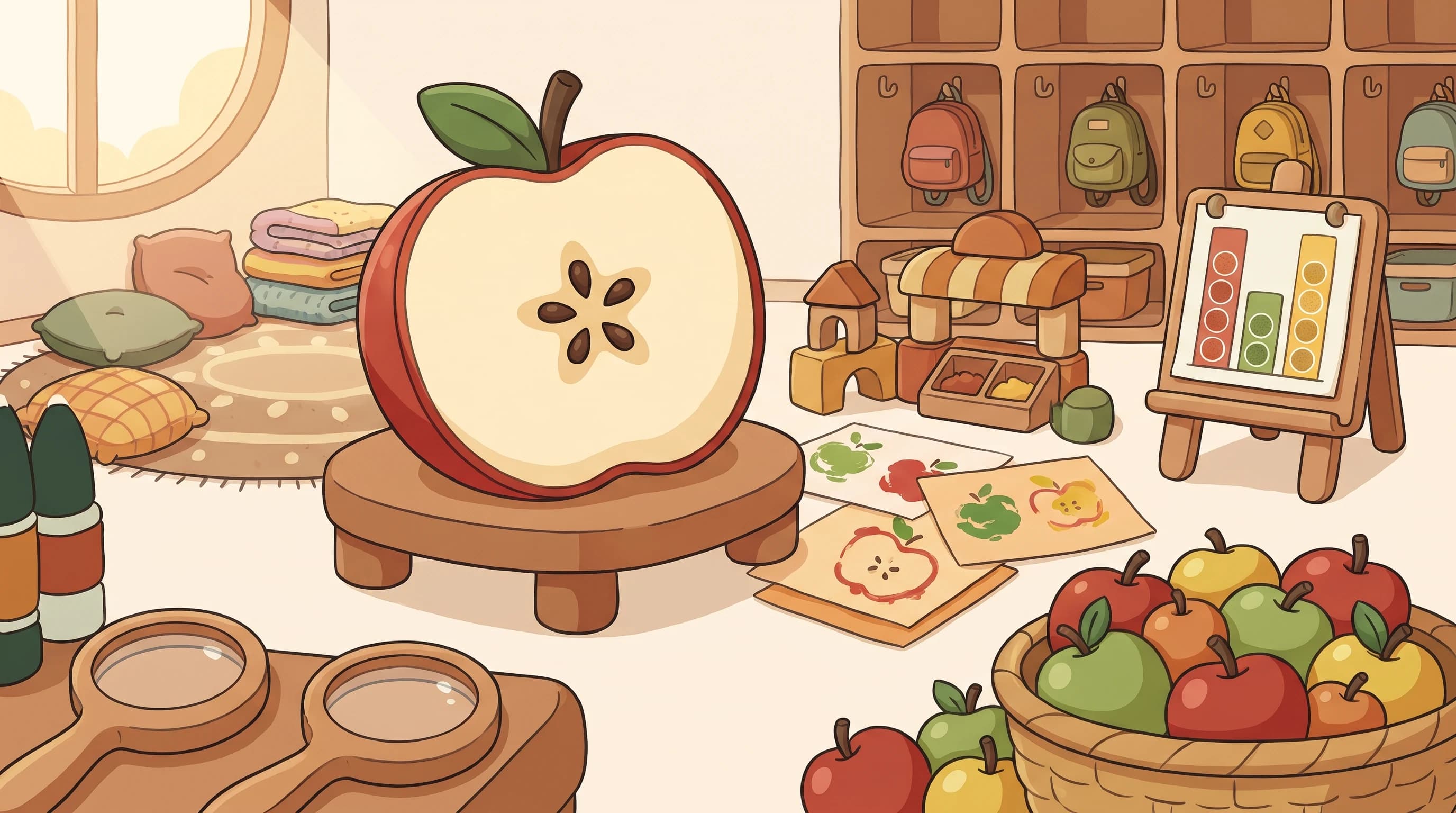
A preschool lesson plan maps a day or a week of play-based learning to what 3- and 4-year-olds are working on: language, early literacy and math, science thinking, motor skills, social and emotional growth, and approaches to learning such as persistence and curiosity. In Head Start programs, and in many other US preschools, those areas come from the Head Start Early Learning Outcomes Framework (ELOF).
This page explains how the ELOF is organized for preschoolers, then gives you a weekly theme template, a daily activity template, and a complete five-day “Apples” theme week for a class of 4-year-olds. State early learning standards vary, so the template leaves room for your state’s own references too.
The Head Start Early Learning Outcomes Framework: Ages Birth to Five is published by the Office of Head Start. The full framework document is dated 2015 and replaced the 2010 Head Start Child Development and Early Learning Framework. Headstart.gov notes that the Head Start Program Performance Standards require grantees to use program and teaching practices aligned with the ELOF.
The framework has five central domains: Approaches to Learning; Social and Emotional Development; Language and Literacy; Cognition; and Perceptual, Motor, and Physical Development. For preschoolers, two of them split, because learning becomes more differentiated between ages 3 and 5:
| Central domain | Preschool domain(s) | Preschool sub-domains |
|---|---|---|
| Approaches to Learning | Approaches to Learning | Emotional and behavioral self-regulation; cognitive self-regulation (executive functioning); initiative and curiosity; creativity |
| Social and Emotional Development | Social and Emotional Development | Relationships with adults; relationships with other children; emotional functioning; sense of identity and belonging |
| Language and Literacy | Language and Communication | Attending and understanding; communicating and speaking; vocabulary |
| Language and Literacy | Literacy | Phonological awareness; print and alphabet knowledge; comprehension and text structure; writing |
| Cognition | Mathematics Development | Counting and cardinality; operations and algebraic thinking; measurement; geometry and spatial sense |
| Cognition | Scientific Reasoning | Scientific inquiry; reasoning and problem-solving |
| Perceptual, Motor, and Physical Development | Perceptual, Motor, and Physical Development | Gross motor; fine motor; health, safety, and nutrition |
Each sub-domain contains goals with codes such as P-MATH 2 or P-SCI 4. Each goal has a developmental progression for 36 to 48 months and 48 to 60 months, and indicators describing what children should know and be able to do by 60 months, with the note that some children show them earlier and some later. The framework notes that goals are sometimes called standards in state early learning guidelines, and that indicators are not exhaustive.
The framework is explicit on two points that shape any lesson plan:
A 2026 letter from the Office of Head Start, printed at the front of the current PDF, adds that programs may choose research-based curricula aligned with the ELOF and, where applicable, with state early learning standards.
Plan the week first, then the day. Choose three to five ELOF goals for the week rather than trying to cover every domain every day.
Copyable text
Copy includes the complete text. No signup needed.
WEEKLY PRESCHOOL PLAN
Classroom: Age group: Week of:
Theme or study topic:
Big question children will explore:
FOCUS GOALS THIS WEEK (ELOF code and short wording)
-
-
-
State early learning standard references (if your program uses them):
VOCABULARY TO USE ALL WEEK:
MON TUE WED THU FRI
Large group
(circle, song,
read-aloud)
Small group
(teacher-led)
Centers
(blocks, art,
dramatic play,
science, library,
writing, sensory)
Outdoor or
gross motor
Family
connection
OBSERVATION FOCUS (which children, which goal, how recorded):
Supports for dual language learners:
Supports and accommodations from IFSPs, IEPs or 504 plans:
Materials to gather:
Notes for next week:
Use one of these for each small-group or large-group activity you lead. Centers usually need only a line in the weekly grid.
Copyable text
Copy includes the complete text. No signup needed.
ACTIVITY PLAN
Activity name: Group: large / small / center
Day and time: Length:
ELOF goal(s) (code and wording):
What I hope children will do or say:
Materials:
Setup:
Introduction (how I invite children in):
Main experience (what children do; my questions and comments):
Closing (how we wrap up or transition):
Adaptations:
- For children learning English:
- For children who need more support:
- For children ready for more challenge:
What I will observe and how I will record it:
Class: 18 children aged 4 to 5, half-day program, two teachers. Five children are dual language learners (Spanish at home). One child has an IEP with speech and language goals.
Big question: What can we find out about apples by using our senses?
Focus goals for the week (wording from the ELOF preschool goals):
Vocabulary: apple, seed, core, stem, skin, peel, crunchy, juicy, sour, sweet, predict, more, fewer.
Safety note: check allergy and dietary information with families before any tasting, and adults handle all cutting.
| Day | Large group | Small group (teacher-led) | Centers | Outdoor | Goal focus |
|---|---|---|---|---|---|
| Monday | Read-aloud of a picture book about apples; children ask one question about the pictures. | Feel-and-describe bag: children reach in, describe an apple without looking, then check. | Art: apple prints with paint; dramatic play: apple stand with baskets and play money. | Apple relay: carry a beanbag “apple” on a spoon. | P-LIT 5, P-SCI 1 |
| Tuesday | Prediction chart: “What is inside an apple?” Children draw or dictate a guess. | Teacher cuts an apple across the middle; children find the star and count seeds in their piece. | Science: magnifying glasses with apple slices and seeds; writing: label an apple drawing. | Collect leaves; sort by color. | P-SCI 4, P-MATH 2 |
| Wednesday | Taste test of red, green and yellow apples; children vote with a sticker on a class graph. | Count stickers in each column; compare which has more or fewer. | Math: count apples (counters) into baskets with 1 to 5 dots; library: reread the apple book. | Climbing structure as an “apple tree”; picking pretend apples from a hoop. | P-MATH 2, P-SCI 1 |
| Thursday | Song and fingerplay about five apples on a tree; children show fingers. | Float or sink: predict, test an apple in water, record with a thumbs-up chart. | Blocks: build an orchard and farm stand together; sensory bin with dried apple slices and scoops. | Wheelbarrow walk to deliver “apples” to friends. | P-SCI 4, P-SE 4 |
| Friday | Children share one thing they learned; teacher records answers on chart paper. | Make applesauce together: take turns adding, stirring and describing changes. | Repeat favorite centers; art: tear paper for an apple collage. | Free play with a cooperative parachute game. | P-SE 4, P-SCI 1 |
The Wednesday sticker graph, the Thursday float or sink chart and the Friday applesauce discussion give more evidence for the same goals, so by Friday each child has been seen working on the week’s focus several times in different ways.
What should be included in a preschool lesson plan?
The theme or topic, a few focus goals (for Head Start, ELOF goals), large-group, small-group, center and outdoor activities, materials, vocabulary, supports for dual language learners and children with IFSPs, IEPs or 504 plans, and a plan for observing children.
What are the five ELOF domains?
Approaches to Learning; Social and Emotional Development; Language and Literacy; Cognition; and Perceptual, Motor, and Physical Development. For preschoolers, Language and Literacy is presented as Language and Communication plus Literacy, and Cognition as Mathematics Development plus Scientific Reasoning.
How do I write a weekly lesson plan for preschool?
Choose a theme and a big question, pick three to five focus goals, then fill a five-day grid with large-group, small-group, center and outdoor activities that return to those goals in different ways. Our general weekly lesson plan template shows the same planning order for older grades.
Do all US preschools use the ELOF?
Head Start programs must align their practices with it. Other preschools often follow their state’s early learning standards or guidelines, which vary from state to state, so check your state’s document and your program’s curriculum.
Blog