Kindergarten TEKS Lesson Plan: Addition and Subtraction Within 10
A complete Texas kindergarten mathematics lesson aligned to TEKS K.3(B), with concrete models, drawings, word problems and an observable exit task.
Draft My Lesson Team
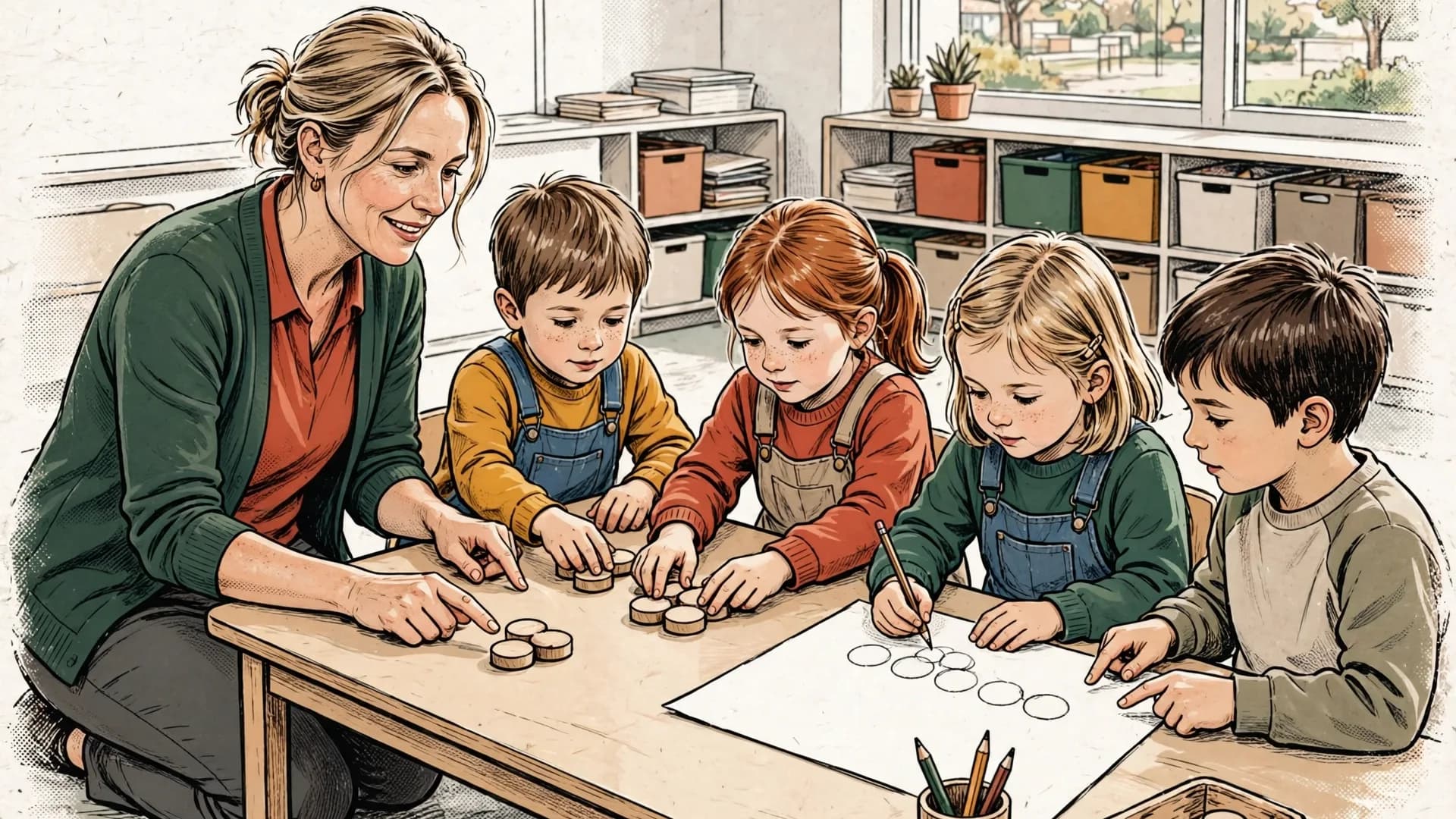
Kindergarten students can solve an addition problem without yet understanding the action that the symbols represent. A strong TEKS lesson makes the action visible first, then connects it to drawings, spoken reasoning and a number sentence.
This complete 45-minute lesson uses Texas kindergarten mathematics student expectation K.3(B). The Texas Education Agency's current kindergarten compilation asks students to solve word problems with objects and drawings for sums to 10 and differences within 10. The same section also places addition in joining situations and subtraction in separating situations.
Use the central TEA TEKS catalogue to confirm that you have the current grade compilation, and check the agency's mathematics resources for current state guidance. These sources do not replace your district's scope and sequence.
Use the Texas curriculum profile in Draft My Lesson to keep planning inside the Texas source scope. Before teaching, confirm the official document and your district's current sequence.
Lesson at a glance
Title: Build it, draw it, solve it
Grade and subject: Kindergarten mathematics
TEKS: §111.2, K.3(B), supported by K.3(A) and K.3(C)
Duration: 45 minutes
Group: Whole class, then pairs and individual check
Materials: Two-color counters, ten-frames, story picture cards, crayons, pencils and small paper cups
Objective: Students will solve joining and separating word problems within 10 by modelling each story with objects, drawing the action and stating the answer.
Success criteria:
- I can show what happened with counters.
- I can draw the joining or separating action.
- I can tell how many there are now.
The language is intentionally concrete. “Solve addition and subtraction problems” is accurate but less useful to a five-year-old than “show what happened, draw it and tell how many.”

Before the lesson
Prepare six picture cards. Three should show joining situations and three should show separating situations. Keep every quantity within 10.
Examples:
- Four birds are at a feeder. Three more birds arrive.
- Eight blocks are in a tower. Two blocks fall off.
- Five markers are on a table. One more marker is added.
- Seven toy cars are in a basket. Three are taken out.
Avoid clue-word teaching such as “more always means add.” Children need to follow the action in the story. The question “How many more?” can require comparison, not joining.
Place counters and a ten-frame at each pair's workspace. Fold one sheet of paper in half and label the sides “Build” and “Draw.”
Complete 45-minute lesson sequence
Opening: act out the change (0-6 minutes)
Invite three students to stand at the front. Say: “Three children are waiting for the bus. Two more children join them. What changed?”
Ask students to turn and tell a partner what they noticed. Accept everyday language first: “There were three, then two came, now there are five.” Introduce “join” after students describe the action.
Repeat with five students standing and two sitting down. Ask what changed and introduce “separate” or “take away.”
Teacher check: Listen for students who recount the final group only. They may need the story repeated in two clear scenes: before and after.
Model: build, draw and say (6-15 minutes)
Read this problem aloud:
Mia has 4 red counters. Her friend gives her 2 blue counters. How many counters does Mia have now?
Model the routine:
- Build it: Place four red counters, pause, then join two blue counters.
- Draw it: Draw four circles, then two circles in a second color.
- Say it: “Four joined with two makes six. Mia has six counters now.”
- Record it: Write
4 + 2 = 6after the meaning is clear.
Repeat with a separating story using seven counters and removing three. Physically move the removed counters away so the action remains visible.
Guided pairs: story-card rounds (15-28 minutes)
Give each pair one joining and one separating card. Partner A reads or retells the story while Partner B models it. Both students agree on the drawing and answer. They switch roles for the second card.
Use this observation checklist:
| Look for | Evidence |
|---|---|
| Represents the starting quantity | The first set matches the story. |
| Shows the action | Counters visibly join or separate. |
| Keeps within the given quantities | The model does not add objects that were not in the story. |
| States the result | The spoken answer includes the final quantity and unit. |
Prompt without solving:
- “Show me what was there first.”
- “What happened next?”
- “Which counters show the part that changed?”
- “Tell the story with your model.”
Independent application (28-38 minutes)
Read two problems aloud one at a time. Students build and draw independently.
Problem 1: Six frogs sit by a pond. Two more frogs hop over. How many frogs are by the pond now?
Problem 2: Nine apples are in a basket. Four apples are taken out. How many apples remain?
Students may write a number sentence, but score the model, drawing and answer first. K.3(B) specifically allows objects and drawings as the route to solving.
Share and compare strategies (38-42 minutes)
Display two correct drawings for the frog problem. One might show six circles plus two circles. Another might fill eight spaces in a ten-frame.
Ask: “What is the same in both drawings? What is different?” The goal is not to declare one representation best. It is to connect both to the same joining action and total.
Exit task (42-45 minutes)
Give each student a paper cup and seven counters. Say:
Seven buttons are in a cup. Three buttons fall out. Show what happens, draw it and tell how many stay in the cup.
Record each student's result with this three-point check:
- Model: starts with seven and removes three.
- Drawing: shows the separating action or the remaining set clearly.
- Answer: states four buttons remain.
One correct spoken answer without a matching model is partial evidence. One correct model with no spoken or pictorial result also needs follow-up.
Support without changing the expectation
For students developing English: Use the same objects while repeating the sentence frame: “There were ___. Then ___ joined/left. Now there are ___.” A picture card and gesture reduce language load without lowering the mathematics.
For students who lose count: Place counters in a ten-frame or straight row. Let the student touch each object once while counting.
For students ready to extend: Ask them to create a different joining story with the same equation, then explain what changed and what stayed the same.
For fine-motor access: Let students photograph or point to a model and explain it orally instead of requiring a detailed drawing.

Teacher reflection after the lesson
Sort exit tasks into three groups:
- Secure: model, drawing and answer agree.
- Developing: action is correct but counting or recording breaks down.
- Needs a new representation: model does not match the story action.
The second group needs targeted counting or recording practice. The third group needs more acted stories and concrete modelling before another symbolic worksheet.
Copy this kindergarten planning frame
TEKS student expectation:
Joining or separating context:
Quantities (within the expected range):

Student-friendly objective:
Build-it model:
Draw-it representation:
Say-it sentence frame:

Opening story:
Teacher model:
Partner story 1:
Partner story 2:
Independent problem:
Exit problem:

Observation evidence:
Language support:
Motor or attention support:
Extension:
The broader TEKS lesson planning guide shows how to move from any Texas student expectation to objective, evidence and sequence. You can also use the lesson plan template for a general planning structure.
When you are ready to draft another lesson, create a Draft My Lesson account, choose the Texas profile and give the generator the exact kindergarten expectation, quantities, duration and evidence you want. Review every model and story problem before it reaches students.
Related articles
Math TEKS Lesson Plan: Grade 4 Decimal Operations
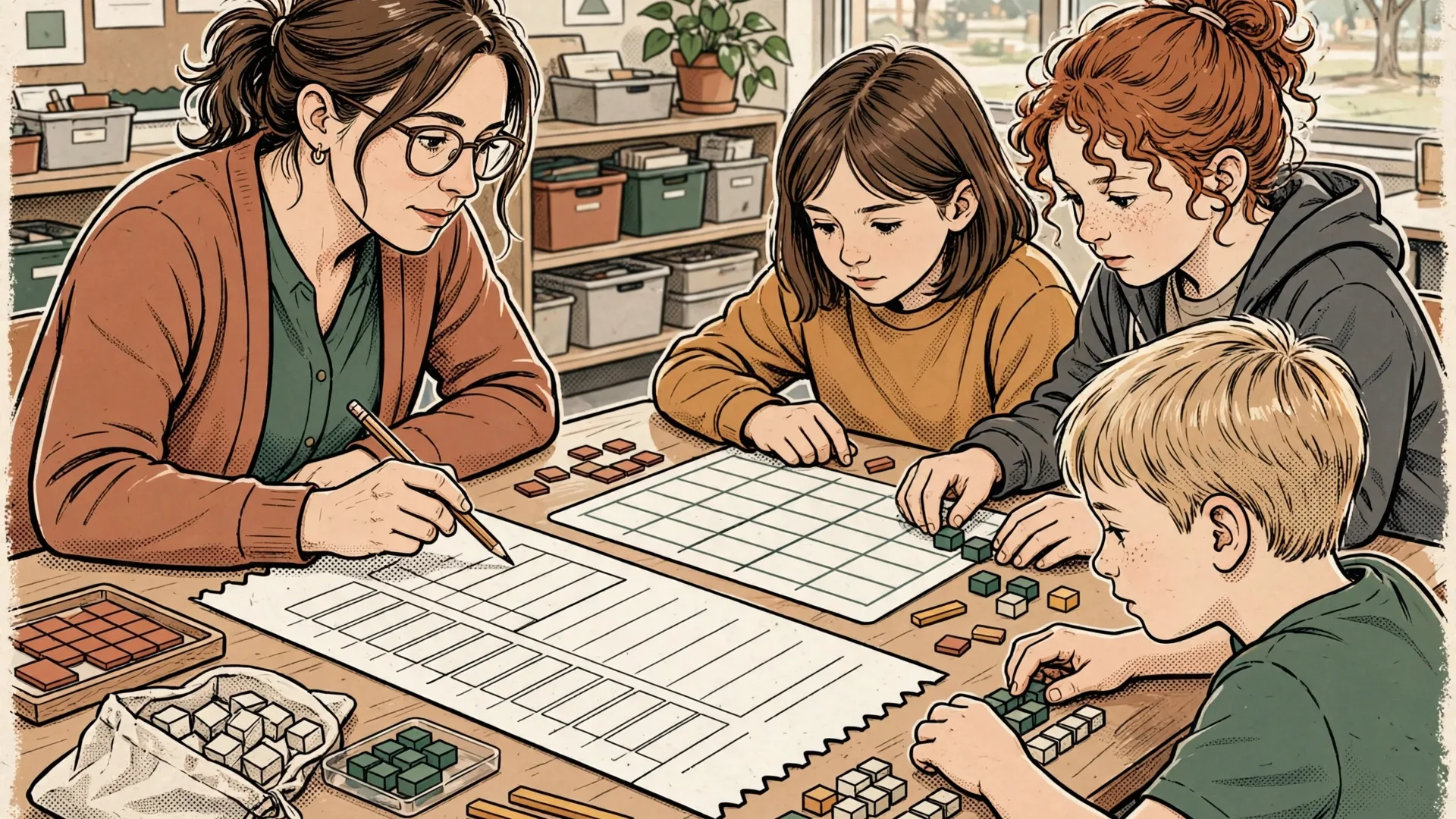
A complete Grade 4 Texas math lesson for TEKS 4.4(A), with place-value models, receipt-error analysis, independent evidence and targeted supports.
Read articleUK Lesson Plan Template: Four-Nation Guide and Full Example
A practical UK lesson plan template with a complete worked example and nation-specific curriculum fields for England, Scotland, Wales and Northern Ireland.
Read articleScience TEKS Lesson Plan: Grade 5 Light Investigation
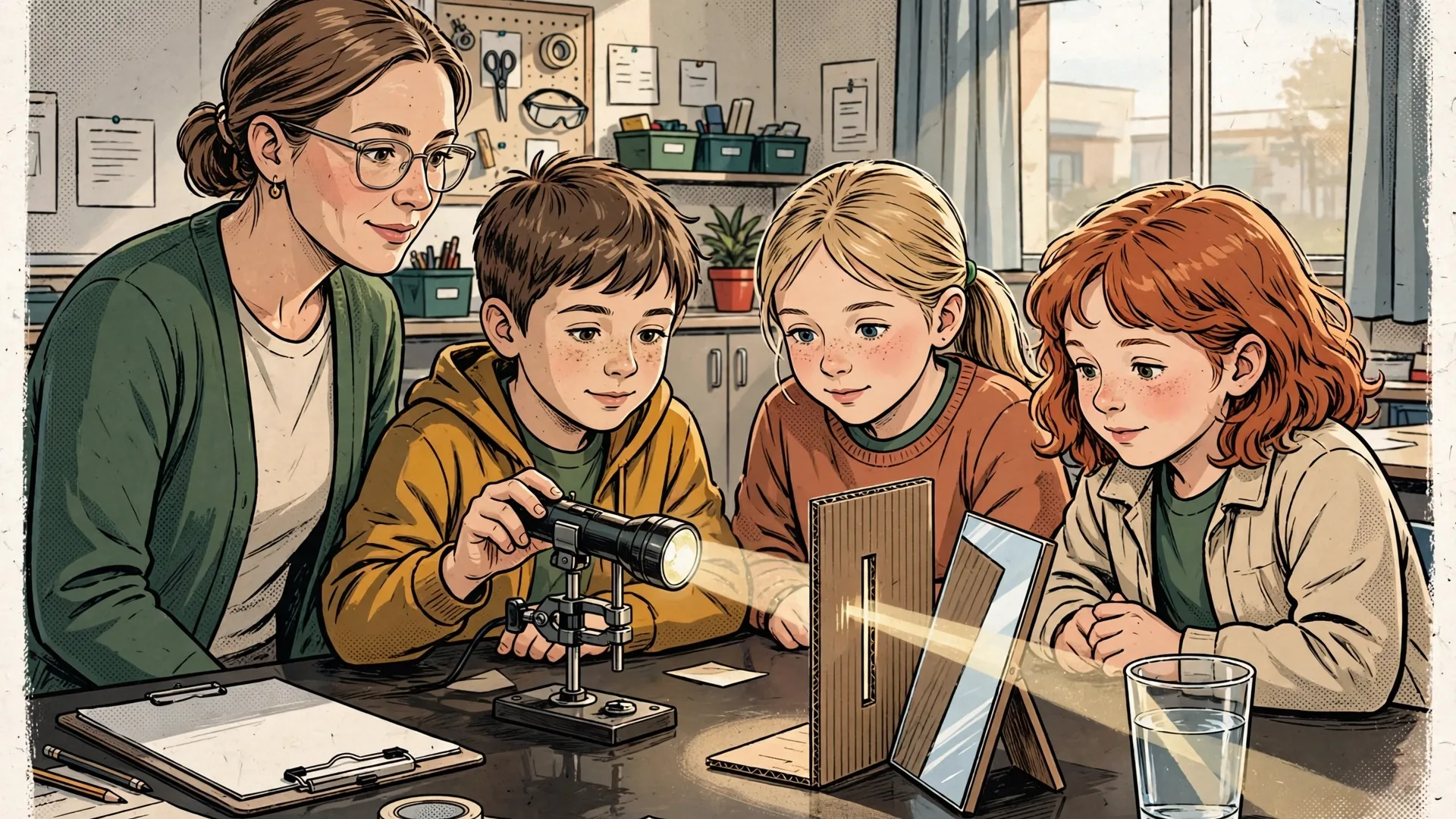
A complete Grade 5 Texas science lesson for TEKS 5.8(C), using stations to investigate light travelling, reflecting, refracting and being absorbed.
Read articleTEKS Lesson Plans: A Practical Guide for Texas Teachers
Turn a current Texas Essential Knowledge and Skills student expectation into an objective, learning sequence and assessment without treating the code as a decorative label.
Read article