Bloom’s Taxonomy Lesson Plan: How to Scaffold Thinking in One Period
Use Bloom’s revised taxonomy to plan a single lesson that climbs from recall to higher-order thinking. Includes a verb table and a full worked example.
The four Webb’s Depth of Knowledge levels explained for lesson planning, with question stems, tasks by level, a copyable template and a Grade 5 science lesson that climbs from DOK 1 to DOK 3.
DOK levels describe how complex the thinking in a task is. Webb’s Depth of Knowledge sorts tasks, standards and test items into four levels: recall, skill or concept, strategic thinking, and extended thinking. Many US districts and state assessment programs use those labels, so teachers are often asked to tag lesson objectives and checks with a DOK level.
This page explains the four levels from the original sources, shows how DOK differs from Bloom’s taxonomy, and gives you question stems, tasks by level, a copyable planning template and a complete Grade 5 science lesson that climbs from DOK 1 to DOK 3.
Norman L. Webb developed Depth of Knowledge as part of his work on alignment: checking whether a test asks for the same kind of thinking as the standards it claims to measure. His 1997 report, Criteria for Alignment of Expectations and Assessments in Mathematics and Science Education (Research Monograph No. 6, ERIC record), was published by the National Institute for Science Education at the University of Wisconsin-Madison with the Council of Chief State School Officers. Later work by Webb set out level definitions for reading, writing, mathematics, science and social studies.
Today WebbAlign, a program of the Wisconsin Center for Education Products and Services, says it works directly with Dr. Webb. Its DOK overview describes DOK as a way to talk about the content complexity of learning expectations, materials and assessment items, and stresses that complexity is not the same as difficulty.
That point matters for planning. The Kansas State Department of Education math DOK page shows it with addition: solving one long addition problem is recall of a known procedure, while using the digits 0 to 9 to build number sentences under constraints asks for more decisions and therefore a higher level. Bigger numbers make a problem harder. They do not make it deeper.
The definitions below paraphrase the mathematics DOK descriptions published by the North Carolina Department of Public Instruction, which follow Webb’s wording. Other subjects use the same four names with subject-specific detail.
| Level | Name | What the task demands | Typical evidence |
|---|---|---|---|
| DOK 1 | Recall | Recall a fact, term, definition or simple procedure; apply a formula or a one-step routine. | Label, list, define, compute a routine problem. |
| DOK 2 | Skill/Concept | Some mental processing beyond a habitual response: students decide how to approach the problem. | Classify, compare data, organize and display data, estimate, explain a simple relationship. |
| DOK 3 | Strategic Thinking | Reasoning, planning and using evidence; explaining thinking; justifying one answer among several. | Draw conclusions from observations, build an argument with evidence, solve a non-routine problem. |
| DOK 4 | Extended Thinking | Complex reasoning and planning, most likely over an extended period, connecting ideas within or across content areas. | Design and run an investigation, synthesize several sources into a new product, critique a design. |
Two details from the North Carolina definitions are easy to miss:
Bloom’s taxonomy and DOK answer different questions. In the ISTE and ASCD article What Exactly Is Depth of Knowledge? (Hint: It’s Not a Wheel!), Erik Francis explains that Bloom’s identifies the kind of thinking students do, usually the verb in an objective, while DOK describes the context in which that thinking is shown and how deeply it must be transferred.
In practice:
The same article notes that the popular “DOK wheel”, which arranges verbs in rings by level, was not designed by Webb. Use verb lists to write clear objectives, then judge the DOK level from the whole task. Karin Hess and colleagues combined the two frameworks in the Cognitive Rigor Matrix, which the Kansas page links, if your district wants both labels on one grid.
These stems are starting points. Check the level against the full task, not the stem alone.
DOK 1: Recall
DOK 2: Skill/Concept
DOK 3: Strategic Thinking
DOK 4: Extended Thinking
| Subject | DOK 1 | DOK 2 | DOK 3 | DOK 4 |
|---|---|---|---|---|
| Math | Solve 4 routine two-digit multiplications. | Choose and draw a model that shows 3 x 14. | Decide which of two pricing plans is cheaper for different months and justify the break-even point. | Plan a class fundraiser budget using real prices collected over two weeks. |
| ELA | Identify the narrator of a story. | Compare two characters’ motives using a T-chart. | Write a claim about the theme and support it with three quotations. | Research an author across several texts and write an analytical essay. |
| Science | Name the parts of a plant. | Classify organisms as producers, consumers or decomposers. | Use pond data to argue what happens if one species disappears. | Monitor a local habitat over weeks and propose an evidence-based change. |
| Social studies | List the three branches of government. | Explain how a bill becomes law with a flow chart. | Evaluate which source gives the more reliable account of an event. | Investigate a local issue and present a proposal to a real audience. |
Notice that DOK 4 tasks span days or weeks. A single 45-minute period can reach DOK 3, and a unit can include a DOK 4 project.
Copyable text
Copy includes the complete text. No signup needed.
Lesson title:
Grade and subject:
Standard (state code and wording):
DOK level of the standard (as your state or district rates it):
Objective(s):
- Objective 1 (DOK __):
- Objective 2 (DOK __):
Lesson sequence (climb, do not jump)
1. Opener, DOK 1: recall needed facts or vocabulary.
Task:
Check:
2. Build, DOK 2: apply, classify, compare or organize.
Task:
Check:
3. Stretch, DOK 3: reason with evidence, justify, solve a non-routine problem.
Task:
Check:
4. Unit link, DOK 4 (only if the unit includes an extended task):
Next step in the project:
Questions to ask at each level:
- DOK 1:
- DOK 2:
- DOK 3:
Exit ticket (match the highest DOK level of the objective):
Support for students who need it (keep the same DOK level):
Extension (go deeper, not just longer):
The two rules built into the template are the ones that matter: each check matches the level of its task, and support changes the scaffolding, not the level of thinking expected.
Context: Grade 5, 24 students, 50-minute period. Students know the words producer and consumer from Grade 4.
Standard: your state’s Grade 5 life science standard on how matter and energy move among plants, animals, decomposers and the environment. Write the exact code and wording from your state document.
Objectives:
Materials: organism cards with pictures and diet notes, chart paper, markers, a short data table showing pond populations over three seasons, exit ticket slips.
| Time | Phase and DOK | What happens | Check |
|---|---|---|---|
| 0 to 7 min | Opener, DOK 1 | Quick quiz on whiteboards: define producer, consumer, decomposer; label the direction an arrow points in a food chain. | All boards up; reteach arrow direction if more than four students reverse it. |
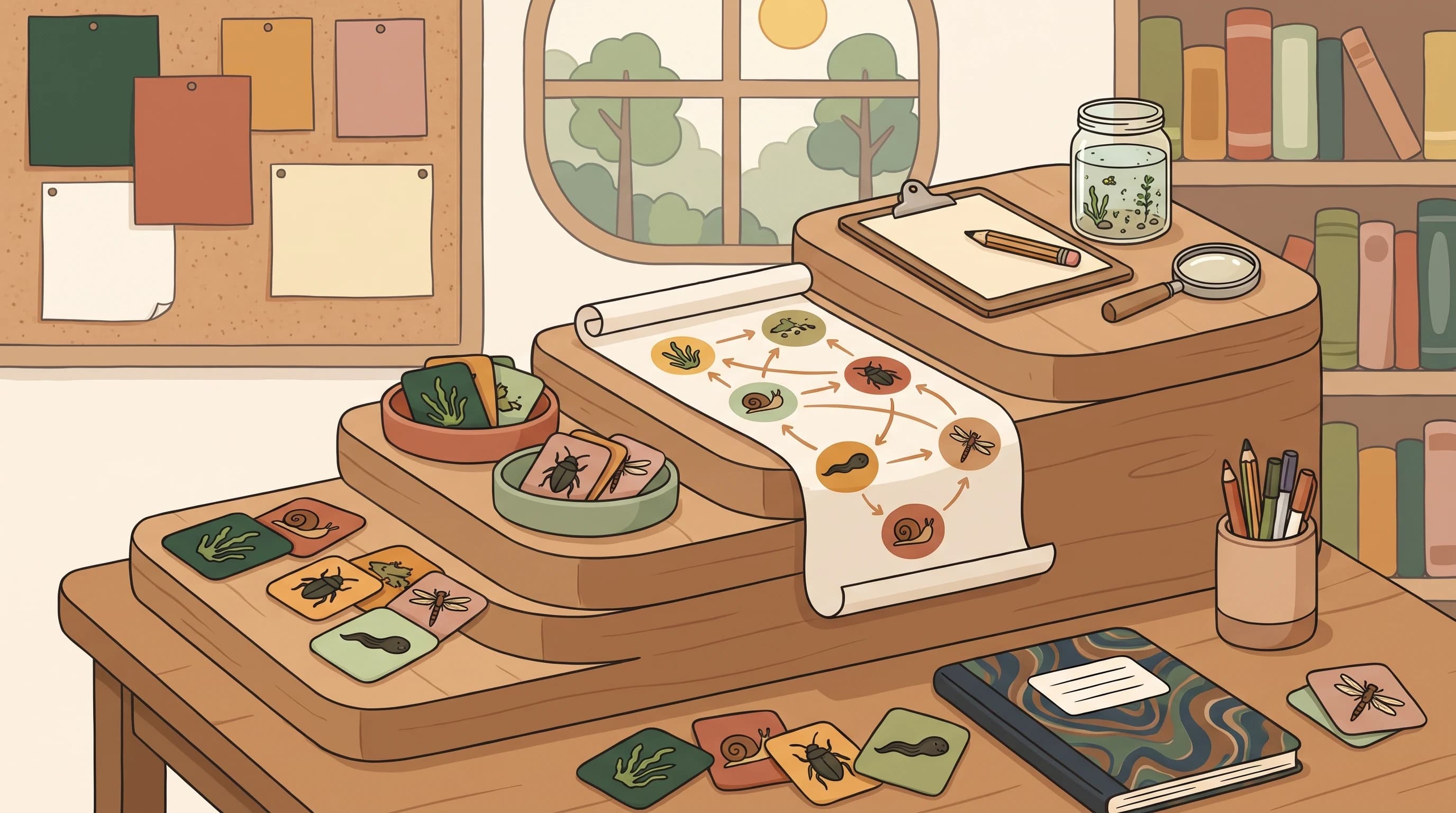
| 7 to 20 min | Build, DOK 2 | In groups of four, students sort 12 organism cards into three groups, then build a food web on chart paper from the diet notes. | Each group explains one sorting decision to the teacher. |
| 20 to 25 min | Gallery check | Groups compare webs and fix arrows that disagree with the diet notes. | Teacher marks webs with fewer than eight correct arrows for a quick conference. |
| 25 to 42 min | Stretch, DOK 3 | Each group receives a scenario: the frogs disappear from the pond. Students use their web and the population table to predict two effects and justify them in a claim, evidence and reasoning paragraph. | Teacher listens for “because” statements tied to specific arrows or numbers. |
| 42 to 50 min | Exit ticket, DOK 3 | Individual task: “If the algae died off, which organism would be affected last? Explain using the web.” | Sort tickets into: correct with reasoning, correct without reasoning, incorrect. |
Support at the same level: a sentence frame for the DOK 3 paragraph (“If ... disappeared, then ... would ... because the web shows ...”), and organism cards with diet arrows already started for two students who need it. The thinking demand stays at DOK 3.
Unit link to DOK 4: over the next two weeks, the class monitors a schoolyard habitat or aquarium, records observations, and proposes one change that would support more organisms. That extended task is where DOK 4 belongs.
For more ways to turn the exit ticket into next-day groups, see our exit ticket templates and examples.
What are the 4 DOK levels?
Webb’s four Depth of Knowledge levels are DOK 1 Recall, DOK 2 Skill/Concept, DOK 3 Strategic Thinking and DOK 4 Extended Thinking. They describe the complexity of the thinking a task requires, from recalling a fact to complex reasoning carried out over an extended period.
Is DOK the same as Bloom’s taxonomy?
No. Bloom’s names the type of cognitive process, usually the verb in an objective. DOK rates how complex the task around that verb is. The same verb can appear at several DOK levels, which is why verb wheels are not a reliable way to assign a level.
What is an example of a DOK 3 question?
“Which of these two plans is cheaper over a year, and what evidence supports your answer?” Students must reason, choose a method and justify the result with evidence, which matches the DOK 3 description.
Can a single lesson reach DOK 4?
Rarely. DOK 4 describes complex work that most likely takes an extended period. Plan lessons that climb to DOK 3 and place DOK 4 in a multi-day project or unit task.
Where can I find official DOK definitions for my subject?
Start with WebbAlign’s DOK definitions page, which lists documents for math, reading, science and social studies, then check your state department of education, since many states publish their own DOK guidance for state assessments.
Blog