How to Write a Lesson Plan: A 7-Step Guide for Teachers
A step-by-step method for writing a classroom-ready lesson plan in under 30 minutes, with three real K-12 examples and the components every plan needs.
A copyable Ontario lesson plan template built on curriculum expectations, learning goals, success criteria and assessment for, as and of learning, with a complete Grade 4 science lesson on food chains.
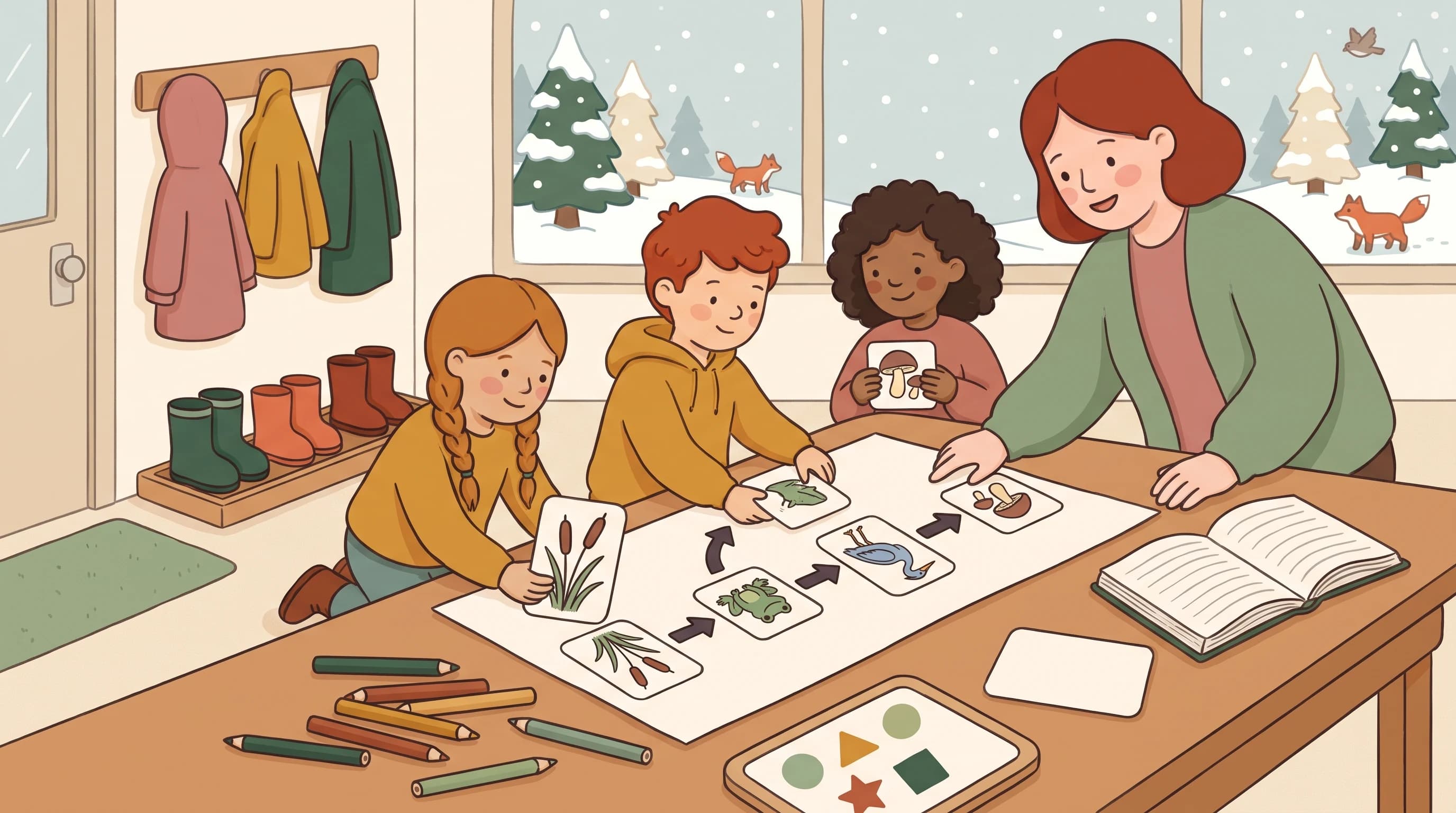
An Ontario lesson plan connects three things: the curriculum expectations you are teaching, the learning goals and success criteria you share with students, and the assessment you will use to see where they are. Those terms come from Growing Success, the ministry’s assessment, evaluation and reporting policy, and from the expectations published on the Curriculum and Resources site.
This page is for Ontario elementary teachers, teacher candidates on placement and occasional teachers. It explains each part of the plan in Ontario terms, gives a copyable template and walks through a complete Grade 4 science lesson. The ministry does not prescribe a lesson plan format, so if your faculty, associate teacher or school gives you one, keep its headings and use this page to fill them well.
Each Ontario curriculum document lists overall expectations (the broad learning for the grade, coded like B2) and specific expectations (the detailed learning under each one, coded like B2.3). Growing Success states that all expectations must be accounted for in instruction and assessment, while evaluation focuses on the overall expectations. In a lesson plan, name one or two specific expectations and the overall expectation they belong to.
Growing Success describes learning goals as statements of what students should know and be able to do, written in language students can understand and based on the curriculum expectations. They are shared at or near the beginning of a cycle of learning, then clarified through discussion. Many teachers write them as “We are learning to...” statements.
Success criteria describe in specific terms what achieving the learning goal looks like. Growing Success links them to the achievement chart and notes that they can become an assessment tool such as a checklist, a rubric or an exit card. They work best when students help build them, for example by looking at samples of work, and they can be revised as learning progresses. Many teachers write them as “I can...” statements.
| Purpose | What Growing Success says it is | In a single lesson |
|---|---|---|
| Assessment for learning | Gathering information to give descriptive feedback and coaching for improvement | Questioning, observation, exit card, mini whiteboards |
| Assessment as learning | Helping students set goals, monitor their own progress and reflect | Self-assessment against success criteria, peer feedback |
| Assessment of learning | Evaluation: judging the quality of learning against performance standards, often at the end of a period of learning | Usually not in a single lesson; planned for the end of the unit |
Each subject’s achievement chart has four categories (Knowledge and Understanding, Thinking, Communication and Application) and four levels, with level 3 described as the provincial standard. Growing Success asks teachers to assess in a balanced way across the categories, so noting which category a task targets helps over a whole unit.
Growing Success says evidence of achievement comes from observations, conversations and student products. Teachers often call this triangulation. A lesson plan can name which of the three you will collect, and from whom.
Copy this block into your daybook or a document. For a version with fillable fields, you can also start from the lesson plan template.
Copyable text
Copy includes the complete text. No signup needed.
ONTARIO LESSON PLAN
Teacher: Date: Duration:
Grade: Subject and strand:
Unit and lesson number:
CURRICULUM EXPECTATIONS
Overall expectation (code and short wording):
Specific expectation(s) (codes and short wording):
Curriculum document and year:
LEARNING GOAL (student-friendly)
We are learning to:
SUCCESS CRITERIA (co-constructed or shared)
I can:
I can:
I can:
ASSESSMENT
For learning (what, when, how I will give feedback):
As learning (how students self- or peer-assess):
Of learning (if any, or where this feeds the unit evaluation):
Evidence: observation / conversation / product
Achievement chart category: K/U T C A
MATERIALS AND PREPARATION
LESSON SEQUENCE
Minds On (hook and prior knowledge, minutes):
Action (teaching and practice, minutes):
Consolidation (sharing, reflection, minutes):
DIFFERENTIATION
Accommodations (IEP, English language learners):
Extension:
REFLECTION AND NEXT STEPS
What the evidence showed:
Change for next lesson:
The Minds On, Action and Consolidation structure is a common three-part lesson format in Ontario schools. It is a planning habit, not a ministry requirement, so swap in your own headings if your school uses a different model.
This is a complete fictional lesson for a Grade 4 class of 24 students, the third lesson in a Habitats and Communities unit. The expectations come from the Grade 4 Science and Technology strands page and the B2 specific expectations.
We are learning to explain how energy moves through a food chain in a local habitat.
Co-constructed in Minds On, then posted:
Assessment for learning: listen during turn and talk for students who already use the words producer and consumer. Note three names on the clipboard.
Assessment for learning: circulate with a checklist of the three success criteria. Ask each group one “what if” question and record the answer (conversation). Give descriptive feedback on the spot, for example: “Your arrows show who eats whom. Now check: does the arrow point to the eater?”
Assessment as learning: the notebook self-assessment and the gallery feedback. Assessment of learning: none in this lesson. Evaluation of B2 happens in the culminating habitat model in lesson 10, scored with a rubric built from the unit’s success criteria.
Sort the exit cards into three piles: all criteria met, arrows reversed, decomposers missing. Start lesson 4 with a two-minute fix-it task for the second and third groups, then move on to food webs. Our exit ticket templates and examples have more formats for this sorting step.
For a general walk-through of planning order, from objective to assessment to activities, see how to write a lesson plan. For verbs and wording that make learning goals measurable, see lesson plan objectives. To place this lesson in the year, the Ontario long range plan template shows where Habitats and Communities can sit in a Grade 4 calendar.
We did not find a ministry template. Growing Success sets the assessment vocabulary (learning goals, success criteria, assessment for, as and of learning), and faculties of education and schools build their own formats around it.
The learning goal says what students are learning. The success criteria describe what achieving it looks like, in terms specific enough to check with a checklist, rubric or exit card.
No. Growing Success describes evaluation as happening at strategic times, often at the end of a period of learning. Most single lessons focus on assessment for and as learning.
Give the code and a short version of the wording, such as “B2.3: classify organisms as producers, consumers or decomposers.” Check the current document on the Curriculum and Resources site, since several elementary subjects were revised between 2019 and 2023.
Blog