Lesson Plan Objectives: 3 Types, Bloom’s Verbs, and ABCD Examples
The 3 objective types are cognitive, affective, and psychomotor. Use the free builder, Bloom’s verb bank, and ABCD examples to write your own.
How to prepare a lesson plan for a demonstration teaching: how the demo is rated in DepEd Teacher I hiring, how to design objectives the panel can see, a complete Grade 5 Mathematics demo plan and a checklist for demo day.
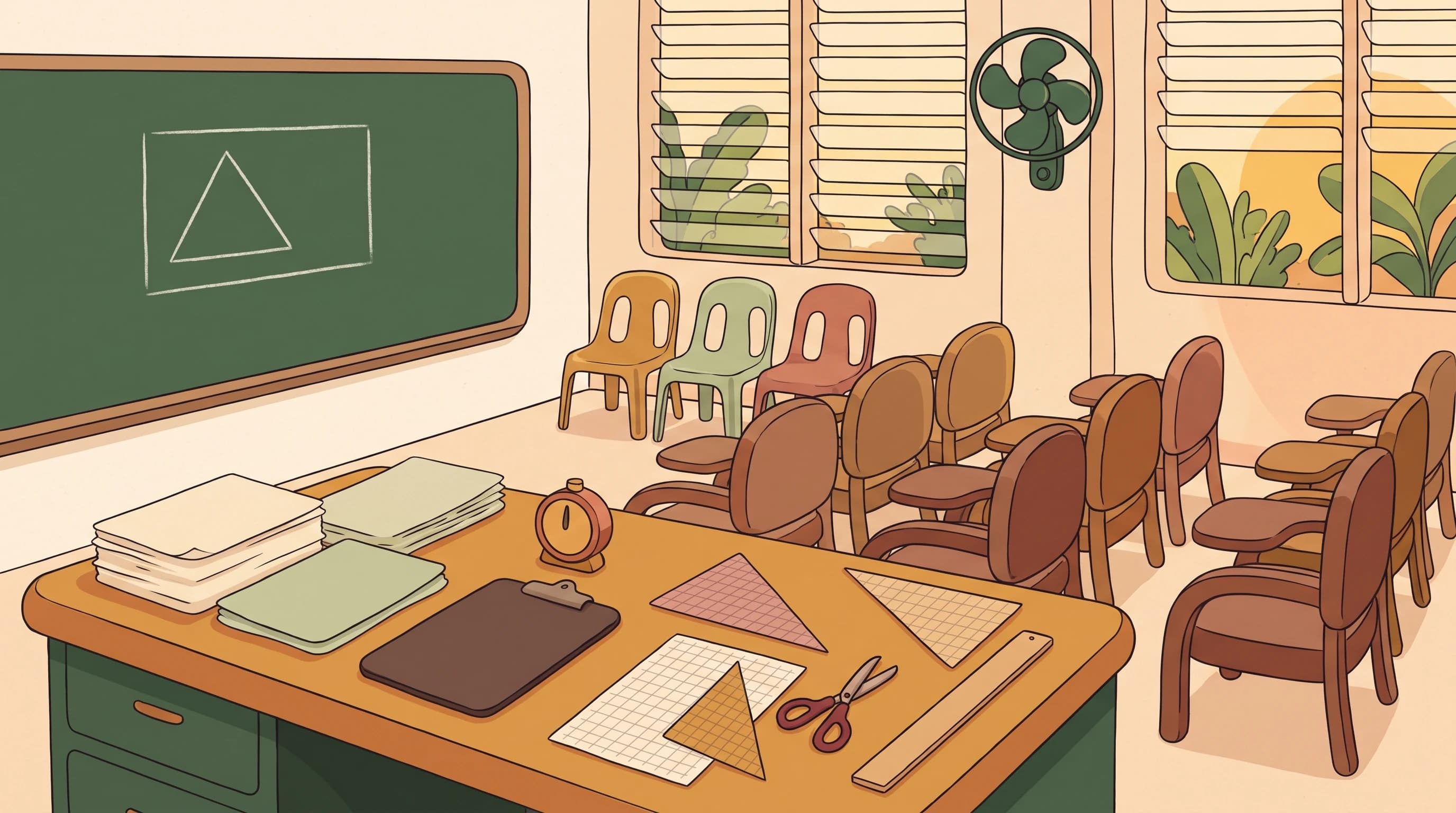
A demonstration teaching lesson plan is the plan you give the panel before you teach a sample lesson to real learners. In public school hiring in the Philippines, the demo is how the selection committee rates your classroom practice for a Teacher I position. In teacher education, it is the lesson your cooperating teacher or supervisor observes and grades. Either way, the plan has one job: make every skill the observers must rate easy to see.
This page explains how the demo is scored under the current DepEd hiring guidelines, how to design objectives a panel can check in one period, and gives a complete 50-minute demo plan with a checklist for demo day.
Teacher I hiring follows DepEd Order No. 7, s. 2023 (Guidelines on Recruitment, Selection and Appointment in the Department of Education), as amended by DepEd Order No. 21, s. 2024. Both are named as the basis of the SY 2026-2027 recruitment in Division Memorandum No. 017, s. 2026 of the Schools Division of Bulacan, which reproduces Enclosure 2 of DO 7, s. 2023, the criteria and point system for Teacher I. The facts below come from that enclosure. We could not open the order on deped.gov.ph when writing, so check the signed order and your own division memorandum.
| Criterion | Maximum points |
|---|---|
| Education, training, experience | 10 each |
| PBET, LET or LEPT rating | 10 |
| PPST classroom observable indicators (COIs), through classroom observation or demonstration teaching | 35 |
| PPST non-classroom observable indicators (NCOIs), through the Teacher Reflection Form | 25 |
| Total | 100 |
What the enclosure says about the demo:
The enclosure does not prescribe a lesson plan format. Use the one your division memorandum sets, if any. In DepEd schools, lesson planning now follows the ILAW framework of DepEd Order No. 016, s. 2026, which does not require a single national template (see our ILAW lesson plan format guide). The sample below uses the four ILAW parts with the 4As inside.
The middle column paraphrases each indicator; read the exact wording in the enclosure.
| Indicator | What it asks for | What your plan should make visible |
|---|---|---|
| 1.1.2 | Content knowledge applied within and across curriculum areas | Accurate content and terms, one link to another learning area |
| 1.4.2 | Strategies that build literacy and numeracy | Learners read, explain in words and compute, not only listen |
| 1.5.2 | Strategies for critical, creative and higher-order thinking | Why and how questions, a task with more than one answer |
| 4.1.2 | A developmentally sequenced lesson that meets curriculum requirements | The competency, a logical sequence, realistic minutes |
| 5.1.2 | Diagnostic, formative and summative assessment consistent with the curriculum | A pre-check, checks during the lesson, an evaluation with a key |
Indigenous Peoples Education (IPEd) applicants are observed on 1.1.2, 1.4.2, 1.6.2 (Mother Tongue, Filipino and English), 3.5.2 (culturally appropriate strategies for learners from indigenous groups) and 5.1.2. The other 25 points come from the Teacher Reflection Form, a written task on indicators 6.1.2, 6.3.2, 7.2.2 and 7.3.2, given 45 minutes to one hour. The division PPST-COI and PPST-NCOI information page calls these the demonstration teaching and teacher reflection evaluations.
Student teachers: your college uses its own rating sheet. Ask for it early and plan against its criteria the same way.
Your objectives decide what the panel looks for. A demo objective passes one test: can an observer see it happen, and see it checked, within this period?
| Weak demo objective | Stronger version |
|---|---|
| Understand the area of a triangle. | Given the base and height, compute the area of a triangle, with at least 4 of 5 items correct. |
| Appreciate the importance of fractions. | Explain in one sentence why two strips of the same length name equivalent fractions. |
| Learn about the parts of a plant. | Label the root, stem, leaf and flower on a real plant and state one function of each. |
| Participate actively in the discussion. | Give one reason with a “because” sentence during the pair discussion. |
Fill this grid before writing the procedure:
Copyable text
Copy includes the complete text. No signup needed.
OBJECTIVE-TO-EVIDENCE GRID
Competency (with code): _____________________________
Objective | Practised in step | Checked by | Success criterion | Indicator
1. ______ | ________ | ________ | ________ | ____
2. ______ | ________ | ________ | ________ | ____
3. ______ | ________ | ________ | ________ | ____
Indicators not yet visible in any step: _____________
Fill it in the order objectives, evaluation, then learning experience. Remove the indicator column from the panel copy if your division sets a format.
Copyable text
Copy includes the complete text. No signup needed.
DEMONSTRATION TEACHING LESSON PLAN
Name: __________ Position or course: __________ Date and time: ______
Grade and section: ______ Learning area: ______ Duration: ______
I. INTENTIONS
Learning competency (with code): ______________________
Objectives (2 to 3, observable): a) ____ b) ____ c) ____
Why the lesson matters: _______________________________
Materials and references: ____________________________
L. LEARNING EXPERIENCE
Step | Minutes | Activities | Key questions | Indicator
Diagnostic check, Activity, Analysis, Abstraction, Application
Support for learners who need help: ___________________
Extension for early finishers: ________________________
A. ASSESSING LEARNING
Items per objective, answer key, success criterion: ____
W. WAYS FORWARD (after teaching)
Learners who met the objectives: ____ of ____
Remediation, reteaching or enrichment: ________________
If your college asks for the five-part format (Objectives, Subject Matter, Procedure, Evaluation, Assignment), the same content fits: see the detailed lesson plan for the scripted version and the semi-detailed lesson plan for the shorter one.
An illustration of a teacher-made plan for a 50-minute lesson; no classroom results are claimed. Replace the competency with the exact wording and code from your curriculum guide.
I. Intentions
L. Learning Experience
| Step | Min | Activities and key questions | Indicator |
|---|---|---|---|
| Diagnostic check | 5 | Learners find the area of three rectangles (5 cm by 3 cm, 8 cm by 6 cm, 10 m by 4 m) on 1/4 sheets; note who struggles. | 5.1.2 |
| Activity | 10 | Pairs cut their rectangle along a diagonal and compare the two triangles. Then they draw a triangle with the same base and a top vertex anywhere on the top side, cut off the two outside pieces and fit them onto the triangle. | 1.4.2, 4.1.2 |
| Analysis | 8 | What is the rectangle’s area? How do the two triangles compare? Did the outside pieces cover the triangle exactly? What does that say about any triangle? | 1.5.2 |
| Abstraction | 7 | Learners state the rule in their own words; the class writes: area = (base x height) ÷ 2, in square units. The teacher stresses that height is perpendicular to the base and links to Science: planting beds are measured the same way. | 1.1.2 |
| Application | 10 | Pairs read aloud and solve: “A triangular garden plot has a base of 6 m and a height of 4 m. What is its area?” They underline the given facts and answer in a sentence. Challenge: draw two different triangles with an area of 12 square centimeters and explain why both work. | 1.4.2, 1.5.2 |
| Evaluation | 7 | Five items (below). | 5.1.2 |
| Closure | 3 | One learner restates the rule; assignment given. | 4.1.2 |
The minutes add up to 50. Support: learners who missed diagnostic items count squares on a grid card. Extension: find the base when the area and height are given.
A. Assessing Learning
Items: (1) base 10 cm, height 4 cm; (2) base 7 m, height 6 m; (3) a right triangle with legs of 5 cm and 8 cm; (4) area 30 square centimeters, base 10 cm: find the height; (5) explain in one sentence why we divide by 2. Key: 20 square centimeters; 21 square meters; 20 square centimeters; 6 cm; a triangle is half of a rectangle with the same base and height. Success: 4 of 5 correct. Objective (a) is also checked during the Analysis, objective (c) through the Application sentence.
Assignment. Measure the base and height of a triangular shape at home and compute its area, answering in a sentence.
W. Ways Forward (after teaching). Learners who met the objectives: ____ of ____. Reteach with grid cards and two more items; enrichment on composite figures.
Each observed indicator appears in at least one step, and every objective has a check. That is what the panel can rate.
What is a demonstration teaching in DepEd hiring?
The classroom observation part of the Teacher I comparative assessment. Under Enclosure 2 of DO 7, s. 2023, two or three observers rate five PPST classroom observable indicators with the COT-RSP, for up to 35 of 100 points.
How long is a demo teaching?
The enclosure highly recommends the whole period, 45 minutes to one hour, and allows at least 15 minutes when logistics prevent it. Your division memorandum sets the schedule.
What lesson plan format should I use for my demo?
The hiring enclosure does not prescribe one. Follow your division memorandum; otherwise a clear ILAW, detailed or semi-detailed plan works.
How do I write objectives for demo teaching?
Write two or three observable objectives tied to the competency, put one above recall, and pair each with the task that checks it during the period.
Can the demo be done online?
The enclosure allows online observation when face-to-face is not feasible, under the same protocols.
Blog