Frayer Model: Free Template, 4 Filled Examples and How to Teach It
What the Frayer model is, how to teach it in four steps, a free printable and editable template, and filled examples for math, science, ELA and geography.
Draft My Lesson Team

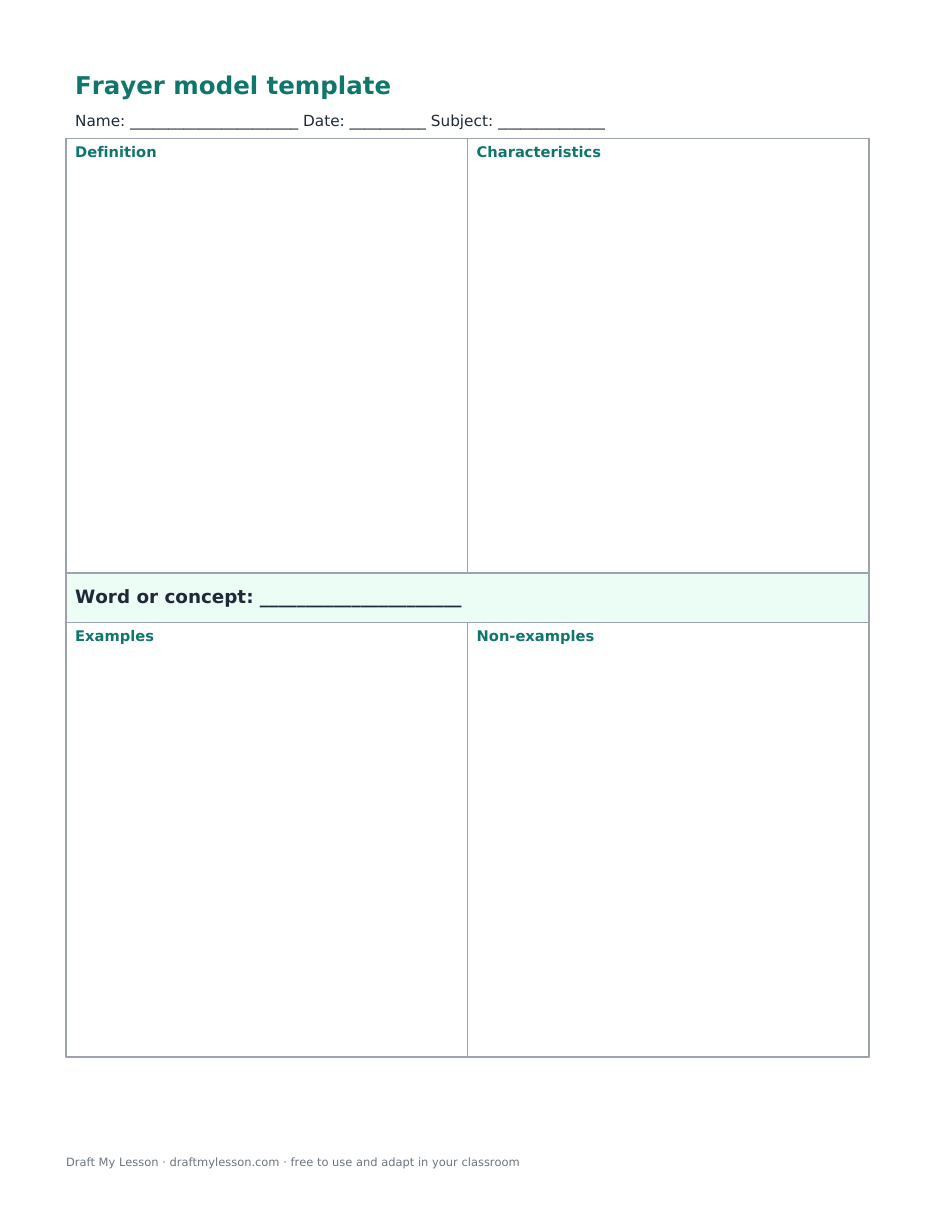
The short answer: The Frayer model is a four-square graphic organizer for learning a word or concept. The term goes in the center, and students fill four boxes around it: definition, characteristics, examples and non-examples. The non-examples are what make it work: deciding why something does not belong forces students to use the defining features instead of memorizing a sentence.
Key takeaways
- It comes from a 1969 working paper by Dorothy Frayer, Wayne Frederick and Herbert Klausmeier at the University of Wisconsin, on how to teach and test concept mastery.
- Use it for concepts with clear features (prime number, mammal, metaphor, peninsula), not for every word on a vocabulary list.
- Teach the first one together, then let students complete one in pairs before asking for one alone.
- The best non-examples are near misses: a simile for metaphor, a shark for mammal, 9 for prime number.
Free Frayer model template (PDF and Word)
Download the printable Frayer model template (PDF) or the editable Word version. The file has three pages: a full-page organizer, two organizers per page for quick vocabulary practice, and a version with a picture box for younger students. The four filled examples (Word) match the examples below. No account is needed.
To use it in Google Docs, upload the Word file to Google Drive, right-click it and choose Open with > Google Docs. Students can then type in each box or insert an image into the picture box.

What is the Frayer model?
The Frayer model is named after Dorothy Frayer, the first author of A Schema for Testing the Level of Concept Mastery (Frayer, Frederick and Klausmeier, 1969), a working paper of the Wisconsin Research and Development Center for Cognitive Learning. The authors described what a student must be able to do to show they have mastered a concept: name its relevant attributes, tell them apart from irrelevant ones, and recognize examples and non-examples.
Teachers later turned those tasks into the familiar four-square organizer. You will see two common versions:
| Version | Four boxes | Best for |
|---|---|---|
| Classic | Definition, characteristics, examples, non-examples | Most concepts in grades 3-12 |
| Essential and non-essential | Essential characteristics, non-essential characteristics, examples, non-examples | Concepts where students confuse "usually true" with "always true" (for example, mammals usually give birth to live young, but this is not essential) |
| Picture | Definition in my own words, picture, examples, non-examples | Grades K-3, English learners, concrete nouns |
The template above includes the classic and picture versions. To get the essential/non-essential version, rename the top two boxes.
How to teach the Frayer model in four steps
1. Choose the right concept. The model takes time, so save it for words that carry a unit: photosynthesis, democracy, ratio, theme. A word with a simple synonym does not need four boxes.
2. Model one completely (I do). Fill an organizer in front of the class and think aloud, especially for the non-examples: "Is 9 prime? It is odd, but it has three factors: 1, 3 and 9. So it goes in non-examples."
3. Complete one together, then in pairs (we do, you do together). Give the term and two examples, and let students argue about where the rest go. Disagreements about near misses are the most useful part of the lesson. This sequence follows the I do, we do, you do model.
4. Ask for one alone and check it. A finished organizer is quick evidence. A student who lists "has fur" as the definition of mammal and "dog, cat, hamster" as the only examples has a narrow concept. A student who puts whale in examples and penguin in non-examples, and can explain why, has the concept.
Frayer model examples
The four examples are in the downloadable file and are written for the grade levels shown.
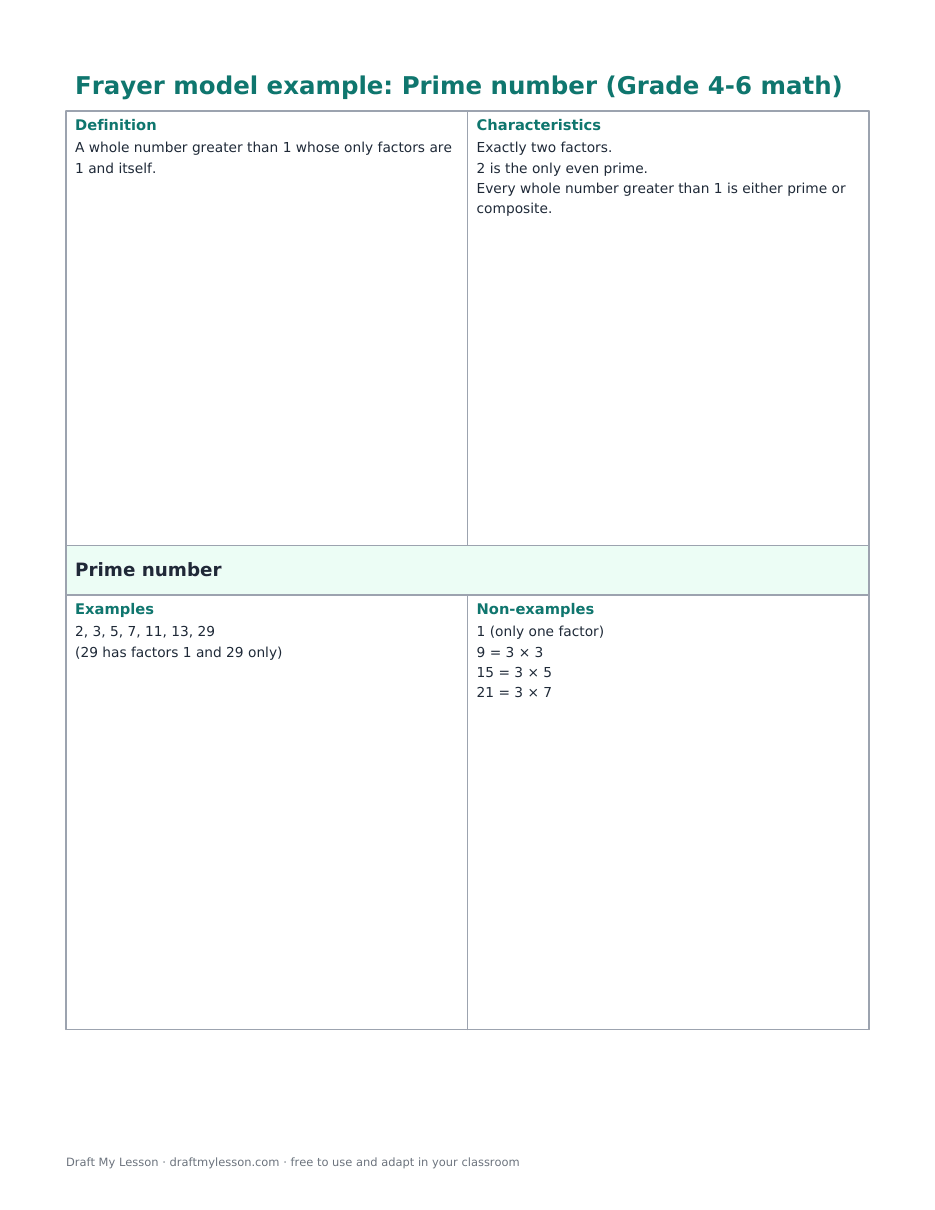
Math: prime number (grades 4-6)
| Box | What students write |
|---|---|
| Definition | A whole number greater than 1 whose only factors are 1 and itself. |
| Characteristics | Exactly two factors. 2 is the only even prime. Every whole number greater than 1 is either prime or composite. |
| Examples | 2, 3, 5, 7, 11, 13, 29 |
| Non-examples | 1 (only one factor), 9 = 3 × 3, 15 = 3 × 5, 21 = 3 × 7 |
Science: mammal (grades 3-5)
| Box | What students write |
|---|---|
| Definition | An animal that has hair or fur and feeds its young with milk. |
| Characteristics | Breathes air with lungs. Keeps a steady body temperature (warm-blooded). Has hair at some stage of life. Most give birth to live young; the platypus and echidnas lay eggs. |
| Examples | dog, human, bat, whale, platypus |
| Non-examples | shark (fish), penguin (bird), frog (amphibian), lizard (reptile) |
ELA: metaphor (grades 4-8)
| Box | What students write |
|---|---|
| Definition | A figure of speech that describes something by saying it is something else, without "like" or "as". |
| Characteristics | Compares two unlike things. Not literally true. Shows a quality of the first thing. |
| Examples | "The classroom was a zoo." "Time is a thief." |
| Non-examples | "The classroom was as loud as a zoo." (simile), "The classroom was noisy." (literal), "I have told you a million times." (hyperbole) |
Geography: peninsula (grades 3-6)
| Box | What students write |
|---|---|
| Definition | A piece of land almost surrounded by water but connected to a larger landmass. |
| Characteristics | Water on most sides, often three. Joined to the mainland by land. Can be small or very large. |
| Examples | Florida, Italy, the Iberian Peninsula, the Korean Peninsula |
| Non-examples | Madagascar (an island, water on all sides), the Isthmus of Panama (a narrow strip joining two larger landmasses), a lake |
Variations that keep it useful
- Frayer wall: each group completes one concept from the unit, and the class gallery becomes a reference wall.
- Sort first, then fill: give students a pile of cards (examples and near misses) to sort before they write a definition. They build the definition from the sort.
- Exit ticket version: give only the non-examples box: "Name two non-examples of peninsula and say why." It takes three minutes and shows whether the concept is precise. More quick checks are in our exit ticket examples.
- Before and after: students complete the definition box on day 1, then revise it at the end of the unit with a different color.
Common mistakes
- Copying the glossary definition. Ask for the definition in the student's own words, or fill the definition box last.
- Easy non-examples. "A car" is a non-example of mammal, but it teaches nothing. Choose things students might actually confuse.
- Using it for every word. Ten Frayer models a week becomes busywork. One or two per unit, for the central concepts, is enough.
- Never using the finished organizers. Have students refer back to them in discussion and writing, or the time is lost.

Plan the whole vocabulary lesson
The template covers the organizer. If you want the lesson around it, the Draft My Lesson lesson generator drafts an editable lesson plan with objectives, activities, practice and an assessment from your topic, grade and duration. Add the Frayer model to the guided practice, and review the content and timing before teaching. Your free account includes two complete lessons.
Frequently asked questions
What are the four parts of the Frayer model?
The four boxes are definition, characteristics (or facts), examples and non-examples, arranged around the word or concept in the center. Some versions split characteristics into essential and non-essential, and versions for young children replace characteristics with a picture.
Is the Frayer model evidence-based?
It comes from research on concept learning, and it combines practices that vocabulary research supports: defining a word, connecting it to examples, and contrasting it with near misses. Most studies test it as part of a broader vocabulary program rather than on its own, so treat it as a sound routine for key concepts rather than a guaranteed fix.
How do I make a Frayer model in Google Docs?
Upload the Word template from this page to Google Drive and open it with Google Docs, or insert a 2 × 2 table, type the word in a centered text box or a merged middle row, and label the four cells. Share it with students as a copy so each one gets an editable version.
What grade level is the Frayer model for?
It works from about grade 2 through high school. For kindergarten to grade 2, use the picture version and complete it together. In middle and high school, use it for subject concepts such as ratio, photosynthesis or federalism.
What are the disadvantages of the Frayer model?
It is slow, so it does not suit long word lists. It also works poorly for abstract words without clear examples. For those, a semantic map or a short discussion of word parts may be faster.
More lesson planning tools
- KWL chart: activate prior knowledge before a unit.
- Bloom's taxonomy verbs: write the objective for a vocabulary lesson.
- Lesson plan template: daily, elementary, secondary and subject templates in Word and PDF.
Related articles
KWL Chart: Free Template, a Filled Example and How to Use It Well
What a KWL chart is, how to run each column so it actually drives learning, free KWL, KWHL and KWL+ templates, and a filled science example.
Read articleBloom's Taxonomy Verbs: 150 Action Verbs by Level, With Question Stems
A complete list of Bloom's taxonomy verbs for the six revised levels, with question stems, sample objectives and a free printable verb chart.
Read articleLesson Plan Objectives: 3 Types, Bloom's Verbs, and ABCD Examples
The 3 objective types are cognitive, affective, and psychomotor. Use the free builder, Bloom's verb bank, and ABCD examples to write your own.
Read articleI Do, We Do, You Do: The Gradual Release Model With a Template and Example
How the "I do, we do, you do" gradual release model works, where it comes from, when to move to the next phase, a free lesson plan template and a complete Grade 7 math example.
Read article