TEKS Lesson Plans: A Practical Guide for Texas Teachers
Turn a current Texas Essential Knowledge and Skills student expectation into an objective, learning sequence and assessment without treating the code as a decorative label.
Draft My Lesson Team
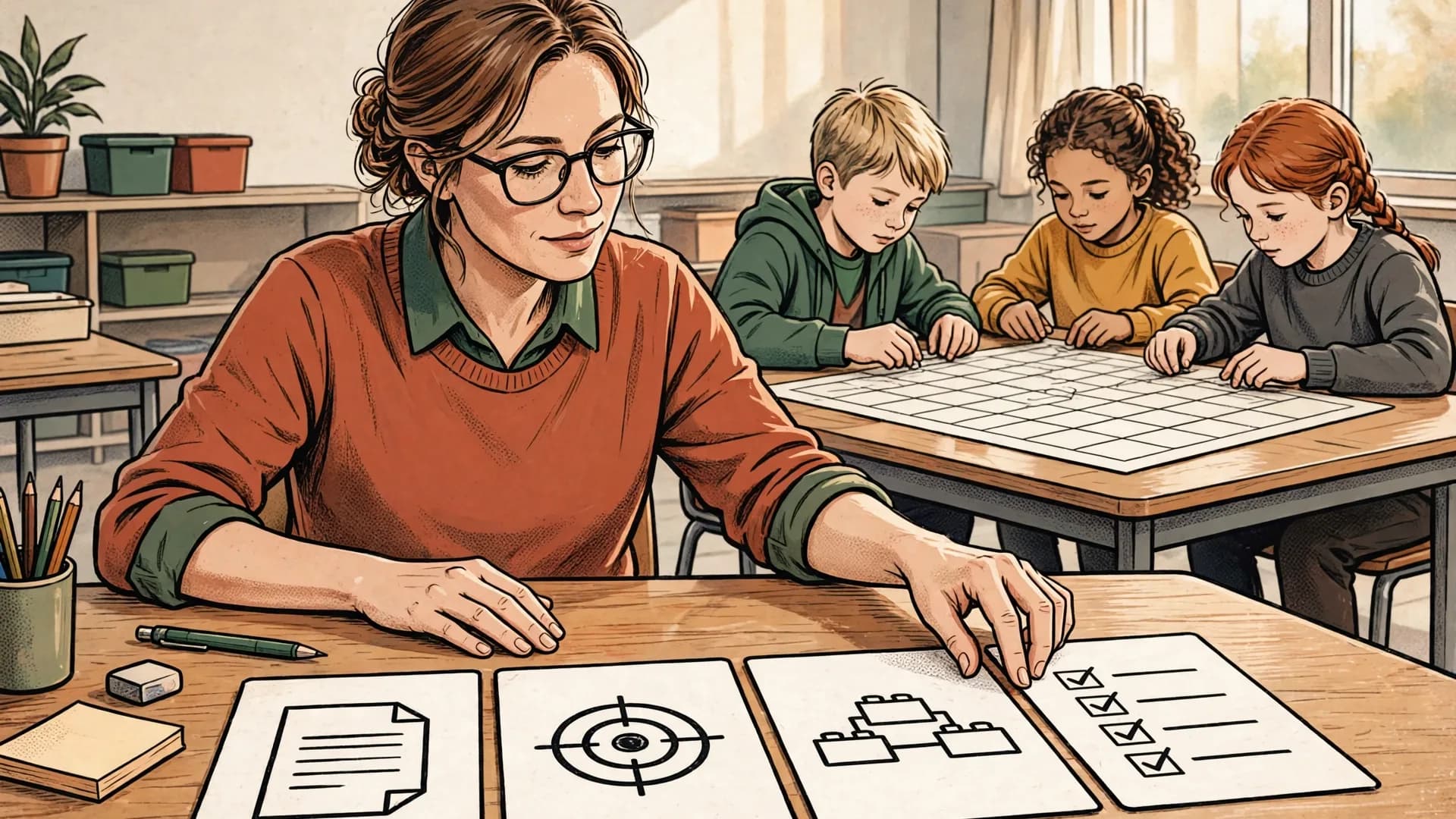
A TEKS lesson plan is not aligned because a code appears in the header. The standard has to shape what students do, what evidence you collect and what you assess.
The Texas Education Agency defines the Texas Essential Knowledge and Skills as the current state standards for what students learn in each grade or course. TEA publishes the standards by subject chapter and also provides elementary compilations by grade. That makes the official source the starting point, not a standards summary copied from a worksheet marketplace.
This guide gives you a repeatable TEKS-to-lesson workflow and a complete worked example. Draft My Lesson's Texas curriculum profile can use verified official context within the Texas scope, but you remain responsible for the final standard selection, district sequence and lesson.
The short version
- Verify the current TEKS in the TEA source.
- Separate the knowledge-and-skills statement from the student expectation.
- Turn the expectation's verb and content into observable evidence.
- Plan instruction and practice that lead to that evidence.
- Check the final draft against local scope, sequence and assessment requirements.
What a TEKS reference contains
A usable TEKS reference has more than a short code. Record these five parts before you plan:
| Field | What to capture | Why it matters |
|---|---|---|
| Grade or course | The exact grade level or named course | A similar code in another grade may expect different depth. |
| Subject and chapter | For example, Chapter 111 for mathematics | It confirms that you are in the correct official document. |
| Strand | The larger content area | It places the expectation in its progression. |
| Knowledge and skills statement | The sentence introducing the numbered item | It explains the concept students are developing. |
| Student expectation | The lettered expectation students must demonstrate | Its verb and content should drive the evidence. |
TEA notes that statements using “including” identify content that must be mastered, while “such as” introduces possible examples. That distinction affects planning. You may replace an illustrative example, but you should not silently remove required content.
The TEKS-to-lesson planning workflow
1. Verify the current official text
Open the TEA TEKS catalogue and select the current grade or subject document. Check the implementation and revision information in that document. Do not rely on a code from last year's slide deck without checking it.
Copy the reference into your planning notes, then paraphrase the expectation in your own words. Keeping both helps you spot a mismatch before it reaches the lesson.
2. Identify the expected student action
Underline the verb. “Identify,” “model,” “compare,” “explain” and “design” require different evidence.
- If students must identify, a correct selection or label may be enough.
- If students must model, they need a representation, not only a verbal answer.
- If students must compare, the task needs at least two cases and a basis for comparison.
- If students must explain, the assessment must capture reasoning.
- If students must design, students need constraints, a product and criteria.
This is where many TEKS lesson plans drift. A standard asks students to explain, but the exit ticket asks them to circle an answer. The topic matches; the evidence does not.
3. Write the objective and success criteria
Use one objective that combines the required action, content and conditions.
Planning frame: By the end of the lesson, students will [TEKS verb] [required content] by [student product or performance].
Then write two or three success criteria students can use while working. Our lesson plan objectives guide explains how to keep objectives measurable without turning them into rigid scripts.
4. Decide the final evidence before choosing activities
Ask: what would convince me that a student met this expectation today?
Choose one final product or performance. It might be an annotated model, a worked problem with reasoning, a short constructed response, an investigation record or an oral explanation captured with a checklist. Then plan backward from that evidence. The backward design lesson plan guide gives you the full unit-level method.
5. Sequence instruction, practice and assessment
A dependable sequence is:
- Opening check: reveal prerequisite knowledge or a likely misconception.
- Model or investigation: make the target concept visible.
- Guided practice: let students try the expected action with feedback.
- Independent application: remove enough support to see what each student can do.
- Assessment: collect evidence using the same kind of action named in the expectation.
This sequence is not mandated by TEKS. It is a planning structure that keeps the standard, teaching and evidence connected.
Complete example: Grade 4 mathematics
This 55-minute example uses Grade 4 mathematics student expectation 4.4(A). In the current TEA Grade 4 compilation, the expectation asks students to add and subtract whole numbers and decimals through hundredths using the standard algorithm.
Lesson title: Find and fix the checkout error
Grade and subject: Grade 4 mathematics
TEKS: §111.6, 4.4(A)
Duration: 55 minutes Prerequisite: Place value through hundredths and alignment of decimal places
Objective: Students will add and subtract decimals through hundredths using the standard algorithm and explain how place-value alignment prevents errors.
Success criteria:
- I align digits by place value before calculating.
- I calculate accurately through the hundredths place.
- I can explain and correct a misplaced-digit error.
Materials: Three fictional store receipts, place-value grids, dry-erase boards, pencils and an exit ticket.
| Time | Lesson move | Evidence to collect |
|---|---|---|
| 0-6 min | Display 8.40 + 2.75 = 10.115. Students decide whether the total is reasonable and mark where the work went wrong. | Initial explanations reveal whether students use place value or only recompute. |
| 6-14 min | Model one addition and one subtraction with a place-value grid. Connect each written column to ones, tenths and hundredths. | Students annotate why decimal points align. |
| 14-27 min | Pairs audit two fictional receipts. Each receipt contains one correct line and one alignment error. | Teacher checklist: setup, computation, explanation. |
| 27-40 min | Guided practice with three problems. Pause after each setup so students compare alignment before calculating. | Whole-class scan of written setups. |
| 40-49 min | Independent task: calculate a basket total, subtract a coupon and write a two-sentence justification. | Individual work on the full expectation. |
| 49-55 min | Exit ticket: correct 12.5 - 3.78 from an intentionally misaligned example and explain the correction. | Final evidence includes both accurate calculation and explanation. |
Assessment rule: A student has not yet met the lesson objective if the answer is correct but the written setup shows unreliable place-value alignment. That student needs another example that makes the structure visible, not just another page of computation.
Support: Provide a place-value mat and pre-drawn vertical columns. Read the receipt context aloud where language is a barrier. Keep the mathematical expectation unchanged.
Extension: Ask students to create a plausible incorrect receipt line, exchange it with a partner and explain the exact place-value error.
A copyable TEKS lesson plan template
Use this planning block for any grade or subject:
Lesson title:
Grade/course and subject:
Official TEKS source checked on:
TEKS chapter and section:
Strand:
Knowledge and skills statement:
Student expectation:

Objective:
Success criteria:
Prerequisite check:
Final evidence:

Opening:
Instruction or investigation:
Guided practice:
Independent application:
Assessment:

Supports that preserve the expectation:
Extension:
District or campus requirements to confirm:
For more planning fields and filled examples, use the lesson plan template.

Common TEKS alignment mistakes
Choosing the activity before the expectation. A fun activity can fit the topic while missing the required student action. Decide the evidence first.
Listing too many expectations. A 50-minute lesson rarely produces strong evidence for six substantial student expectations. Identify the primary expectation and label supporting expectations only when they are genuinely taught or assessed.
Assessing a weaker verb. If the expectation says explain, a selected-response question can check knowledge but cannot be the only evidence.
Treating TEKS as the entire local curriculum. TEKS define state learning expectations. Districts and schools still organise scope, sequence, resources, pacing and local assessments.
Copying a code without checking the current document. Revisions and implementation dates matter. Always return to TEA before reusing a plan.
Use the Texas profile without giving up teacher control
Confirm the official expectation and keep your local requirements beside it. Then create a Draft My Lesson account and choose the Texas profile. Give the generator the topic, grade, duration, selected expectation, evidence you want and any campus constraints.
Review the output in the same order you planned it: exact expectation, objective, evidence, sequence and assessment. A generated draft is useful when it makes that review faster. It is not a substitute for it.
Related articles
Kindergarten TEKS Lesson Plan: Addition and Subtraction Within 10
A complete Texas kindergarten mathematics lesson aligned to TEKS K.3(B), with concrete models, drawings, word problems and an observable exit task.
Read articleMath TEKS Lesson Plan: Grade 4 Decimal Operations
A complete Grade 4 Texas math lesson for TEKS 4.4(A), with place-value models, receipt-error analysis, independent evidence and targeted supports.
Read articleScience TEKS Lesson Plan: Grade 5 Light Investigation
A complete Grade 5 Texas science lesson for TEKS 5.8(C), using stations to investigate light travelling, reflecting, refracting and being absorbed.
Read articleThe 5E Lesson Plan: A Practical Guide for K-12 Teachers
The 5E model (Engage, Explore, Explain, Elaborate, Evaluate) is the most widely used inquiry framework in US K-12 science. Here is what each phase looks like, where it works, and two full worked examples.
Read article