Science TEKS Lesson Plan: Grade 5 Light Investigation
A complete Grade 5 Texas science lesson for TEKS 5.8(C), using stations to investigate light travelling, reflecting, refracting and being absorbed.
Draft My Lesson Team
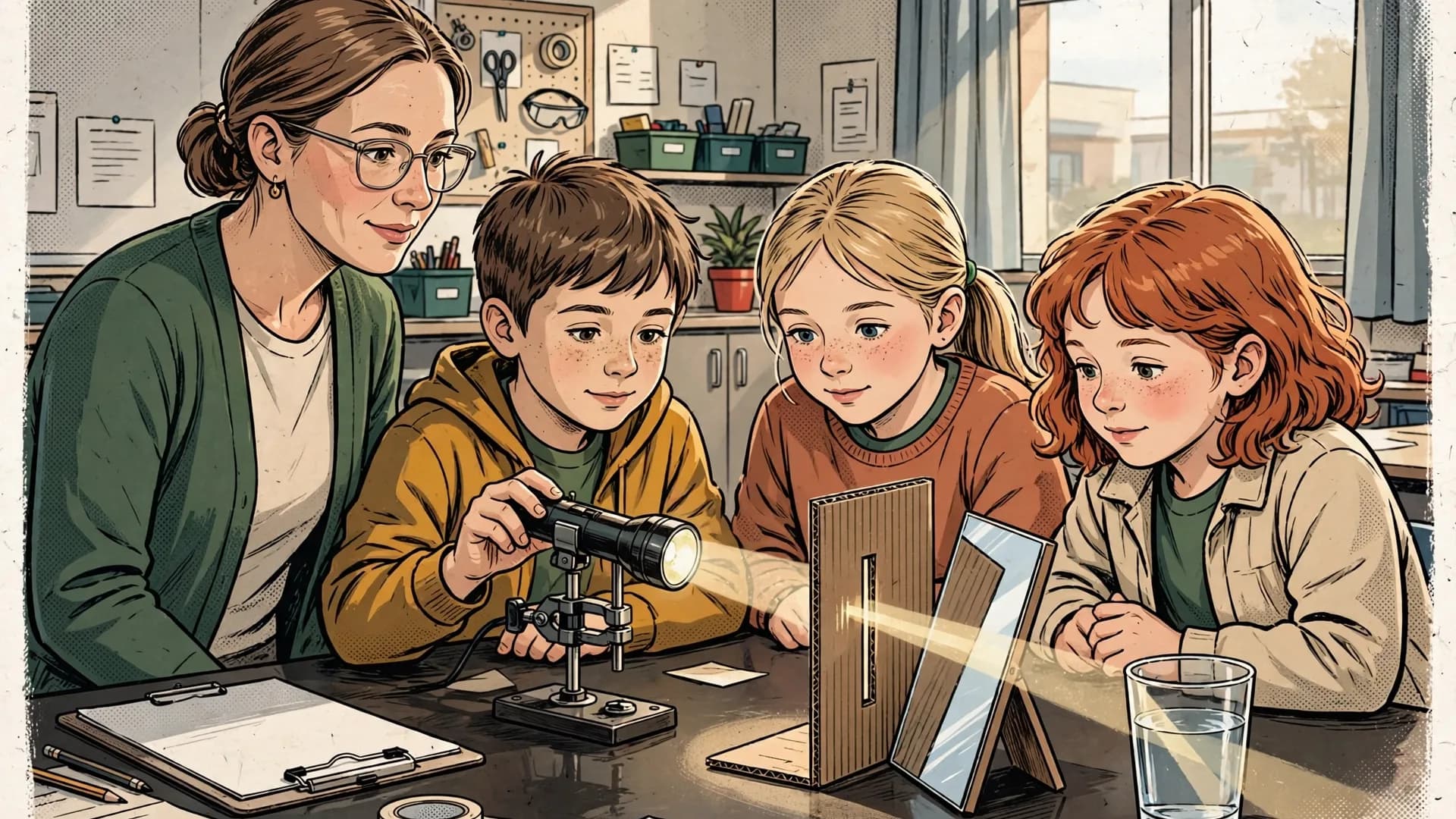
A flashlight-and-mirror activity is not automatically a TEKS investigation. Students need to observe distinct interactions, record evidence and explain what happened to the light in each case.
This complete Grade 5 lesson uses science student expectation 5.8(C). In the Texas Education Agency Grade 5 compilation, students demonstrate and explain that light travels in a straight line and can be reflected, refracted or absorbed. The current science standards were adopted in 2021 and implemented for the 2024-25 school year.
TEA's current Chapter 112 page identifies Grade 5 science as Section 112.7, and the agency's implementation table places the revised Kindergarten-Grade 5 science TEKS in 2024-25. Recheck both before the article's publication date.
The lesson combines a short phenomenon, four investigation stations, a shared model and an individual explanation. Confirm the current source and local laboratory-safety rules before teaching.
Lesson overview
Title: Where did the light go?
Grade and subject: Grade 5 science
TEKS: §112.7, 5.8(C), supported by scientific and engineering practices 5.1 and 5.3
Duration: 60 minutes
Grouping: Teams of three at stations, then individual assessment
Materials: LED flashlights, index cards with small holes, mirrors, clear cups of water, pencils, black and white paper, aluminium foil, station cards and goggles where locally required
Safety: Use cool LED flashlights. Students must never shine a light into anyone's eyes. Keep water in stable clear cups away from electrical outlets and devices. Follow district requirements for room darkening and protective equipment.
Objective: Students will use observations from four stations to demonstrate and explain that light travels in a straight line and may be reflected, refracted or absorbed when it meets different materials.
Success criteria:
- I record what I changed and what I observed.
- I identify the light interaction shown at each station.
- I use a labelled ray or path model to support my explanation.
- I distinguish evidence from a guess.

Set up four evidence stations
Station 1: straight-line travel
Stand three index cards upright, each with a small hole at the same height. Place a flashlight behind the first card and a target behind the third. Students first align the holes, then move the middle card sideways.
Observation to seek: Light reaches the target only when the openings share a straight path.
Station 2: reflection
Place a mirror on a marked angle line. Students aim a flashlight beam at it and adjust the mirror until the reflected spot reaches two different targets.
Observation to seek: Light changes direction after meeting the mirror and remains visible on a new target.
Station 3: refraction
Place a pencil in a clear cup of water. Students view it from the side and from above. They draw what the pencil appears to do at the water surface.
Observation to seek: The pencil appears displaced or bent because light changes direction as it passes between air and water.
Station 4: absorption and comparison
Shine the same flashlight from the same distance onto black paper, white paper and aluminium foil. Students compare the visible return of light without touching materials to judge temperature.
Observation to seek: The black surface returns less visible light to the viewer; the white paper returns more scattered light; foil produces a stronger directional reflection. Keep the claim to observed visible light unless you use instruments to measure another energy change.
Complete 60-minute sequence
Engage with a blocked beam (0-7 minutes)
Aim an LED flashlight through one card hole at a wall target. Insert a second card so its hole is out of line and the target disappears.
Ask students to sketch a possible light path and answer: “What would have to be true for the spot to return?” Collect two or three competing ideas without confirming one.
This opening creates a testable question. It does not pre-teach all four interaction terms.
Establish the investigation record (7-13 minutes)
Model the four-column station table:
| Station | What we changed | What we observed | Best explanation |
|---|---|---|---|
| Example | Moved the middle card | Spot disappeared | Light did not bend around the blocked path |
Assign team roles: materials manager, investigator and recorder. Students rotate roles at every station.
Rotate through stations (13-37 minutes)
Allow six minutes per station, including movement. At each station students must:
- follow the setup card;
- change one named part;
- record a direct observation;
- draw the light path;
- select straight-line travel, reflection, refraction or absorption and justify the choice.
Circulate with these prompts:
- “What did you directly observe?”
- “Where does your drawing show the light before and after contact?”
- “Which material or boundary caused the change?”
- “What evidence rules out another interaction?”
Build a shared model (37-46 minutes)
Create a four-part class chart. Invite one team to contribute a labelled ray or path for each interaction.
Clarify:
- Straight-line travel: the beam path remains straight through aligned openings.
- Reflection: light changes direction at a surface and returns into the original medium.
- Refraction: light changes direction as it crosses between materials.
- Absorption: the material takes in some light energy, so less visible light returns or passes through.
Do not tell students that black objects absorb “all” light. The station supports a comparative claim, not an absolute one.
Individual explanation (46-56 minutes)
Students respond to this prompt:
A student shines a flashlight at a clear tank of water. The beam changes direction as it enters the water, strikes a small mirror under the water and travels toward a new target. Draw and label the path. Explain where refraction and reflection occur, using evidence from two stations.
Score the response with four criteria:
| Criterion | Evidence |
|---|---|
| Path | Arrows show a continuous path from source to target. |
| Refraction | Direction change is placed at the air-water boundary. |
| Reflection | Direction change is placed at the mirror. |
| Explanation | Two station observations support the model. |
Exit check (56-60 minutes)
Show four quick scenarios and ask students to label the most relevant interaction:
- A shadow forms behind an opaque book.
- A face appears in a mirror.
- A straw looks shifted in a glass of water.
- A black card returns less visible light than white paper in the same setup.
Students choose one answer and explain why. The explanation matters more than completing all four labels.
Supports that preserve the science expectation
Language support: Pair each term with a consistent diagram and verb: travels straight, bounces from a surface, changes direction at a boundary, or is taken in by a material. Students can rehearse orally before writing.
Recording support: Provide partially drawn station setups. Students add only the light-path arrows and observation labels.
Attention support: Use one instruction card per station with no more than four steps. Add a visible timer and a role card for each team member.
Low-vision access: Increase target contrast, enlarge diagrams and provide a tactile path model. Work with the student's specialist so the evidence mode remains accessible.
Extension: Ask students to design a five-turn “light route” with mirrors. They must predict each target position, test it and revise the diagram using measured observations.
Diagnose the misconception, not just the score
Use student models to identify the next step:
- A ray curves through open air: revisit straight-line travel with aligned cards.
- A ray stops at a mirror: revisit reflection as a changed path, not disappearance.
- A ray “bends because water is wavy”: repeat refraction with still water and a labelled boundary.
- Black paper is said to absorb every bit of light: compare the visible evidence and refine the claim.
These are different ideas. One generic reteach on “light” will not address all of them.
Copyable science TEKS planning block
Grade and science strand:
Official TEKS checked on:
Primary student expectation:
Required demonstration:
Required explanation:

Phenomenon or question:
Variables or conditions students change:
Direct observations to record:
Model students will produce:
Final individual explanation:

Materials:
Safety controls:
Team roles:
Language and recording supports:
Likely misconceptions:
Extension design challenge:
The TEKS lesson plan guide covers the full code-to-evidence workflow. The 5E lesson plan guide can help you expand this station lesson into an inquiry sequence, and the Grade 4 math TEKS example shows the same alignment logic in another subject.
To draft a new investigation, create a Draft My Lesson account, choose the Texas curriculum profile and provide the exact student expectation, available materials, time, safety limits and individual evidence you need. Verify every TEKS reference, scientific claim and safety instruction before teaching.
Related articles
Kindergarten TEKS Lesson Plan: Addition and Subtraction Within 10
A complete Texas kindergarten mathematics lesson aligned to TEKS K.3(B), with concrete models, drawings, word problems and an observable exit task.
Read articleMath TEKS Lesson Plan: Grade 4 Decimal Operations
A complete Grade 4 Texas math lesson for TEKS 4.4(A), with place-value models, receipt-error analysis, independent evidence and targeted supports.
Read articleTEKS Lesson Plans: A Practical Guide for Texas Teachers
Turn a current Texas Essential Knowledge and Skills student expectation into an objective, learning sequence and assessment without treating the code as a decorative label.
Read articleEmergency Sub Plans: A Complete Low-Prep Day for Grade 4
Use a complete Grade 4 emergency sub plan with a full-day schedule, original reading and math pages, answer keys, no-internet backups, and handover notes.
Read article