Math TEKS Lesson Plan: Grade 4 Decimal Operations
A complete Grade 4 Texas math lesson for TEKS 4.4(A), with place-value models, receipt-error analysis, independent evidence and targeted supports.
Draft My Lesson Team
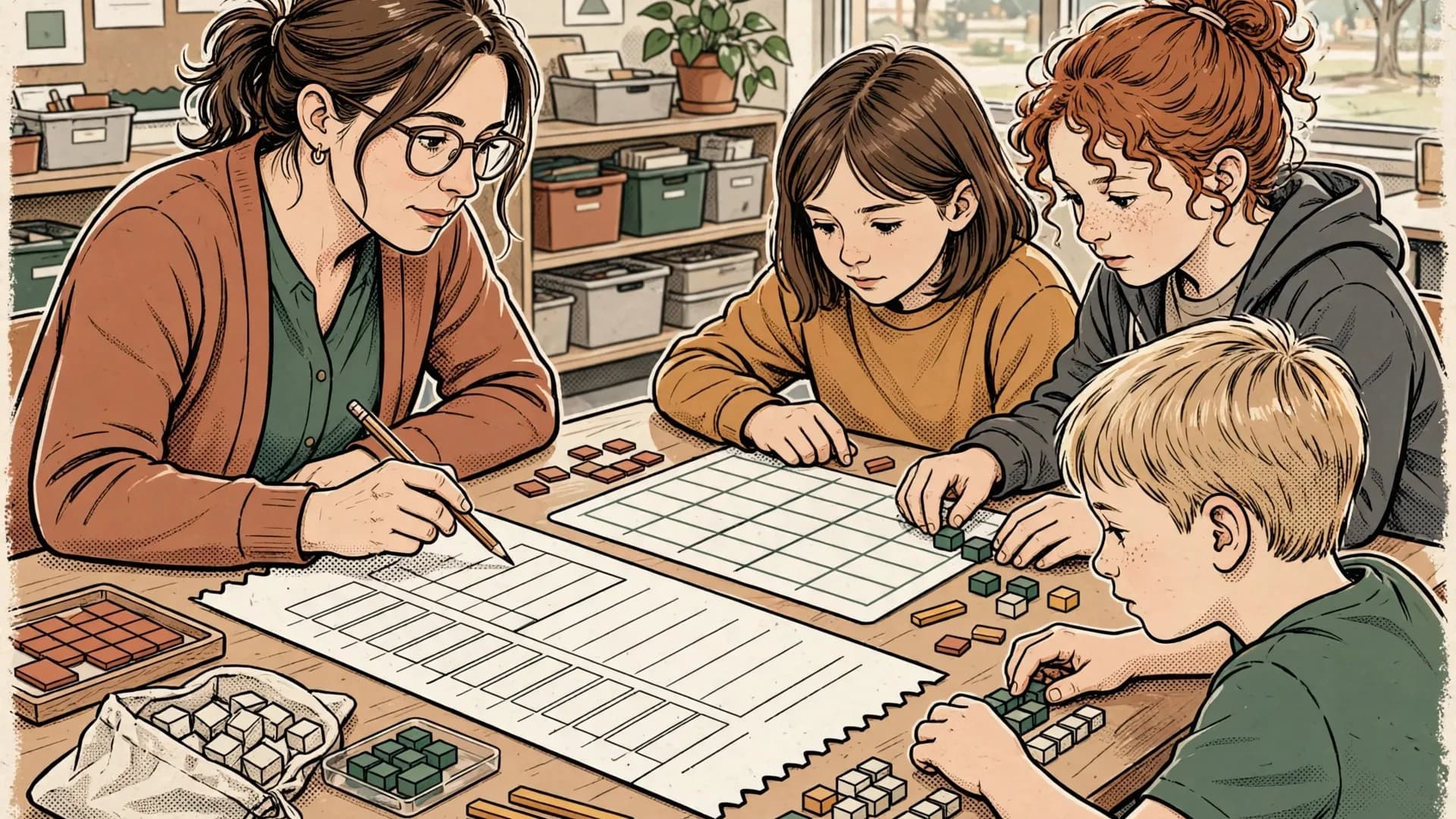
Decimal errors in Grade 4 are often place-value errors disguised as calculation errors. A student can know the subtraction algorithm and still write 8.5 - 2.37 as if the 5 and 7 occupy the same place.
This complete Texas lesson addresses that problem through TEKS 4.4(A). The Texas Education Agency Grade 4 compilation states that students add and subtract whole numbers and decimals through the hundredths place using the standard algorithm. The grade introduction also says students work without calculators.
Confirm the compilation through the central TEA TEKS catalogue, then check the agency's mathematics resources for current state guidance. Keep district pacing, materials, and local assessment expectations beside the state reference.
The plan below connects the algorithm to a place-value model, then asks students to diagnose an error before working independently. Confirm the current official standard and your district sequence before teaching.
Lesson overview
Title: Audit the class store receipt
Grade and subject: Grade 4 mathematics
TEKS: §111.6, 4.4(A), with mathematical process standards 4.1(A), 4.1(D) and 4.1(G)
Duration: 55 minutes
Materials: Place-value charts, decimal grids, fictional receipts, dry-erase boards, pencils and exit slips
Objective: Students will add and subtract decimals through hundredths with the standard algorithm and explain how place-value alignment supports an accurate solution.
Success criteria:
- I align ones, tenths and hundredths in the correct columns.
- I use the standard algorithm accurately.
- I estimate before calculating and use the estimate to check my answer.
- I can identify and explain a place-value error.

Prepare the receipt set
Create three short fictional receipts. Use prices with one and two decimal places so students must reason about equivalent notation.
Receipt A: correct total
Notebook       $3.75
Markers        $2.40
Total          $6.15
Receipt B: misaligned digits
Poster board   $8.50
Paint          $2.37
Incorrect sum $32.20
Receipt C: subtraction error
Basket total  $14.25
Coupon         $3.80
Incorrect due $11.55
Receipt B makes the place-value problem visible. Receipt C reveals whether students regroup accurately after a sound setup.
Complete 55-minute sequence
Launch with reasonableness (0-6 minutes)
Display 8.50 + 2.37 = 32.20 without showing the written work.
Ask students to write one sentence: “This answer is reasonable or unreasonable because...” Do not let them calculate immediately. Collect estimates such as “a little more than 10” and connect them to the size of the addends.
Evidence: Students who accept 32.20 need work on magnitude as well as the algorithm.
Connect the model to the written algorithm (6-16 minutes)
Represent 8.50 and 2.37 on a place-value chart. Use ones, tenths and hundredths columns. Then write the vertical algorithm directly below the chart.
Think aloud:
- The decimal point marks the boundary between ones and tenths.
- Each digit goes in its matching place-value column.
8.5can be written as8.50because the added zero does not change its value.- Add from hundredths to ones.
- Compare
10.87with the estimate.
Students annotate a matching example on their own chart.
Guided error analysis (16-28 minutes)
Pairs receive Receipts B and C. For each one, they must:
- estimate the expected total or difference;
- circle the first incorrect step;
- write the numbers with correct place-value alignment;
- calculate the correct answer;
- explain the error in one sentence.
Use this sentence frame only where needed: “The ___ digit was placed in the ___ column, but it belongs in the ___ column.”
Teacher look-fors:
- Students align decimal points rather than the rightmost digits.
- Added zeros are used as place holders, not treated as new value.
- The explanation names a place value rather than saying only “they lined it up wrong.”
Guided practice (28-39 minutes)
Work through three problems, increasing the demand:
12.46 + 5.3020.00 - 7.85- A receipt with three items:
4.75 + 2.60 + 1.89
For each problem, students show an estimate before the algorithm. Pause after setup so partners can check only the alignment. Then calculate.
Do not add a separate rule that students must always write two decimal places. The goal is correct place-value reasoning through hundredths. Equivalent notation is a support for alignment.
Independent performance (39-50 minutes)
Students complete this class-store task:
A customer buys a folder for $3.85, a set of pens for $6.40 and paper for $2.75. The customer uses a $5.00 coupon. Find the amount due. Show each algorithm and write one sentence explaining how you checked the result.
Expected total before coupon: 13.00. Expected amount due: 8.00.
Score four pieces of evidence:
| Criterion | Secure evidence |
|---|---|
| Setup | All digits occupy the correct place-value columns. |
| Algorithm | Addition and subtraction are accurate. |
| Reasonableness | Estimate or inverse check fits the context. |
| Explanation | Student names how alignment or checking supports the answer. |
Exit ticket (50-55 minutes)
Show this student's work:
  9.4
- 2.68
------
  6.72
Ask students to decide whether the answer is correct, rewrite the setup if needed and explain one check. The correct difference is 6.72, so this task catches an important misconception: untidy notation does not automatically mean the arithmetic is wrong. Students should recognise that 9.4 represents 9.40 and explain why the columns work.
Support and extension
Place-value support: Give students a chart with columns labelled ones, tenths and hundredths. Fade the chart after two correct setups.
Language support: Pair the terms “tenths” and “hundredths” with a labelled model. Let students rehearse the error explanation orally before writing.
Regrouping support: Separate setup from computation. First approve the aligned problem, then let the student calculate with a base-ten or decimal-grid model.
Extension: Students design a receipt with a total of exactly $20.00 using three items, then write a coupon that leaves an amount between $11.50 and $12.50. They must prove both constraints.

What to do with the evidence
Sort student work by error type, not by total score:
- Magnitude error: estimate does not fit the numbers.
- Alignment error: digits are placed in the wrong columns.
- Regrouping error: setup is sound but calculation breaks down.
- Explanation gap: calculation is correct but reasoning is unclear.
Each group needs a different next lesson. Repeating the same mixed worksheet hides the reason students are stuck.
Copyable math TEKS planning block
Grade and mathematics strand:
Official TEKS checked on:
Primary student expectation:
Supporting process standard:

Student action required by the TEKS:
Objective:
Success criteria:
Estimate or reasonableness check:
Final independent evidence:

Concrete or visual model:
Connection to the standard algorithm:
Guided error analysis:
Independent application:
Exit ticket:

Likely misconception:
Support that preserves the expectation:
Extension constraint:
Use the TEKS lesson plan guide for the full standards-to-evidence workflow and the kindergarten TEKS example for a concrete early-years model. The lesson plan template provides a reusable general structure.
To draft another Texas math lesson, create a Draft My Lesson account, select the Texas profile and include the exact student expectation, prerequisite skill, model and final evidence in your prompt. Check every number, solution and TEKS reference before using the material.
Related articles
Kindergarten TEKS Lesson Plan: Addition and Subtraction Within 10
A complete Texas kindergarten mathematics lesson aligned to TEKS K.3(B), with concrete models, drawings, word problems and an observable exit task.
Read articleUK Lesson Plan Template: Four-Nation Guide and Full Example
A practical UK lesson plan template with a complete worked example and nation-specific curriculum fields for England, Scotland, Wales and Northern Ireland.
Read articleScience TEKS Lesson Plan: Grade 5 Light Investigation
A complete Grade 5 Texas science lesson for TEKS 5.8(C), using stations to investigate light travelling, reflecting, refracting and being absorbed.
Read articleTEKS Lesson Plans: A Practical Guide for Texas Teachers
Turn a current Texas Essential Knowledge and Skills student expectation into an objective, learning sequence and assessment without treating the code as a decorative label.
Read article