UDL Lesson Plan Example: One Complete, Adaptable Science Lesson
See a complete UDL lesson plan example with anticipated barriers, options for engagement, representation, action, and expression, plus one shared goal.
Draft My Lesson Team
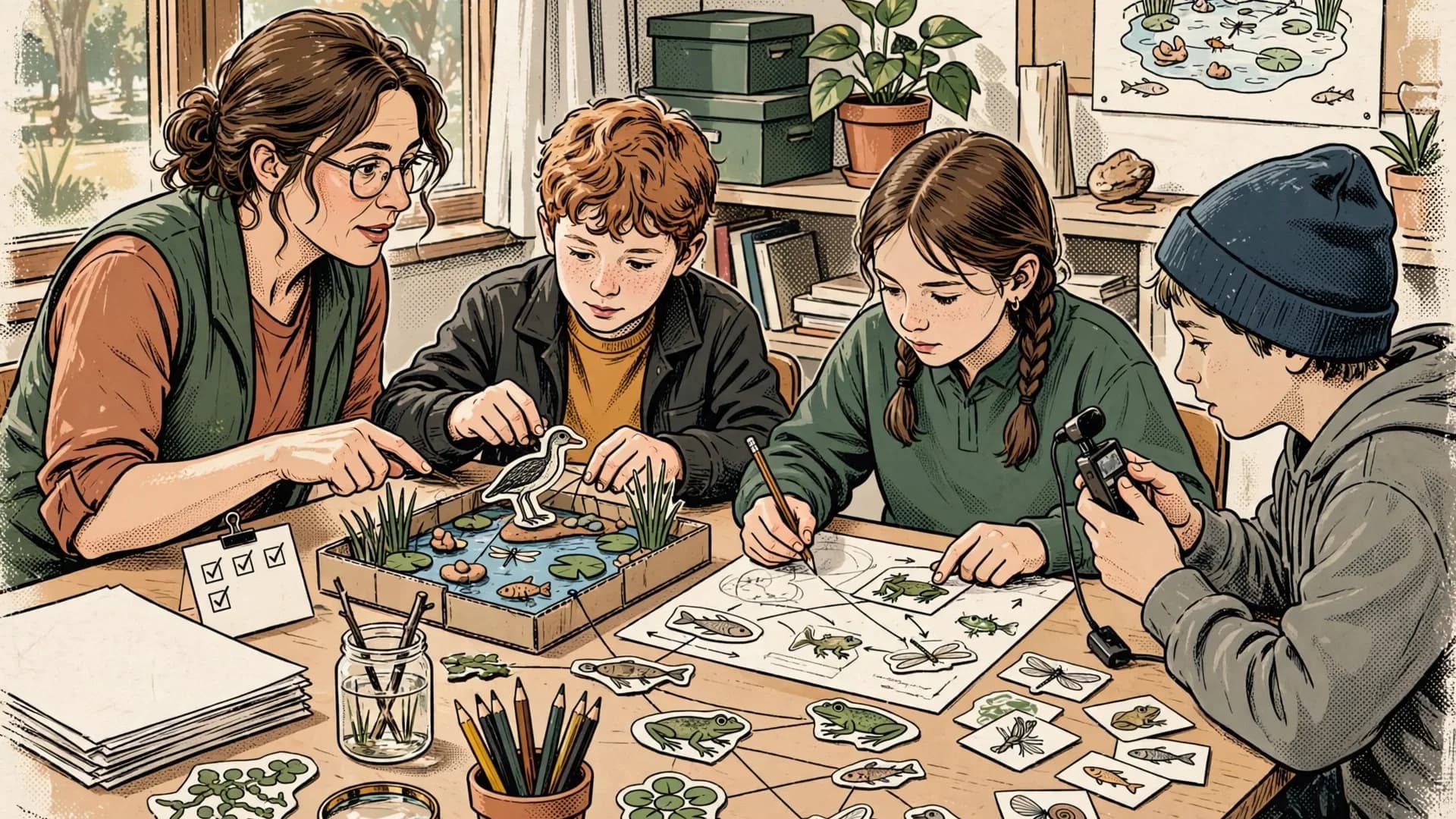
A Universal Design for Learning lesson does not need three versions of every worksheet or a different objective for every student. It starts with a clear learning goal, anticipates barriers in the lesson design, and offers purposeful options for engaging with information and showing learning.
The CAST UDL Guidelines organize the framework around engagement, representation, and action and expression. CAST's current UDL overview emphasizes clear goals, anticipated environmental barriers, meaningful options, and learner variability. Its UDL On Campus overview also makes an important boundary explicit: UDL is a flexible design framework, not a single prescribed formula. The example below uses all three principles while keeping one shared science objective and one evidence standard.
This is a classroom example, not a curriculum-alignment claim. Add the current framework or standard reference required for your class, then check that the objective and evidence genuinely match it.
Lesson at a glance
- Grade: 6
- Subject: science
- Time: 55 minutes
- Topic: relationships in a pond ecosystem
- Shared evidence: an explanation of how one change affects at least two parts of the system
- Flexible expression: annotated model, written explanation, or recorded explanation using the same criteria
The complete UDL lesson plan
Lesson context
Lesson title: What happens when one pond population changes?
Prior learning: Students can identify producers, consumers, and decomposers and can read arrows in a simple food-web model.
Materials: Pond food-web diagram, organism cards, change-scenario cards, chart paper or shared board, colored pencils, optional text-to-speech access, recording tool if available, and exit-ticket criteria.
Measurable objective: Given a pond food-web model and a change scenario, students will explain how the change affects at least two other parts of the ecosystem, using accurate cause-and-effect reasoning and evidence from the model.
Student-facing goal: I can use a food web to explain how one change can affect other organisms in an ecosystem.
Success criteria:
- Name the original change.
- Trace at least two connected effects.
- Use arrows, labels, or quoted model details as evidence.
- Explain why each effect could happen.
The goal does not require handwriting, public speaking, or memorizing organism names. Those demands would measure skills outside the intended science learning.
Anticipated barriers and design responses
| Possible barrier in this lesson | Design response available to everyone |
|---|---|
| Dense arrows make the food web hard to track | Color-coded organism groups, a simplified first model, and a finger or ruler tracking routine |
| Key vocabulary blocks reasoning | Picture vocabulary cards, short definitions, and sentence stems that preserve the science relationship |
| Students lose the multi-step causal chain | A three-box “change, first effect, next effect” organizer and a completed non-pond example |
| Writing demand hides science understanding | Choice of annotated model, written paragraph, or short recording, all checked with the same criteria |
| Open choice creates uncertainty | Three prepared scenario cards with increasing complexity and a teacher-recommended starting option |
| Students see no reason to solve the problem | A brief local-pond image and a decision prompt: “Which change should the park team investigate first?” |
Anticipating a barrier does not mean assuming every student will meet it. It means the support is ready and normal to use, rather than added after a learner has already failed.

Lesson sequence with UDL choices
1. Engage and retrieve prior learning (7 minutes)
Display a pond image beside a simple food web. Offer the prompt in writing and aloud: “If the insect population suddenly drops, what might change next?”
Students choose one response mode:
- point to and trace one possible path on the diagram;
- write a one-sentence prediction;
- tell a partner using the frame “If ___ decreases, then ___ may ___ because ___.”
Collect two contrasting predictions. Do not correct them yet. Ask students what evidence in the model would help decide.
Check for understanding: Every student identifies a starting organism and one connected organism. If the arrow convention is still unclear, pause for the prepared mini-model before continuing.
2. Model cause-and-effect reasoning (10 minutes)
Use a smaller three-organism model unrelated to the final task. Think aloud while completing the organizer:
Original change:
The __________ population increases / decreases.

First connected effect:
The __________ population may __________ because __________.

Next connected effect:
Then the __________ population may __________ because __________.

Evidence from the model:
The arrow / label / connection shows __________.
Show the reasoning as speech, written sentences, and arrows on the model. These representations repeat the same relationship in different forms. They do not add a separate objective.
Ask students to find one weak step in a second worked example where the claimed effect is not connected to the model.
3. Guided investigation (13 minutes)
Pairs choose or receive one scenario:
- algae grows rapidly;
- the insect population decreases;
- a new fish species competes for the same food.
They use organism cards or the diagram to build a two-effect chain. Students may record the chain with arrows, the organizer, or oral rehearsal before writing. Each pair must be ready to show where the model supports both effects.
Teacher prompts:
- Where does the change begin?
- Which connection gives you evidence for the first effect?
- What could happen next, and why?
- Is that effect shown by the model, or are we adding an assumption?
Check for understanding: Each pair shows one supported chain. Sort responses into ready for independent work, needs arrow-model practice, and needs cause-and-effect language support.
4. Independent application (17 minutes)
Students select a new scenario or use the teacher-recommended one. They produce one of three evidence formats:
- Annotated model: trace the chain, label two effects, and add a reason beside each arrow.
- Written explanation: one paragraph using the change, effects, reasons, and model evidence.
- Recorded explanation: a 60- to 90-second explanation while pointing to or displaying the model.
All formats use the same four success criteria. Students may use vocabulary cards, the organizer, text-to-speech, speech-to-text, or a quiet recording area if available.
Students who finish early test a competing possibility: “What information is missing from this model, and how could that change your explanation?” This deepens the same system-modeling goal instead of assigning unrelated extra work.
5. Closure and next instructional decision (8 minutes)
Students highlight or name:
- the original change;
- their two connected effects;
- the model evidence they used.
Then they complete one reflection: “The support that helped my reasoning most was ___ because ___,” or “The part of my explanation I would revise is ___.”
Review the work with one shared rubric:
| Criterion | Ready | Developing | Next teaching move |
|---|---|---|---|
| Original change | Accurately identified | Missing or unclear | Revisit scenario language |
| Connected effects | Two plausible, connected effects | One effect or disconnected chain | Use the three-box organizer with a new model |
| Model evidence | Specific arrow, label, or relationship used | General reference to the picture | Practice pointing to evidence before explaining |
| Cause-and-effect reasoning | Explains why both effects could follow | Names changes without reasoning | Model “because” statements and compare examples |
The rubric evaluates science reasoning, not the chosen output format.
Where the UDL design appears
Engagement
The lesson offers a real decision prompt, bounded scenario choice, partner rehearsal, individual application, and reflection on useful support. Choice has a purpose: it helps students enter the same learning goal without turning the class into thirty unrelated tasks.
Representation
Students encounter the system through an image, diagram, cards, teacher think-aloud, written causal chain, vocabulary support, and worked example. The teacher makes the arrow convention and the cause-and-effect structure explicit instead of assuming students can infer both.
Action and expression
Students can build, point, annotate, write, discuss, or record at different stages. The final formats vary, but every student must identify the change, trace two effects, cite the model, and explain the reasoning.
UDL, differentiation, and accommodations
UDL designs flexible access and expression into the lesson from the start. Differentiation uses evidence about readiness, interest, or learning need to adjust instruction. An accommodation is an access support a specific student may require.
They can work together. The shared visual model and output choices are available to everyone. A teacher can still provide targeted small-group modeling, a student's required accommodation, or a more complex scenario based on current evidence. The guide to differentiated instruction explains those responsive decisions in more detail.
Do not use “UDL” to avoid precise planning. More options do not repair a vague objective. Start with a measurable target using the lesson objective guide, then ask which parts of the lesson create barriers unrelated to that target.
Copyable UDL planning prompts
Add these prompts to the detailed lesson plan template, then place the lesson in Agenda so its preparation and follow-up stay visible in the week:
Shared learning goal:
Evidence all students must produce:

Barrier in engagement or sustained effort:
Design response:

Barrier in perceiving or understanding information:
Design response:

Barrier in acting, navigating, or expressing learning:
Design response:

Choice that supports the goal:
Choice that would distract from the goal:

Supports available to everyone:
Targeted support based on current evidence:
Required individual accommodations to confirm:

One shared success criterion across output options:
Evidence that will determine the next teaching move:

Create an adaptable lesson draft
Draft My Lesson can create an editable teacher plan and student materials from your topic, duration, level, teaching direction, and selected school-system profile. Use the prompts above to review the draft: keep one clear goal, identify unnecessary barriers, and make sure every output option produces comparable evidence.
Create your first lesson draft, then apply the professional judgment, learner knowledge, and required accommodations only you can provide.
Frequently asked questions
Does a UDL lesson need all three principles in every activity?
No. Design the lesson as a whole around barriers to the goal. An activity needs the options that make its learning accessible and assessable, not a decorative choice for every principle.
Do students always choose how to complete the assessment?
Only when different formats can produce valid evidence of the same goal. If the goal is oral presentation, a written paragraph cannot replace the performance. If the goal is ecosystem reasoning, writing, annotation, or recording may all provide comparable evidence.
Is UDL the same as making work easier?
No. Remove barriers that are unrelated to the intended learning while keeping the goal and success criteria clear. Vocabulary access may help a student explain a food web without lowering the reasoning expected.
How many choices should I offer?
Offer a small number of meaningful, manageable options. Three clear scenarios or output formats are usually more usable than an open request to “show learning any way you want.” Recommend a starting option when choice itself becomes a barrier.
Related articles
Differentiated Instruction: Adapting Lessons for Every Student
Differentiation doesn't mean creating three separate lesson plans. Learn practical strategies to adapt your teaching for diverse learners without tripling your prep time.
Read articleLesson Plan Objectives: 3 Types, Bloom's Verbs, and ABCD Examples
The 3 objective types are cognitive, affective, and psychomotor. Use the free builder, Bloom's verb bank, and ABCD examples to write your own.
Read articleInclusive Education: 5 Myths Worth Debunking
Inclusive education is often misunderstood as extra paperwork or lowered standards. Here are five myths every K-12 teacher hears, honestly debunked with classroom-ready practice.
Read articleEmergency Sub Plans: A Complete Low-Prep Day for Grade 4
Use a complete Grade 4 emergency sub plan with a full-day schedule, original reading and math pages, answer keys, no-internet backups, and handover notes.
Read article