Differentiated Instruction: Adapting Lessons for Every Student
Differentiation doesn't mean creating three separate lesson plans. Learn practical strategies to adapt your teaching for diverse learners without tripling your prep time.
Draft My Lesson Team

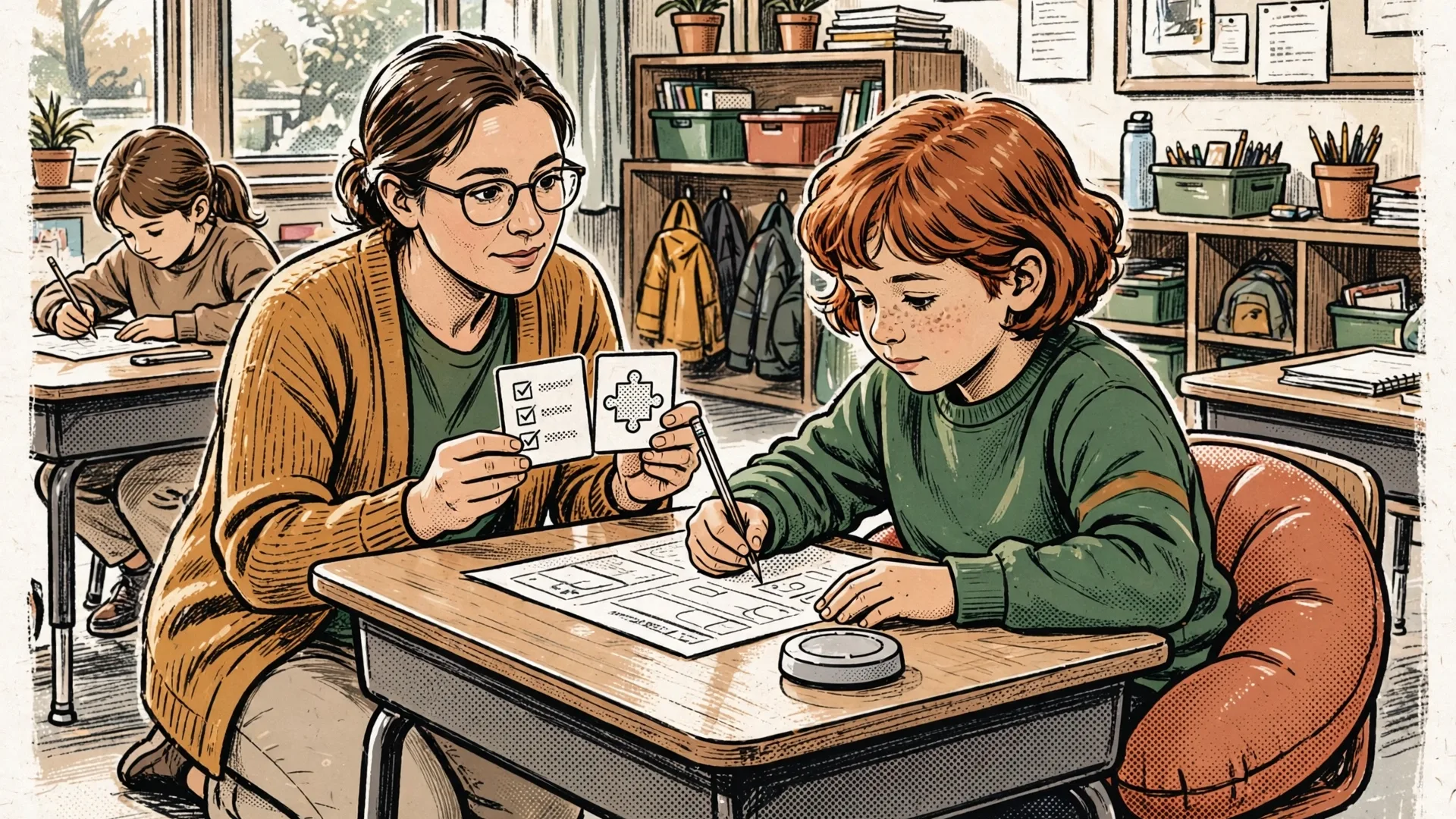
You have 28 students in your classroom. Some are reading two years above grade level. Others are still working on foundational skills. A few have IEPs. One arrived from another country last month and is learning English.
Differentiated instruction isn't optional anymore, it's the reality of modern teaching. But the way it's often presented makes it sound impossible: create multiple versions of every lesson, track every student individually, and somehow fit it all into the same 50-minute period.
Here's the truth: effective differentiation doesn't require separate lesson plans for every student. It requires smart design choices that create flexibility within a single lesson.
<Callout type="info" title="Key takeaways"> - Differentiation adjusts content, process, or product so every learner can reach the same objective. - Pick one area to differentiate per lesson, not all three at once. - Tiered tasks, flexible grouping, choice boards, and scaffolded materials cover most classroom needs. - Pre-assessment and lightweight tracking turn differentiation from guesswork into informed design. - Sustainable differentiation is built from reusable materials, not from heroic weekly effort. </Callout>What Differentiation Actually Means
Differentiation means adjusting instruction so students can work toward an appropriate learning objective through different paths. It is not a reason to ignore an IEP or another individual plan. It is a way to build useful flexibility into the shared lesson while honouring those requirements.
Carol Ann Tomlinson, the leading researcher on differentiation, identifies three areas you can differentiate:
- Content: What students learn or the materials they use
- Process: How students engage with and make sense of the content
- Product: How students demonstrate their understanding
You don't need to differentiate all three in every lesson. Picking one area per lesson is realistic and effective. Her foundational framework is documented through ASCD's work with Tomlinson, still the most widely cited reference in the field.
<Callout type="quote"> "Differentiation is simply a teacher attending to the learning needs of a particular student or small group of students, rather than teaching a class as though all individuals in it were basically alike."Attributed to Carol Ann Tomlinson </Callout>

Strategy 1: Tiered Assignments
All students work toward the same learning objective, but the complexity of the task varies.
How it works:
- Tier 1 (Approaching): More structure, fewer steps, concrete examples. Students might complete a graphic organizer or use sentence frames.
- Tier 2 (Meeting): Standard-level work with moderate independence.
- Tier 3 (Exceeding): More open-ended, requires synthesis or evaluation. Students might compare perspectives or create their own examples.
Example for a science lesson on ecosystems:
- Tier 1: Label a food web diagram using a word bank
- Tier 2: Create a food web from a list of organisms, explaining each relationship
- Tier 3: Predict what happens to the food web when one species is removed, and justify your reasoning
Key principle: All three tiers assess the same objective (understanding food web relationships). The cognitive demand increases, not the amount of work.
Strategy 2: Flexible Grouping
Group students differently depending on the purpose of the activity.
- Homogeneous groups (similar ability): For targeted skill practice where students need instruction at their level
- Heterogeneous groups (mixed ability): For collaborative projects where students learn from each other
- Interest groups: For research or extension activities where motivation drives engagement
- Random groups: For routine tasks where social dynamics matter more than ability
The key word is "flexible." Students should not always be in the same group. Rotating groupings prevents labeling and gives students experience working with diverse peers. The Education Endowment Foundation's evidence on within-class attainment grouping shows flexible groupings outperform fixed ability tracks.
Strategy 3: Choice Boards
Give students a grid of activities that all address the same objective. Students choose which activities to complete.
Example for a history unit on the American Revolution:
| Write a diary entry from a soldier's perspective | Create a timeline of 10 key events | Compare the perspectives of a Loyalist and a Patriot |
|---|---|---|
| Draw and annotate a map of a key battle | Core activity (required): Read the primary source and answer analysis questions | Design a newspaper front page from 1776 |
| Write 5 quiz questions with answer key | Create a cause-and-effect flowchart | Record a 2-minute "podcast" explaining a key event |
Students must complete the center square plus two others. This builds in differentiation naturally: students gravitate toward formats that match their strengths while still meeting the learning objective.
Strategy 4: Scaffolded Materials
Provide the same base content with layered supports that students can use as needed.
Practical scaffolds:
- Vocabulary glossary printed on the handout (students who don't need it simply ignore it)
- Sentence starters for written responses ("One reason this is important is...")
- Step-by-step checklists for multi-part tasks
- Anchor charts displayed in the classroom for reference
- Worked examples students can consult while solving similar problems
The beauty of scaffolds is that they're available to everyone but used only by those who need them. This avoids the stigma of being singled out for "the easy version." John Hattie's Visible Learning meta-analyses place scaffolding and worked examples among the highest-leverage instructional moves teachers can deploy.
Strategy 5: Pre-Assessment and Student Tracking
Differentiation works best when it's informed by data. You need to know where each student stands before you can adjust instruction effectively.
Quick pre-assessment methods:
- A 5-question entry quiz at the start of a unit
- A KWL chart (Know, Want to know, Learned)
- A skills checklist students self-assess against
- Reviewing previous assessment results
Tracking student progress doesn't have to be complicated. A simple spreadsheet with objectives down the left and student names across the top lets you see patterns at a glance: which objectives need reteaching, which students need support, and which are ready for extension. OECD analyses of equity in education consistently link formative tracking with stronger outcomes for the lowest performers.
Digital tools can simplify this further. Draft My Lesson, for example, lets you track student levels and generate exercises adapted to different proficiency levels, so the differentiation is built into the materials from the start.
Making It Manageable
The biggest barrier to differentiation isn't knowledge, it's time. Here's how to make it sustainable:
Start small. Don't try to differentiate everything at once. Pick one lesson per week and one differentiation strategy. Build from there.
Plan for two levels, not five. In practice, a "standard" and "supported" version covers most of your students. Advanced learners often just need an extension question, not a separate assignment.
Use technology strategically. AI tools can generate multiple versions of an exercise in seconds. What used to take an hour of manual rewriting can now happen automatically.
Collaborate with colleagues. If you and a colleague teach the same subject, divide the differentiation work: one creates the supported version, the other creates the extension.
Build a library. Save your differentiated materials. Next year, you won't start from scratch.

A complete one-lesson differentiation plan
This Grade 6 science example keeps one concept in view: explain how a change in one population affects a food web.
| Lesson phase | Shared core | Planned variation | Evidence |
|---|---|---|---|
| Entry check | Identify producer, consumer, and decomposer in one diagram | Vocabulary bank available to everyone | Three labelled arrows |
| Model | Teacher thinks aloud through one population change | Worked example remains visible | Students explain the first causal link to a partner |
| Practice | Predict the effect of removing one species | Supported group uses a partially completed chain; extension group compares two changes | Annotated food web and written explanation |
| Checkpoint | One hinge question before independent work | Regroup by the response, not by a permanent ability label | Choice and one-sentence justification |
| Exit task | Explain one direct and one indirect effect | Sentence frame available; extension requires a counterargument | Two linked effects using evidence from the web |
The objective stays visible, but the amount of structure changes. The supported task removes avoidable reading and organisation load. It does not replace reasoning with colouring or give the student fewer chances to show the target skill.
A five-minute planning decision
Before making extra worksheets, answer these questions:
- What exactly must every student demonstrate today?
- Which barrier is most likely: vocabulary, background knowledge, task organisation, reading load, or cognitive demand?
- Can one scaffold remove that barrier without changing the objective?
- What response will tell you who needs the scaffold next time?
If you cannot name the barrier, do a short diagnostic or formative check before creating tiers. Differentiation based on a guess can create more work and still miss the learner.
The Payoff
When differentiation works, the classroom changes. Struggling students engage instead of shutting down. Advanced students are challenged instead of bored. And the messy middle, the students who are "fine" but could do more, actually grow.
Differentiation isn't about being a superhero teacher who creates thirty individualized lesson plans. It's about designing lessons with built-in flexibility, so every student has a path to success. Start with one strategy, get comfortable with it, and add more over time.
Your students don't all learn the same way. Your lessons shouldn't all look the same either.
Continue your lesson planning toolkit
Differentiation is one layer of effective lesson design. These guides cover the other pieces:
- How to write a lesson plan: a 7-step guide for the full method that gives differentiation a home.
- Six lesson plan formats compared to pick a frame that lends itself to building flexibility into the lesson.
- Six lesson plan examples for every grade level to see what differentiated practice looks like in real lessons.
- Bloom's taxonomy lesson plans for designing tiered tasks that climb the cognitive ladder.
- A copyable lesson plan template for placing the objective, scaffold, checkpoint, and exit evidence in one plan.
Related articles
ADHD in the Classroom: 8 Adaptations That Actually Work
Practical ADHD classroom adaptations any teacher can use right now, no IEP or 504 required. Eight strategies that turn restless energy into engagement.
Read articleEmergency Sub Plans: A Complete Low-Prep Day for Grade 4
Use a complete Grade 4 emergency sub plan with a full-day schedule, original reading and math pages, answer keys, no-internet backups, and handover notes.
Read articleReport Card Comments: Evidence, Progress, Next Steps
Write specific report card comments from classroom evidence, describe progress fairly, and give families one useful next step.
Read articleExit Ticket Template: 30 Examples and 5 Copyable Formats
Copy 30 exit ticket examples for math, ELA, science, and social studies, then use five flexible templates to decide what your class needs next.
Read article