Inclusive Education: 5 Myths Worth Debunking
Inclusive education is often misunderstood as extra paperwork or lowered standards. Here are five myths every K-12 teacher hears, honestly debunked with classroom-ready practice.
Draft My Lesson Team

You read the email at 7:42 a.m. A new student is joining your class on Monday. There is an IEP attached, a 504 plan, an NCCD adjustment, an SEND support plan, or simply a counselor's note depending on where you teach. You skim it, refill your coffee, and a quiet voice in your head says the thing most teachers will not say out loud: "I am not equipped for this."
That feeling is honest, and it is widespread. You did not get a master's in special education. You have 27 other students, three preps, and a parent meeting at 4:30. Inclusion arrives as one more thing on a desk that is already full, and the official guidance often reads like it was written by someone who has never taught a Friday afternoon class.
This article is not a sermon. Inclusive education is hard work and the difficulty is real. But a lot of the resistance you feel, and that you hear in the staffroom, is built on myths that quietly make the job harder than it needs to be. Here are five of them, debunked with practice you can actually use on Monday.
Key takeaways
- Inclusion is a verb, not a seating chart: physical presence without access is still exclusion.
- Well-designed adaptations lift the whole class, they do not slow it down.
- Universal Design for Learning (UDL) is the planning routine that makes inclusion sustainable.
- Lowering the level is the opposite of inclusion: keep the bar, vary the path.
- You are not the system. Specialists, aides, and caregivers are part of the job.
The 5 myths
Myth 1: "Inclusive education means the student with an IEP sits in my class. Done."
Physical presence is not inclusion. A student can be in the room, at a desk, with a worksheet they cannot access, and be just as excluded as if they were down the hall. The legal frameworks are clear on this. In the US, IDEA requires meaningful access to the general curriculum, not just placement. The UK SEND Code of Practice, Australia's NCCD, Canada's provincial frameworks, and New Zealand's inclusive education guidance all hinge on the same idea: the student must be able to participate, learn, and progress.
Practice translation: when a student joins your room with a support plan, read the plan, then ask three questions. What does this student need to access the lesson? What does success look like for them this week? Who can I co-teach or co-plan with for at least one block? If your school offers any form of co-teaching, even 30 minutes a week with a special education colleague, take it. Inclusion is a verb.
Myth 2: "Inclusion slows down the rest of the class."
This is the objection that keeps inclusive education stuck, and the evidence does not support it. Research syntheses on inclusive classrooms, including work from the OECD and meta-analyses from the Education Endowment Foundation, consistently find neutral or positive effects on the achievement of students without disabilities, provided the adaptations are well designed. When adaptations are bolted on as an afterthought, yes, the class can drag. When they are baked into the lesson from the start, the whole class benefits.
Practice translation: stop thinking of adaptations as "extra steps for one kid." Think of them as design choices that lift the floor without lowering the ceiling. A clearer set of instructions, a visual anchor on the board, a sentence starter, a choice of two ways to show understanding, these help your strongest students too. The student you adapted the lesson for is rarely the only one who needed it.
Myth 3: "Inclusion is the specialist's job, not mine."
The specialist is essential. They are not, however, the only adult responsible for the student's learning. Every framework, IDEA, SEND, NCCD, the provincial Canadian codes, the New Zealand Inclusive Education Act, places the general classroom teacher at the center of day-to-day instruction. The specialist designs supports, monitors progress, and co-teaches when possible. You are the one teaching the lesson.
Practice translation: build a 10-minute weekly check-in with the special education teacher, the counselor, or the learning support coordinator. Bring one specific question, not a vague "how is she doing." For example, "On Wednesday's lab, she froze at step 3. What is one thing I can try?" Specialists are far more useful when the question is concrete, and the partnership grows from there.
Myth 4: "To include them, you have to lower the level."
This is the most damaging myth, and it is wrong. Lowering the level is not inclusion, it is the opposite. It tells the student that less is expected of them and quietly removes them from the actual curriculum. If a student leaves your class with a watered-down version of the lesson, they have been excluded politely.
"The problem is not the student. The problem is the curriculum. We need to design learning environments that work for the variability of all learners from the start."
Attributed to David Rose, co-founder of CAST and architect of the UDL framework.
The alternative has a name: Universal Design for Learning, or UDL. UDL asks you to plan, from the start, for predictable variability in your students. It rests on three principles:
- Multiple means of representation. Show the same content in more than one way: a short text, a diagram, a 90-second video, a worked example. The concept stays the same. The doors in change.
- Multiple means of expression. Let students show what they know in more than one form: written, oral, a labeled drawing, a short recording, a structured discussion. The standard stays the same. The path to demonstrate it varies.
- Multiple means of engagement. Give students some agency over how they engage: choice of partner, choice of two prompts, a clear purpose, a visible success criterion. Engagement is not entertainment. It is investment.
Practice translation: pick one lesson next week. Keep the learning objective exactly as it is. Add one alternative representation, one alternative way to express understanding, and one small choice. That is one practical way to apply UDL without lowering the target. The differentiated instruction guide shows how to layer the same decision across a lesson.
Myth 5: "Inclusion means labeling everything."
In practice, the opposite is true. Good inclusive education is person-centered, not label-driven. The label, ADHD, dyslexia, autism, hearing impairment, anxiety, gives you a starting hypothesis about what might help. It does not describe the child. Two students with the same diagnosis can need very different things, and the most useful question is never "what is the label?" It is "what does this learner need to access this lesson, today?"
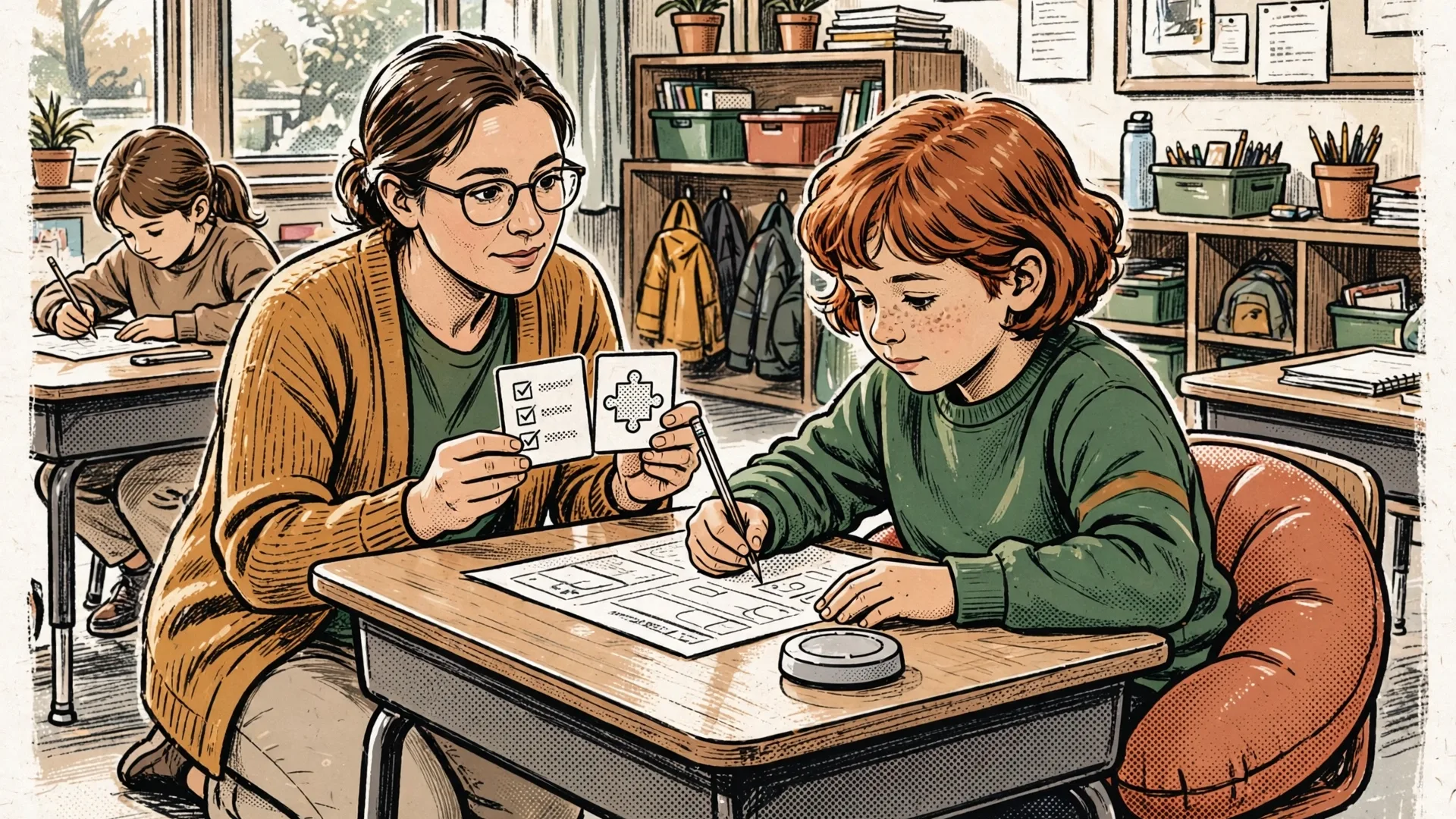
Practice translation: in your planning notes, write the need, not the label. Instead of "ADHD student, needs accommodation," write "needs the task broken into 3 steps with a visible checklist." Instead of "dyslexic student, needs adaptation," write "needs text in a clear font with audio option." The label is a clue. The need is the lesson plan.

UDL: the practical tool
If you keep one thing from this article, keep UDL. It is the framework that turns inclusive education from a values statement into a planning routine. The temptation, when you have 27 students and a unit to deliver, is to plan the lesson for the "average" student and then patch it for the rest. UDL flips that. You design once, for variability, and patch much less.
A simple weekly routine that fits into a real teacher's life:
- Identify the learning goal. One sentence. What will every student know or be able to do?
- Plan the core task. This is your main activity, exactly as you would teach it.
- Add one representation alternative. A visual, an audio version, a worked example, a graphic organizer.
- Add one expression alternative. Two ways to demonstrate the goal: written and oral, text and diagram, individual and paired.
- Add one engagement lever. A choice, a clear success criterion, a real-world hook.
- Identify your tightest support need. Which student needs the most scaffolding, and is there a co-teacher, an aide, or a specialist who can help during that block?
That is six bullet points. It is not a doctorate in special education. It is a habit, and it works.
You're not alone
The biggest mistake teachers make with inclusive education is trying to carry it alone. You are not the system. The system is a team, and using it is part of the job, not a sign you cannot cope. Global guidance from UNESCO on inclusive education is unambiguous on this: inclusion is a system-wide responsibility, not a private burden carried by individual teachers.
Depending on where you teach, your team probably includes some combination of:
- The special education teacher or SEND coordinator (SENCO) in the UK, your closest co-planner for adaptations and IEP/SEND goals.
- The school counselor or wellbeing lead, for the emotional and behavioral side that often shows up before the academic side.
- The speech-language pathologist, occupational therapist, or educational psychologist, who visit classrooms less but bring high-leverage strategies.
- Teacher aides or paraprofessionals, who often know the student's day-to-day patterns better than anyone.
- Parents and caregivers, who have years of expertise on this child and are usually under-consulted.
Two practical habits change the game. First, ask for one concrete strategy each time you meet with a specialist, not a general overview. Second, share what works, not just what fails. If a sentence starter unlocked a student on Tuesday, tell the team. That single data point will show up in three other classrooms by Friday.
If you also teach students with attention difficulties, you may find our piece on ADHD classroom adaptations a useful companion to this one.
Closing thought
Inclusive education is not a personality trait, a vocation, or a bonus skill for the teachers who happen to be patient. It is a planning craft, and you can learn it the way you learned to run a guided reading group or a chemistry lab. The myths are sticky because they offer permission to opt out: not my training, not my job, not my level. The truth is less comfortable and more freeing. You can do this work. It is hard, you will not get it right every week, and you do not have to do it alone.
Start with one lesson. Keep the bar where it is. Add a representation, an expression option, and a small choice. Ask one specific question to one specialist. Write the need, not the label. That is inclusive education on a Tuesday, and it is more than enough to begin.
Draft My Lesson is the AI-powered lesson-planning tool built for English-speaking K-12 teachers. Plan your lessons in minutes and spend more time on what matters. Try it free.
Related articles
ADHD in the Classroom: 8 Adaptations That Actually Work
Practical ADHD classroom adaptations any teacher can use right now, no IEP or 504 required. Eight strategies that turn restless energy into engagement.
Read articleEmergency Sub Plans: A Complete Low-Prep Day for Grade 4
Use a complete Grade 4 emergency sub plan with a full-day schedule, original reading and math pages, answer keys, no-internet backups, and handover notes.
Read articleReport Card Comments: Evidence, Progress, Next Steps
Write specific report card comments from classroom evidence, describe progress fairly, and give families one useful next step.
Read articleExit Ticket Template: 30 Examples and 5 Copyable Formats
Copy 30 exit ticket examples for math, ELA, science, and social studies, then use five flexible templates to decide what your class needs next.
Read article