Report Card Comments: Evidence, Progress, Next Steps
Write specific report card comments from classroom evidence, describe progress fairly, and give families one useful next step.
Draft My Lesson Team
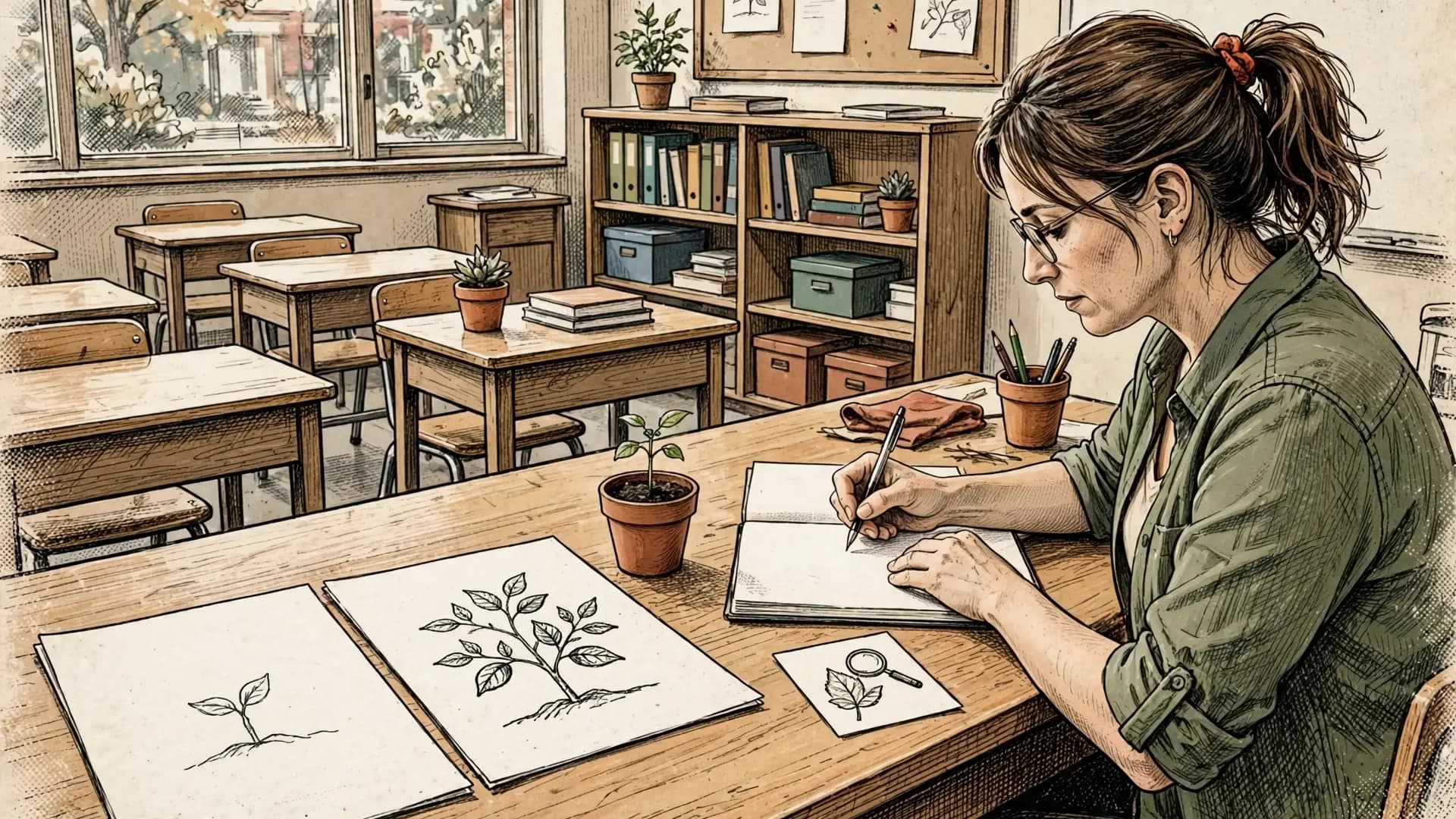
A useful report card comment does more than soften or restate a grade. It helps a student and family understand what the student can do now, how their work has changed, and what to work on next.
The quickest way to write one is not to search a list for a sentence that sounds positive. Start with evidence you have actually seen, compare it with an earlier point or a stated expectation, and name one manageable next step.
The three-part report card comment framework
Use this sequence for most academic comments:
- Evidence: What did the student do, produce, explain, or demonstrate?
- Progress: What has become more secure, more independent, more accurate, or more consistent?
- Next step: What is the next specific skill or action to practice?
A complete comment might read:
During our Grade 4 fractions unit, Lena used visual models to compare fractions with the same denominator accurately. She now explains her comparisons without a prompt. Her next step is to use equivalent fractions when the denominators differ.
Each sentence has a job. The first identifies the evidence and context. The second describes a change in performance. The third points toward instruction.
When there is no clear earlier baseline, do not invent progress. Describe the student's current performance and the next step:
In recent lab explanations, Andre identifies the variable that changes and records accurate observations. His next step is to connect each observation to the claim in a complete sentence.
The exact reporting scale, required fields, accommodations language, and approval process vary by school and district. Use the framework inside your local reporting policy rather than treating any example here as a national template.

Gather evidence before writing
A comment becomes specific when it is anchored in a small, representative evidence set. Review two or three recent sources that match the skill you are reporting, such as:
- a writing sample and its rubric;
- an exit ticket and a later check on the same skill;
- a problem-solving task with the student's working shown;
- a reading conference note;
- a performance, presentation, or lab record;
- dated observations from more than one classroom situation.
Choose evidence that supports the claim you plan to make. A completed assignment can show completion, but it does not by itself show understanding. A test score can summarize performance, but a worked response may show which part of the process is secure.
Use the assessment types guide to check whether the evidence answers the question you are asking. If you want to report growth in oral explanation, for example, use spoken evidence rather than relying only on a written quiz.
Turn notes into a comment
Raw notes: "Grade 2 reading, Aug. 25. Retold the beginning but omitted the problem and ending." "Sept. 8. Read 74 of 80 high-frequency words automatically. Paused at vowel teams. Retold beginning and end but omitted the problem. Asked to check the text twice."
Comment:
Noah reads most of the high-frequency words taught this term automatically and uses the text when prompted. His retell now includes the beginning and ending of a story. His next step is to identify the central problem and use vowel-team patterns when decoding unfamiliar words.
The comment does not include every number in the note. It selects the evidence that makes the learning visible and leaves the detailed record in the teacher's evidence system.
Adaptable examples by subject and grade band
These examples are fictional and deliberately narrow. Adapt the skill, evidence, and level to the work your student actually completed. Grade labels provide context, not a claim that every US school teaches the skill in the same term.
Elementary reading and writing
Grade 1 reading
Eli blends regular one-syllable words and rereads a sentence when it does not make sense. He is using the first sound and the full word more consistently instead of guessing from the picture. His next step is to read words with the vowel patterns taught in our current unit.
Grade 3 writing
Samira organizes a narrative with a clear sequence and adds dialogue that moves the action forward. Since the first-quarter sample, she has begun revising sentences rather than only correcting spelling. Her next step is to group related ideas into paragraphs and explain why the character responds as they do.
Grade 5 reading
Mateo identifies the main idea of an informational text and selects relevant details. He now distinguishes a supporting detail from an interesting fact in guided work. His next step is to explain how two details work together to support the main idea independently.
Elementary and middle school mathematics
Grade 2 mathematics
Priya represents two-digit addition with base-ten drawings and records the matching equation accurately. She has moved from counting all objects to combining tens and ones. Her next step is to explain when a new ten is composed and check the result with a second strategy.
Grade 6 mathematics
Jordan plots ordered pairs accurately in all four quadrants and uses coordinates to describe horizontal and vertical distances. Recent work shows fewer sign errors than at the start of the unit. The next step is to use this precision when finding side lengths in coordinate-plane problems.
Grade 8 mathematics
Ava solves linear equations with a variable on one side and checks solutions by substitution. She now records inverse operations in a consistent sequence. Her next step is to preserve equivalence when variables appear on both sides of the equation.
Science and social studies
Grade 4 science
Darius records detailed observations during investigations and uses measured data in his conclusion. He has become more consistent in separating what he observed from what he inferred. His next step is to explain whether the evidence supports the original prediction and why.
Grade 7 science
Keisha uses particle diagrams to explain changes of state and applies the model accurately to familiar examples. She is beginning to transfer the model to unfamiliar situations. Her next step is to connect changes in particle motion to changes in thermal energy.
Grade 10 social studies
Ben selects relevant evidence from primary and secondary sources when responding to a historical question. His recent paragraphs include clearer links between evidence and claim. His next step is to evaluate how the source's perspective affects what it can show.
High school English and world languages
Grade 9 English
Nia develops a clear claim and selects quotations that relate to it. Across the last two essays, she has moved from summarizing quotations to explaining specific word choices. Her next step is to connect each paragraph's analysis back to the central line of reasoning.
Level 2 Spanish
Owen communicates the main idea in short conversations about familiar routines and asks follow-up questions using practiced structures. He now sustains an exchange for several turns with less reliance on notes. His next step is to use past-tense forms accurately when describing completed events.
Report card comments when a student needs more support
A low grade or an unmet expectation still needs precise language. Describe the work pattern, the support already in place, and the next instructional move. Avoid labels such as "lazy," "weak," "careless," or "unmotivated." They assign a trait or motive without showing what the student did.
Compare these two versions:
Needs improvement in math and must try harder.
In independent fraction problems, Marcus identifies common denominators when a model is provided and often stops before renaming both fractions. With a worked example, he completes the comparison accurately. We will continue practicing the renaming step with visual models, then check the same skill without the prompt.
The second version does not hide the difficulty. It locates it, shows the conditions under which the student succeeds, and names what happens next.
Useful sentence structures
Use these as structures to complete from your records, not as finished comments:
- In recent [task or context], [student] can [observable skill] when [relevant condition].
- Compared with [earlier evidence], [student] now [specific change].
- [Student] is working toward [stated expectation]. Current work shows [what is secure] and [where the process breaks down].
- With [named support], [student] can [observable outcome]. The next check will look for [same outcome with adjusted support].
- The next instructional focus is [one skill], practiced through [brief classroom action].
If evidence is mixed, say so. "In conferences, Talia explains her strategy accurately; in independent written work, she does not yet record enough steps for the reasoning to be followed" is clearer than forcing one broad judgment.
Describe progress without overpromising
Words such as "improved" and "progressing" need a reference point. Name what changed:
- Accuracy: from frequent calculation errors to accurate work on four of the last five checks;
- Independence: from completing the task with a model to starting it without a prompt;
- Complexity: from simple sentences to connected paragraphs with evidence;
- Consistency: from demonstrating the skill occasionally to doing so across several tasks;
- Transfer: from using the skill in a practiced example to using it in a new context.
Do not promise that the next step will produce a particular result. A comment can state the planned instruction and the evidence you will review. It cannot guarantee a grade, diagnosis, placement, or rate of progress.
Comments for multilingual learners
Separate evidence of subject knowledge from evidence of English language use when they are different reporting targets. A student may understand the science concept and still need language support to write the explanation in English.
Linh accurately orders the stages of the water cycle and explains the sequence using a labeled diagram. In English explanations, she uses the unit's key nouns consistently and is beginning to connect ideas with because and therefore. Her next step is to rehearse one oral explanation before writing it independently.
Avoid treating multilingualism as a deficit or using a broad phrase such as "language barrier" in place of evidence. Name the academic skill, the language demand, and the support that helps the student show learning.
For family-facing communication, follow your school or district process for translation and interpretation. US Department of Education guidance says schools must ensure meaningful communication with parents who have limited English proficiency in a language they can understand. The Department's English Learner Family Toolkit is available in several languages.

Sensitive situations: write the record you can support
Some information needs a conversation or a school process, not a compressed conclusion in a report card box. When attendance, behavior, health, safety, family circumstances, disability services, or a possible learning need affects progress:
- use dated, observable facts that are relevant to learning;
- distinguish what you observed from what another person reported;
- do not diagnose or speculate about cause;
- avoid identifying another student;
- document support and follow-up through approved school systems;
- ask the appropriate specialist or administrator to review language when policy requires it.
For example, "During three independent-work periods this month, Rina completed the opening task and left the extended response blank" is an observation. "Rina has an attention problem" is a diagnosis a classroom comment cannot establish.
Report cards and related records may be education records. The US Department of Education's FERPA guidance explains parent and eligible-student rights to inspect and review education records and the limits on disclosure. Apply your school's privacy, custody, recordkeeping, and review procedures to the specific situation.
A report card should not be the first place a family encounters a serious concern. Use the communication process required by your school, and prepare for the conversation with the parent-teacher conference guide.
A quick revision check
Before submitting a comment, ask:
- Can I point to the evidence behind every claim?
- Did I describe learning rather than assign a personality trait?
- Is progress tied to an earlier point, level of support, or stated expectation?
- Does the next step name one teachable skill?
- Would the student recognize the work being described?
- Did I remove another student's information and unnecessary sensitive detail?
- Does the language follow my school's reporting and family-communication policy?
Read the comment aloud once. If it sounds like a sentence that could apply unchanged to half the class, add the task, skill, or evidence that makes it belong to this student.
Use the editable report card comment worksheet
Use the editable Evidence → Progress → Next Step worksheet to collect observations and draft each comment. It includes a one-student planning page, revision checks, and sentence structures you can adapt without turning them into generic labels.
Fill in the worksheet in your browser, then print it or use your browser's print dialog to save a PDF. Download the editable text version if you prefer to work in your own notes.
When the next step is clear, place it inside instruction. The differentiated instruction framework helps you choose one adjustment from current evidence. Then open the Draft My Lesson demo to turn that next learning step into a lesson draft you can review for your class.
Related articles
Exit Ticket Template: 30 Examples and 5 Copyable Formats
Copy 30 exit ticket examples for math, ELA, science, and social studies, then use five flexible templates to decide what your class needs next.
Read articleBackward Design Lesson Plan: A Practical Guide for K-12 Teachers
Backward design flips traditional lesson planning on its head. Start with the results you want, work backward to the assessment, then plan the activities. Here is how to do it without burning a weekend.
Read articleLesson Plan Objectives: 3 Types, Bloom's Verbs, and ABCD Examples
The 3 objective types are cognitive, affective, and psychomotor. Use the free builder, Bloom's verb bank, and ABCD examples to write your own.
Read articleDesigning a Fair Test in Under an Hour
Designing tests that are fair, focused, and finished in 60 minutes is possible. Here is a five-block process that protects your evening and your students.
Read article