Reading Comprehension Lesson Plan: Research-Based Strategies
Plan a reading comprehension lesson with explicit modeling, guided practice, independent transfer, and an exit ticket. Includes a copyable 45-minute plan.
Draft My Lesson Team
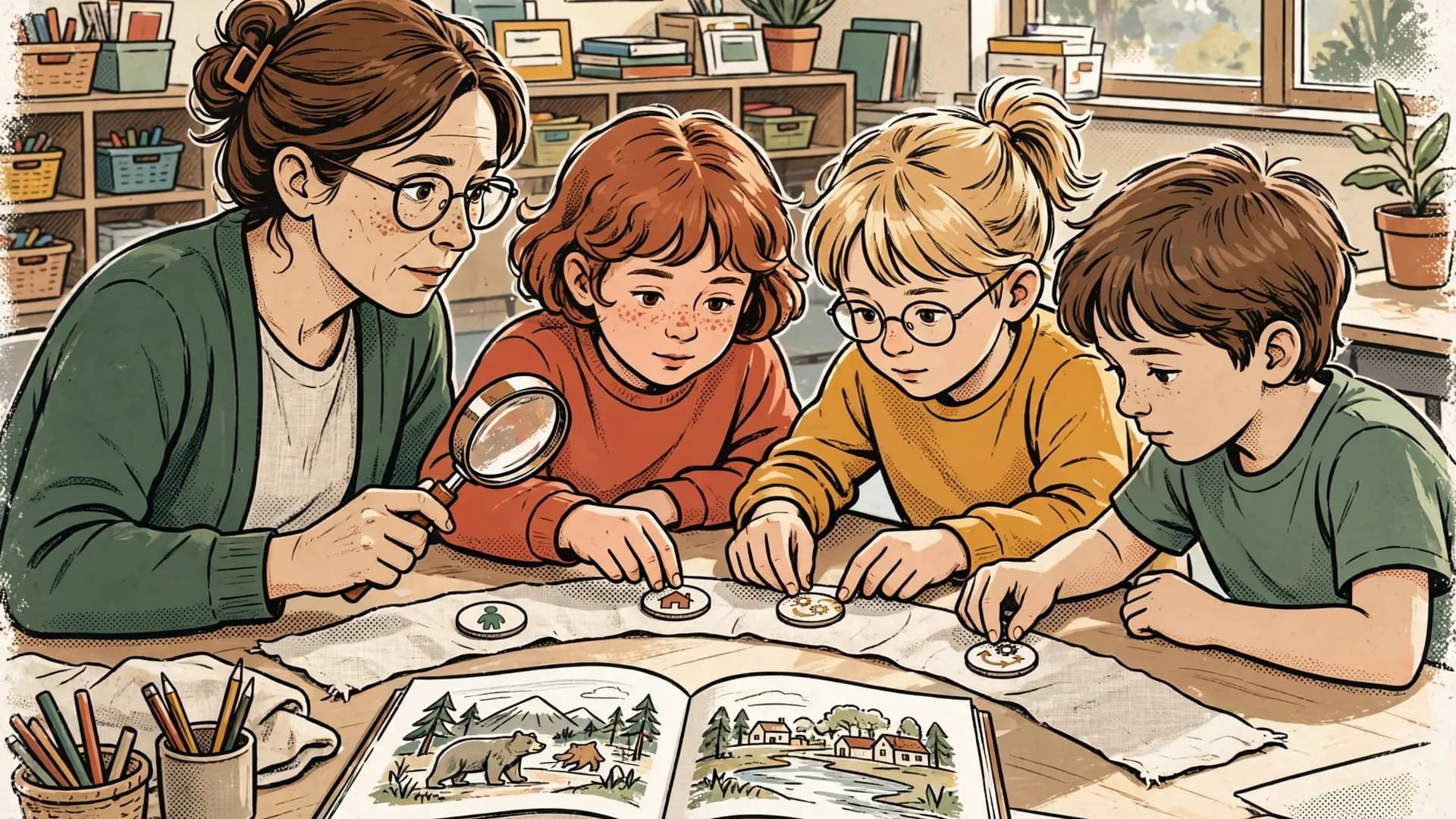
A reading comprehension lesson should teach a move readers can use, not merely check whether students understood one passage. Name and model one strategy, let students try it with support, then ask them to use it on a fresh section of text.
This guide is written for US grades 3-12. Verify the local curriculum objective, text expectations, and accessibility needs before adapting it elsewhere.
Key takeaways
- Diagnose the point at which meaning breaks down before selecting a strategy.
- Model the invisible thinking with a short, preplanned think-aloud.
- Move from teacher modeling to guided practice and independent use.
- Assess transfer on a fresh paragraph, not recall of the modeled answer.
- Treat the strategy as a tool for understanding the text, not as the lesson's final goal.
What the research supports
The US Department of Education's What Works Clearinghouse recommends explicit comprehension strategy instruction and gradual movement toward independent use. Its K-3 reading comprehension practice guide describes explanation, modeling, collaborative use, guided practice, and independent use. The IES K-3 professional learning toolkit provides routines for questioning, monitoring and fixing up, inference, summarizing, and informational text structure.
For students in grades 4-9 who need intervention, the What Works Clearinghouse practice-guide summary recommends teaching students to notice when text stops making sense and take action. For older readers more broadly, the adolescent literacy practice guide recommends direct and explicit strategy instruction alongside vocabulary and discussion of text meaning.
These sources support explicit teaching. They do not prescribe one strategy for every reading difficulty.

Pick the strategy from the reading problem
Start with the text and the evidence in student work.
| Difficulty visible in student work | Strategy and teaching response | Evidence to collect on a fresh section |
|---|---|---|
| A pronoun, connector, or key word breaks the meaning | Clarify the language, then reread the sentence in context | Student identifies the obstacle and explains the repaired meaning |
| Students lack knowledge the text assumes | Briefly build the specific background knowledge before reading | Student uses the supplied fact to explain a passage detail |
| Students miss meaning that is implied | Model an inference from text clues and relevant knowledge | A claim, the clue, and the reasoning bridge |
| Students keep reading after losing the thread | Model monitoring, name the confusion, and choose a repair | A marked stopping point, cause of confusion, and repair used |
| Students copy details without identifying the point | Teach main idea or text structure with a worked example | A main-idea statement supported by two relevant details |
| Students retell every event | Model how to omit minor detail while preserving the central sequence | A concise retelling plus one justified omission |
| Students treat two sources separately | Compare claims or evidence before asking for synthesis | One conclusion that uses evidence from both sources |
Inference will not repair an unknown technical term that carries the whole sentence. Summarizing may be the wrong starting point if students cannot identify the central idea. Match the response to the observed breakdown.
Write an objective that includes evidence
“Students will understand the passage” cannot guide an activity or assessment. Name the reader's action and the evidence you will collect.
Given [a new passage or section], students will [use the named strategy]
to [explain, infer, summarize, compare, or synthesize],
supporting the response with [specific text evidence or success criteria].
Examples:
- Given a new narrative paragraph, students will infer a character's motivation and support it with two text clues.
- Given a short informational article, students will state the main idea and explain how two details develop it.
- Given two short sources, students will write one conclusion that uses evidence from both.
For measurable verbs and success criteria, use the lesson plan objectives guide.
Plan the think-aloud before class
A think-aloud makes the decision process visible. Mark one or two places and script four beats:
- Notice: “The author does not tell me why Maya put the letter away.”
- Name the strategy: “I need to infer her reason.”
- Use evidence: “She reads the first line twice, and her hands shake.”
- State the reasoning: “Those clues suggest she is anxious about what the letter says.”
Also show a repair: “My first inference does not fit the next sentence, so I am revising it.” Students then see comprehension as an active process.
A complete 45-minute reading comprehension lesson
This example teaches inference in a Grade 6 narrative.
Objective: Given a new narrative paragraph, students will infer a character's motivation and support it with two relevant text clues.
Materials: A projected model paragraph, shared-practice paragraph, independent paragraph, inference organizer, and exit ticket.
1. Retrieval and purpose (4 minutes)
Display: “An inference combines what the text says with relevant knowledge.” Ask students to identify the two inputs. Explain that today's evidence is two clues plus the reasoning that connects them.
2. Teacher think-aloud (7 minutes)
Read the model paragraph once. Read it again and model one inference using the four beats. Record inference, text clues, and reasoning.
3. Guided practice (10 minutes)
Read the shared paragraph. Students underline clues independently, then compare with a partner. Build one class inference and reject a plausible answer if the text does not support it.
4. Supported pair practice (8 minutes)
Pairs complete the organizer for a second question. Prompt only where needed:
- What does the character say or do?
- What changed in the paragraph?
- Which clue most strongly supports your inference?
- What other inference could fit, and why is yours stronger?
5. Independent transfer (11 minutes)
Students read a fresh paragraph and answer without partner or teacher prompts. The new text should require the same strategy without repeating the model's plot or vocabulary.
6. Exit ticket and next decision (5 minutes)
Use a two-point check:
- 1 point: the inference fits the passage.
- 1 point: the response uses relevant evidence and explains the connection.
Sort responses into ready to transfer, correct inference but weak evidence, and needs a fresh model. That classification tells you what to teach next.
Copyable reading comprehension lesson plan
Grade / course / text:
Official standard or curriculum reference (verify locally):
Reading problem to solve:
Strategy:

OBJECTIVE
Given [fresh text], students will [reader action], supported by [evidence].

MODEL (___ min)
Text stopping point:
What I notice:
Strategy I name:
Evidence I use:
Reasoning I say aloud:

GUIDED PRACTICE (___ min)
Shared text and prompt:
Questions I will use:
Likely misconception:

INDEPENDENT TRANSFER (___ min)
Fresh text and prompt:
Support available:
Extension:

ASSESSMENT (___ min)
Success criteria:
How I will group the responses:
Next lesson decision:

Common planning mistakes
Teaching too many strategies in one period. Students need to see the conditions for using a strategy. Integrate strategies over time after each has been modeled clearly.
Using the modeled paragraph for the exit ticket. That checks memory of the discussion. A fresh paragraph checks transfer.
Treating background knowledge as guessing. Provide the specific knowledge the text requires. Do not reward guesses the text cannot support.
Scoring the answer but not the reasoning. Require the clue and the bridge between clue and conclusion.
Keeping the scaffold forever. Fade sentence frames and organizers as independent control improves.
Frequently asked questions
What should a reading comprehension lesson plan include?
Include a text-specific objective, explicit modeling, guided practice, independent transfer, and an assessment tied to observable evidence. Plan the vocabulary and background knowledge students need.
Which reading comprehension strategy should I teach first?
Choose from the breakdown in the text and student work. If students lose the central point in nonfiction, teach main idea or text structure. If they miss implied motivation, teach inference.
How do I assess without another worksheet?
Use a short written response, annotated paragraph, oral explanation, or conference note. The format matters less than whether it collects the evidence named in the objective.
Can I use the same lesson with different readers?
Keep the strategy and core objective stable, then adjust text complexity, background support, response mode, prompts, or extension. Do not assume every student needs a different objective.
Build the next lesson
This article owns the planning sequence for comprehension strategy instruction. For broader lesson structure, use how to write a lesson plan. When the objective, text, and evidence are clear, open the lesson generator for a first draft. Review the text level, curriculum reference, prompts, and accommodations before teaching.
Related articles
TEKS Lesson Plans: A Practical Guide for Texas Teachers
Turn a current Texas Essential Knowledge and Skills student expectation into an objective, learning sequence and assessment without treating the code as a decorative label.
Read articleThe 5E Lesson Plan: A Practical Guide for K-12 Teachers
The 5E model (Engage, Explore, Explain, Elaborate, Evaluate) is the most widely used inquiry framework in US K-12 science. Here is what each phase looks like, where it works, and two full worked examples.
Read articleBackward Design Lesson Plan: A Practical Guide for K-12 Teachers
Backward design flips traditional lesson planning on its head. Start with the results you want, work backward to the assessment, then plan the activities. Here is how to do it without burning a weekend.
Read articleBloom's Taxonomy Lesson Plan: How to Scaffold Thinking in One Period
Use Bloom's revised taxonomy to plan a single lesson that climbs from recall to higher-order thinking. Includes a verb table and a full worked example.
Read article