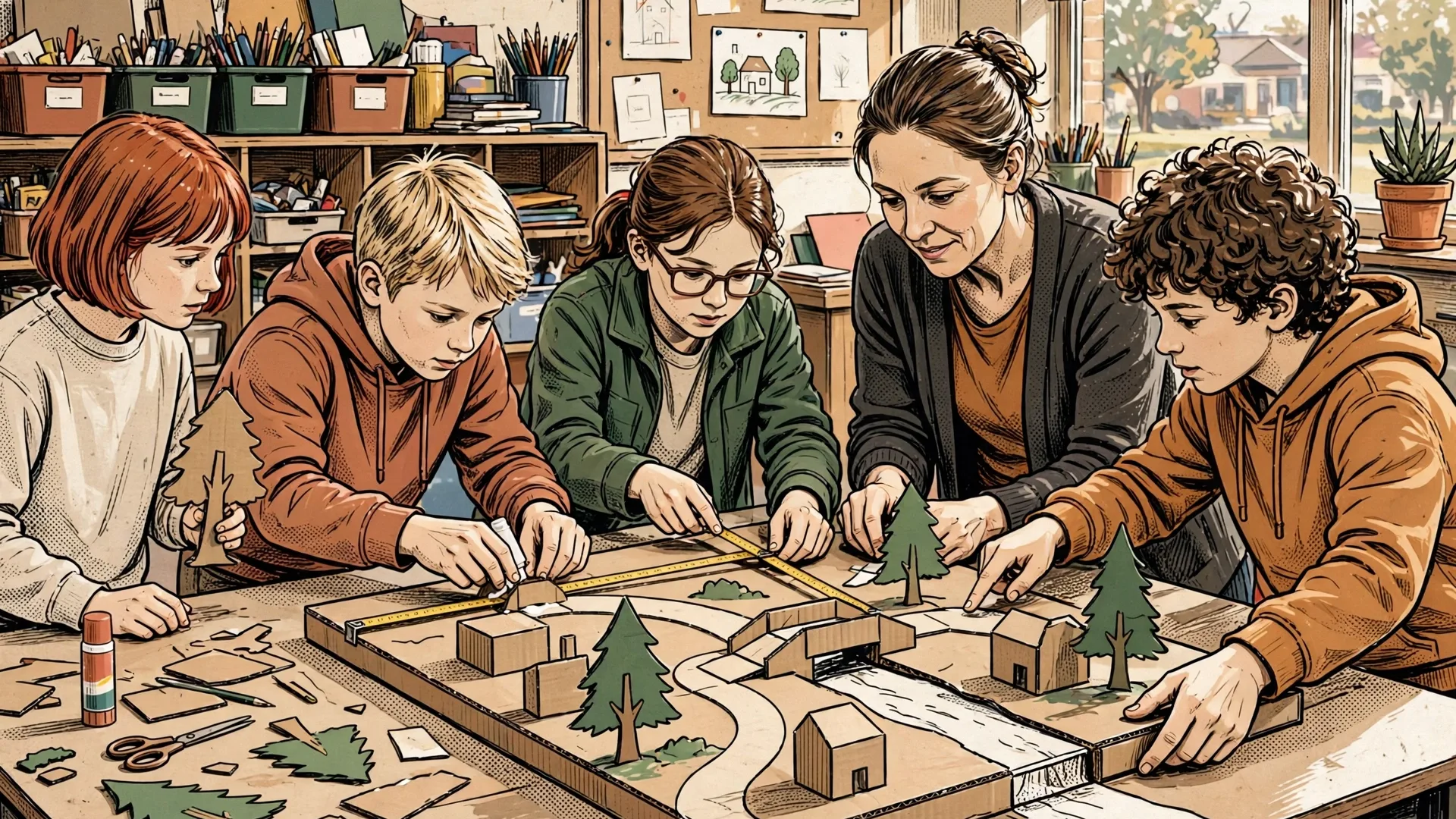
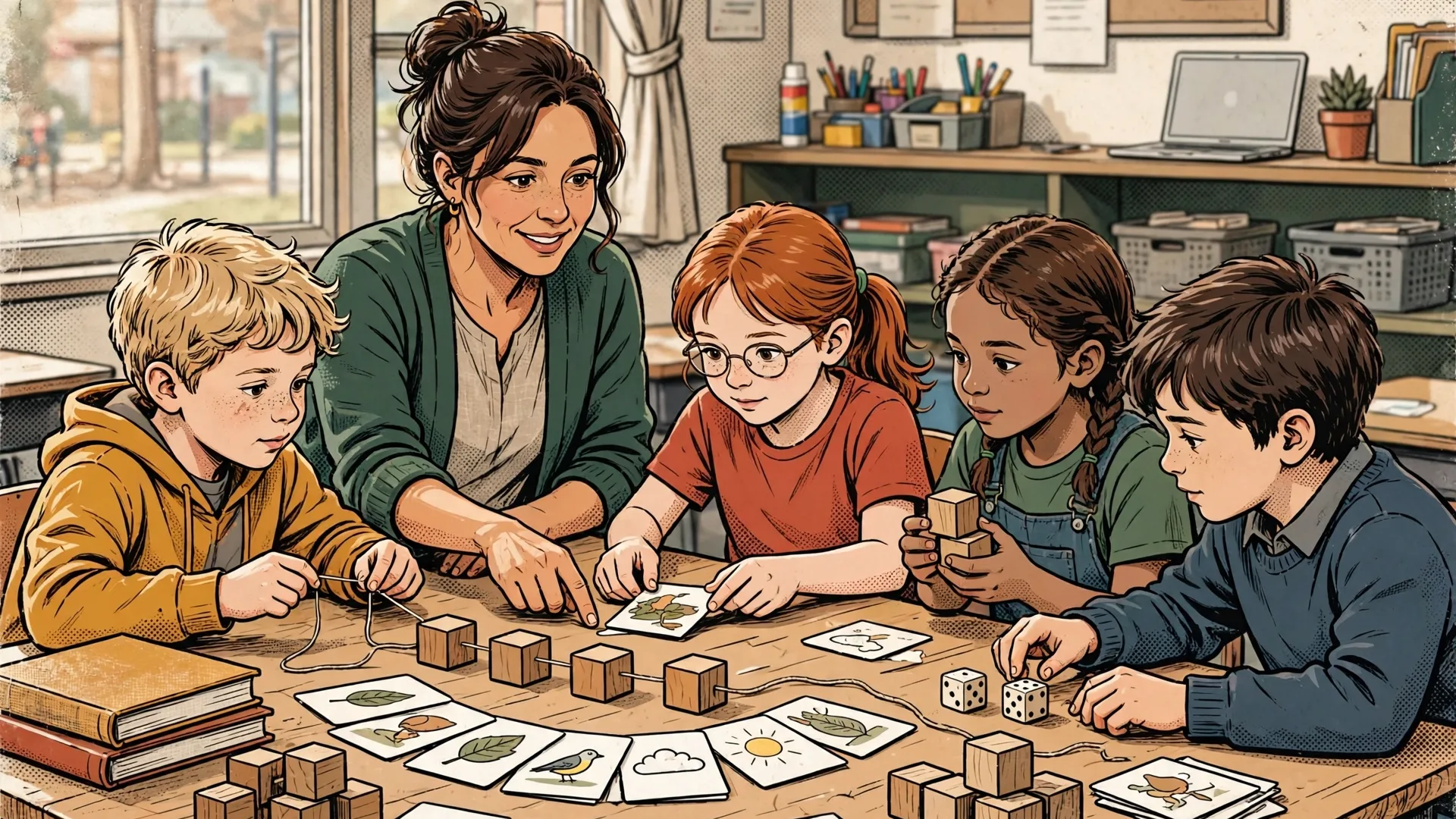
Service-Learning: Designing Your First Community Project
Service learning blends curriculum with real community needs. Here is how to design your first four-week project without confusing it with volunteering.
Draft My Lesson Team
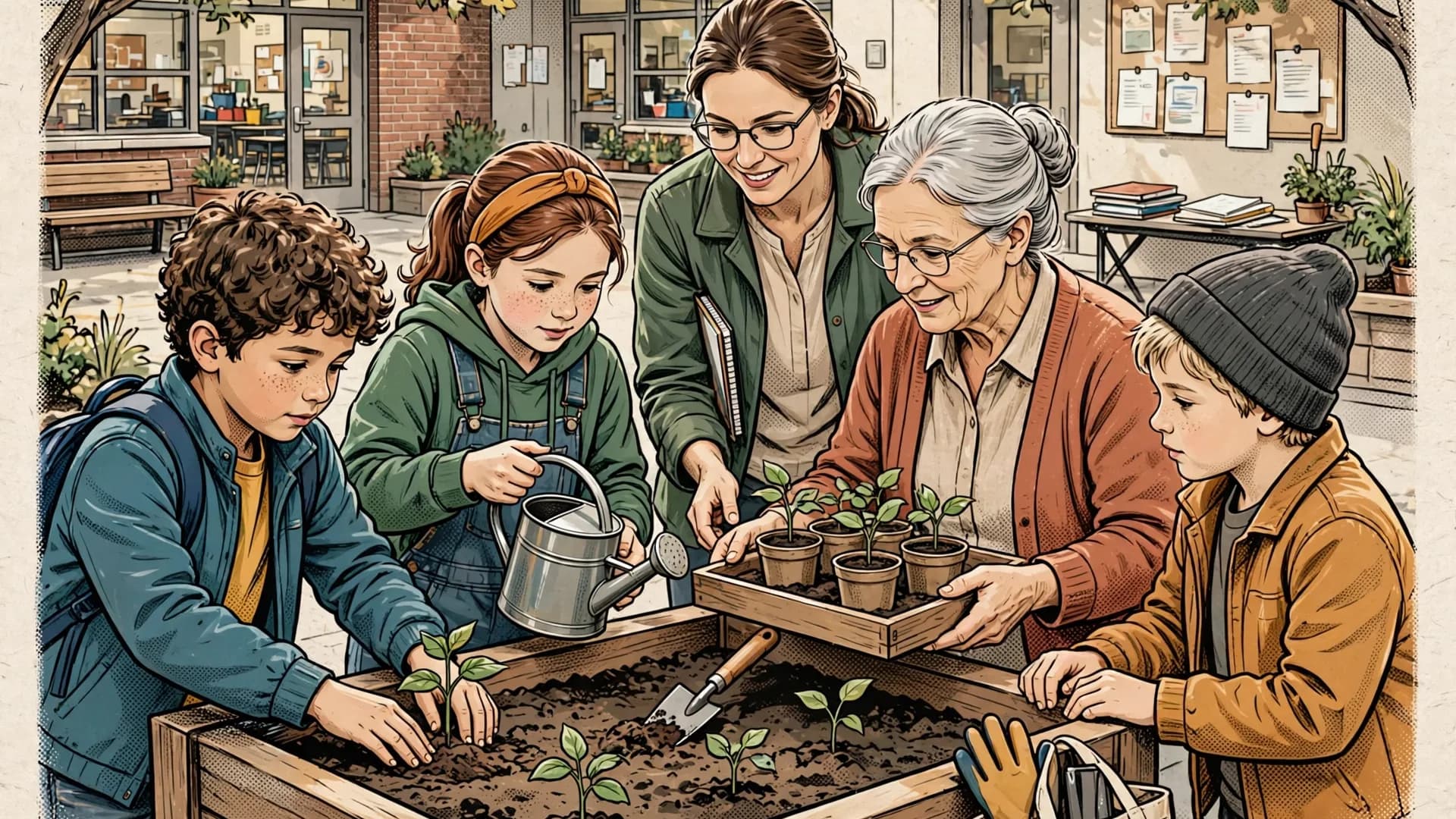
You wrap up a unit on persuasive writing and a colleague says, "We should get the kids out doing some service learning." You nod. Then, walking back to your room, the question lands: isn't this just volunteering with a fancy name? You picture students bagging groceries at a food bank, coming back tired, and you wonder where the curriculum fits in any of that.
Here is the short answer: service learning is not volunteering. It looks similar from the parking lot, but the engine underneath is completely different. In a true service learning project, the curriculum sits at the center. Students do not pause their learning to go help someone. They learn by helping someone, and the help they give is shaped by what they are studying.
That distinction matters, because if you treat service learning like volunteering you will burn a week of instruction and feel guilty about it. If you treat it like a curriculum project with a community partner, you can hit your standards harder than a textbook unit ever would, and your students will remember it for years. This guide walks you through the design from scratch in four weeks, with a concrete Grade 6 example you can adapt tomorrow.
<Callout title="Key takeaways"> - Service learning puts curriculum at the center, with the service work and the academic work as the same work. - A clean first project runs in four weeks: needs detection, curriculum mapping, design and execute, structured reflection. - The four ASLER non-negotiables are meaningful service, curricular integration, student voice, and reflection. - Reflection is the phase that turns community service into service learning. Plan it as a lesson, not a debrief. - Aim for one class, one partner, one product on your first run. Scale only after a clean cycle. </Callout>Service learning vs volunteering: the key difference
Three things often get blurred together. Lining them up makes the rest of the planning much easier.
Volunteering is service with no required link to learning. A class plants trees on Earth Day, comes back, and resumes the regular schedule. The act is good. The curriculum is untouched.
Community service sits one step further along. There is often reflection ("how did that feel?"), but still no deliberate tie to standards. Many schools require community service hours for graduation precisely because the bar is low: show up, help out, log the time.
Service learning is the only one of the three where the curriculum is the spine. You start from a standard or a unit you already need to teach. You find a real community need that lets students practice that content in a meaningful way. You build the project so the academic work and the service are the same work. Then you close with structured reflection that ties the experience back to what students learned.
Two frameworks are worth knowing by name. Community-Based Learning (CBL) broadens the lens to any partnership where the community becomes a classroom. ASLER (the Alliance for Service-Learning in Education Reform) standards, which still anchor most rubrics today, lay out non-negotiables: meaningful service, curricular integration, student voice, and reflection. If your project hits all four, you are doing service learning. If one is missing, you are doing something else, and that is fine, but call it by its real name. Organizations like the Service Year Alliance have spent two decades documenting what separates a meaningful service experience from a logged hour.
<Callout type="quote"> "Service-learning is most effective when the academic learning and the service are intentionally linked through deliberate planning and structured reflection."Attributed to Andrew Furco, service-learning researcher. </Callout>

The 4 phases
Plan your first project across four weeks. One phase per week is realistic for a class running this on top of normal teaching.
1. Needs detection (week 1)
Start with the community, not with your idea. Ask: what real problem, within walking distance or one phone call away, could a class our age actually move the needle on? Talk to the school counselor, the librarian, a feeder elementary, a local nonprofit, a parent who volunteers, the city's recreation department. You are looking for a need that is specific, sized for a class, and visible enough that students will see their impact.
Bring two or three options to your students. Let them weigh in. Student voice is one of the ASLER standards for a reason: ownership at the front of the project drives effort at the back. Vote, and commit.
2. Curriculum mapping (week 2)
Now flip back to your standards document. Which standards from the unit you were already going to teach get hit by this need? List them. If the overlap is thin, either reshape the project or pick a different need. Service learning only works when the academic work is the service work, not a side dish.
Spell out concretely:
- which standards (ELA, math, science, social studies, art) the project will address
- which skills students will practice (writing, editing, designing, presenting, collecting data, interviewing)
- which assessments you will use to grade the academic side
If you want a deeper look at how to plan a multi-week unit around a single driving question, our guide to project-based learning your first unit covers the unit-design fundamentals that service learning shares. For a wider look at how civic engagement intersects with classroom practice, Learning for Justice maintains a deep library of standards-aligned materials worth borrowing from.
3. Design and execute the service (week 3)
This is the doing week. Students plan, draft, build, and deliver. Keep three rails on the track:
- Real partner, real deadline. A handoff date with a real person on the other end is what turns a worksheet into a project. Without it, the work drifts.
- Quality bar from the academic side. If students are writing, the writing has to be edited. If they are designing, the design has to be legible. The community partner deserves a finished product, and your standards demand it.
- Visible progress checks. Daily or every other day, surface what is done and what is stuck. Most service learning projects fail in week 3 because nobody noticed three groups were behind until the morning of the handoff.
4. Final reflection (week 4)
Reflection is not a one-paragraph "what I learned" exit ticket. It is the moment the experience becomes learning. Plan it like a lesson, not a debrief.
Use prompts that force students to connect three layers:
- What I did (the action)
- What I learned academically (the standards in plain language)
- What it meant (the civic and personal layer)
Written reflections, a short presentation to families or the partner, a class discussion structured with sentence stems for students who freeze in open conversation, all work. Pick two formats and commit to both. Without this phase, you have done community service. With it, you have done service learning. Reviews of the evidence on metacognition and self-regulated learning, such as those summarised by the Education Endowment Foundation, point to structured reflection as one of the highest-impact, lowest-cost teaching practices available.
Full example: Literacy activity pack for K-2
Here is one project you can adapt directly.
Class: Grade 6, mixed reading levels. Unit you were already teaching: persuasive and informational writing, with a side of editing for audience. Community need: the elementary school down the road has a cohort of K-2 students reading below grade level. Their teachers are stretched thin and would love extra at-home practice activities that families can run in fifteen minutes.
The project: your Grade 6 students design and produce a literacy activity pack, printed and handed off to those K-2 families.
Phase 1 (needs). A short call with the K-2 lead teacher confirms the need: families want material, but it has to be short, visual, and self-explanatory. Your students hear that directly on a Zoom or in a recorded message. The need is real and they know it.
Phase 2 (curriculum). You map the project to your standards: writing for a specific audience, informational text features, editing and revising, vocabulary use, and a layer of design (typography, layout, imagery). You add a math sub-task: students estimate paper, ink, and packaging needed for 40 packs.
Phase 3 (design and execute). Students work in groups of three. Each group owns two activities (a sight-word game, a short story prompt with picture cues, a rhyming exercise, a "find the letter" page). They draft, peer-edit, get a teacher round of feedback, redesign for K-2 readability, then proof. You print at school. On Friday of week 3, the class walks the packs over and hands them off in person. The K-2 teacher introduces them to the families.
Phase 4 (reflection). Students write a two-page reflection: a paragraph on what they had to change about their writing for a six-year-old, a paragraph on what surprised them, and a section connecting the project to the standards (you give them the list and ask them to point to evidence in their own work). The class then records a short video for the K-2 families thanking them for the partnership.
What did your students learn? ELA standards, hard, with an editor more brutal than any rubric: a real second-grader. Plus design literacy, project management, and the experience of having a smaller child light up at something they made. That is service learning.
Common errors
Three traps catch first-time service learning teachers. All three are easy to avoid once you see them.
Confusing it with volunteering. Symptom: the academic standards are listed at the top of the planning doc but never mentioned again. Fix: write the standards on the board on day one and refer to them every phase. If you cannot show a student where their writing is hitting the standard, the project has drifted.
Skipping reflection. Symptom: the handoff happens, everyone feels good, the bell rings, you move to the next unit. Fix: block out two full class periods in week 4 for reflection before the project starts. Treat that time as untouchable.
Picking a project too small to feel real. Symptom: students go through the motions, the partner barely engages, the work feels performative. Fix: aim for projects that the community partner would actually pay for if you were not doing it. If they would not, the impact is too thin and students will sense it. Real need, real handoff, real stakes.
A fourth, milder trap: doing too much. Your first project does not need to involve four classes, three partners, and the local newspaper. One class, one partner, one product. Get a clean run under your belt, then scale.
Where this fits in your year
Service learning is not a once-a-year stunt. Once you have run a clean project, it becomes a tool you reach for whenever a unit and a community need overlap naturally. You will start spotting opportunities you used to walk past: the senior center that wants someone to read with them, the library running out of bilingual signage, the rec department that needs a new pamphlet for parents.
A few practical notes as you start. Loop your administrator in early so transportation, permission slips, and partner agreements are sorted before week 3. Keep a simple project log so next year's version takes half the prep. And expect the first run to be messier than you would like. That is normal. Students remember the project where the printer jammed and they had to fix it. They forget the worksheets.
You do not need a perfect project. You need a real one. Pick a need, map it to your standards, give students room to own it, and protect the reflection. That is service learning, and it is one of the few things in K-12 that earns the word "transformative" without rolling its eyes.
Draft My Lesson is the AI-powered lesson-planning tool built for English-speaking K-12 teachers. Plan your lessons in minutes and spend more time on what matters. Try it free.
Related articles
Project-Based Learning: Designing Your First PBL Unit, Step by Step
A practical guide to designing your first project based learning unit without the usual flops. Real structure, a real example, and the pitfalls to avoid.
Read articleLow-Tech Classroom: 12 No-Screen Resources That Engage Students
Twelve no screen activities that wake up tired classrooms, from talking circles to paper escape rooms. Practical, low-prep, and built for K-12 teachers who want balance, not luddism.
Read articleEmergency Sub Plans: A Complete Low-Prep Day for Grade 4
Use a complete Grade 4 emergency sub plan with a full-day schedule, original reading and math pages, answer keys, no-internet backups, and handover notes.
Read articleReport Card Comments: Evidence, Progress, Next Steps
Write specific report card comments from classroom evidence, describe progress fairly, and give families one useful next step.
Read article