Project-Based Learning: Designing Your First PBL Unit, Step by Step
A practical guide to designing your first project based learning unit without the usual flops. Real structure, a real example, and the pitfalls to avoid.
Draft My Lesson Team
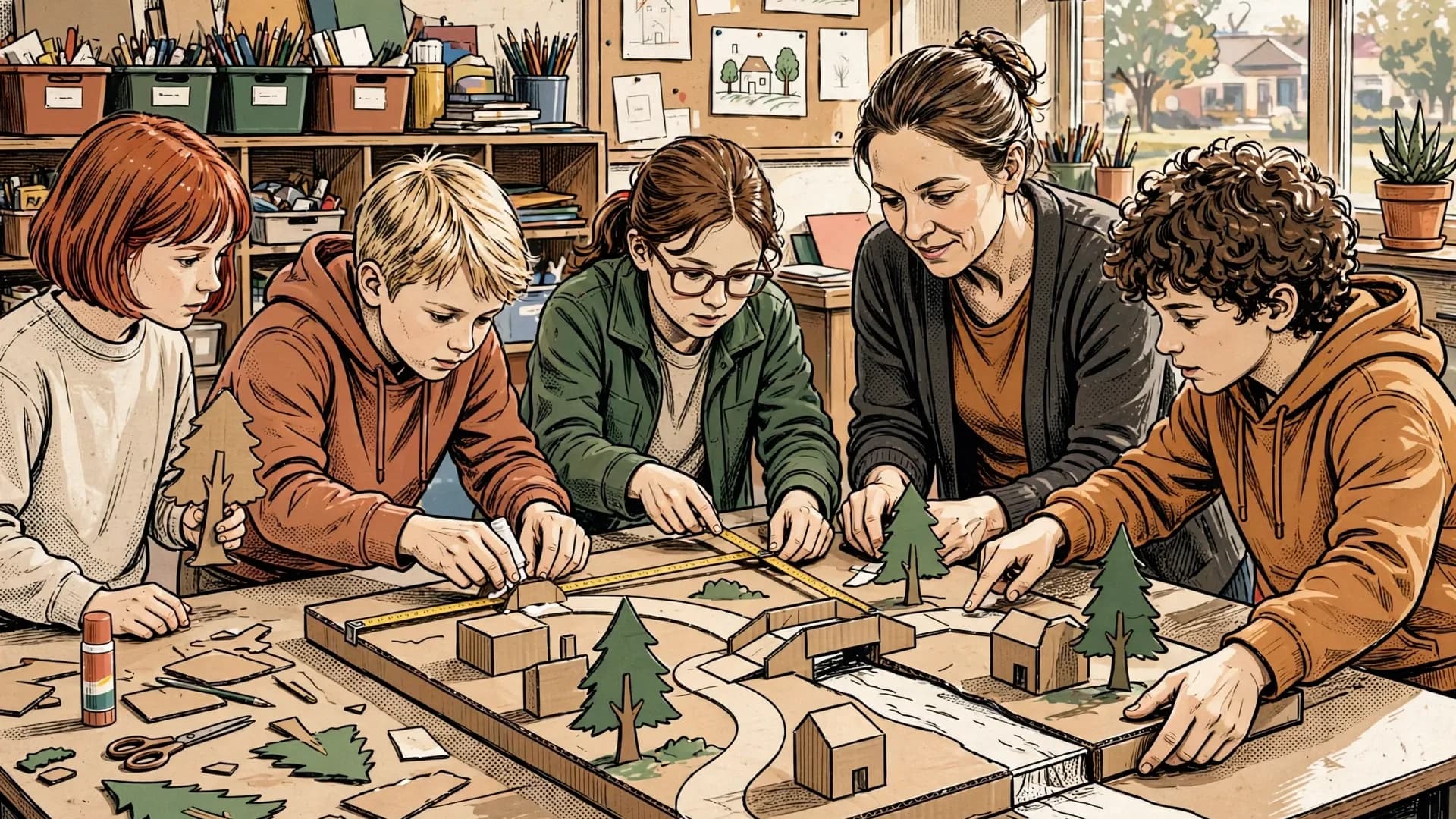
You have probably sat through a PD session that ended with everyone nodding along to the promise of project-based learning. Engaged students, deep thinking, transferable skills, real-world relevance. Then you walked back to your classroom on Monday, asked your students to "make a poster about ancient Egypt," and watched the whole thing collapse into glitter glue and copy-pasted Wikipedia paragraphs.
That experience is so common it has become the default story teachers tell about PBL. The problem is not project-based learning. The problem is that "make a poster" is not a project. It is a craft activity wearing a project costume. There is no real audience, no real question, no real decision for students to make, and the rubric usually rewards neatness over thinking.
Done well, project based learning is one of the few teaching approaches that consistently produces what tests cannot measure: students who can plan, revise, defend their thinking, and work with people they did not choose. Done badly, it eats three weeks of instructional time and leaves you with a stack of cardboard. The difference is structure, and structure is something you can absolutely build, even for your very first unit.
"Rigor is not more work; rigor is real work, where students grapple with meaningful questions and produce something worth sharing." Attributed to John Larmer, PBLWorks.
The 5 mandatory ingredients of a real PBL unit
Before you plan dates, materials, or seating, lock in these five elements. If any one is missing, your project will drift. The Gold Standard PBL framework from PBLWorks (the Buck Institute) codifies these same essentials and is the most cited reference in the field.
1. A driving question that is genuinely open. Not "What was the Civil War?" but "Why do we still argue about Civil War monuments today?" A driving question should be answerable in more than one defensible way, connect to something students actually wonder about, and require investigation rather than recall. Test it on yourself first: if you already know the answer in one sentence, it is not a driving question, it is a worksheet prompt.
2. A tangible final product with a real audience. This is the lever that separates PBL from busy work. A real audience is anyone outside your classroom who will see, use, or respond to the product: parents at an open house, the school board, a local nonprofit, the public library, students in another grade, a town council meeting. The audience does not have to be huge. It just has to be real. The moment students know someone outside the room is going to see the work, the quality jumps.
3. Standards mapped from day one. Open your standards document before you write the schedule. List every ELA, math, science, social studies, or arts standard the project will hit. If you cannot name them, the project will feel fun but you will pay for it later when admin asks what was learned. Mapping standards first also stops scope creep, because you can drop activities that look great but do not serve any standard.
4. Weekly milestones with formative checkpoints. Students need short, visible checkpoints: a research log on Friday of week one, a draft pitch on Wednesday of week two, peer feedback the following Monday. Milestones turn one large deadline into manageable decisions and let you redirect a team before the final week. The Education Endowment Foundation's feedback evidence is a useful guide to making those checkpoints actionable rather than decorative.
5. A rubric that combines content and transferable skills. Half the rubric should assess content (Did students accurately apply what they learned about, say, monuments and civic memory?). The other half should assess transferable skills: collaboration, communication, revision, sourcing. Share the rubric on day one. Students who know exactly how they will be graded produce dramatically better work, and you will spend less time arbitrating "but I worked really hard."
If you want a deeper dive into how to weave assessment into instruction without turning every Friday into a test, our guide to assessment types every teacher should know pairs nicely with this framework.

Full example: "What memorials should our town have?"
Let's walk through a complete unit so you can see the moving parts together. This is a grade 5 unit, four weeks, integrating ELA, Social Studies, and Art. It works equally well in a US elementary classroom, a UK Year 6 setting, an Australian or New Zealand Year 5/6 class, or a Canadian grade 5 class. The driving question travels.
Driving question: What memorials should our town have, and why?
Final product: Each team produces a proposal (written brief plus visual model or diorama) recommending one new memorial for the town. Proposals are presented at a "Memorial Commission" evening attended by parents, the principal, and ideally one local council member or local historian.
Standards mapped (sample):
- ELA: research, citing sources, writing for a specific audience, oral presentation.
- Social Studies: civic life, local history, perspectives in history, primary vs secondary sources.
- Art: composition, symbolism, scale and proportion in 3D models.
Week 1: Inquiry and questioning. Open with a gallery walk of memorials from around the world (the Vietnam Veterans Memorial, a UK war memorial, the Stolpersteine in Berlin, an Indigenous memorial in Australia, a local statue students will recognize). Students journal: What do these memorials say about who is remembered? Who is missing? Introduce the driving question. End the week with a research log: each student picks two events, people, or groups from local history and writes 5 to 7 sentences about each. Friday checkpoint: research log signed off.
Week 2: Investigation and decision-making. Students form teams of three. Each team picks one subject for their proposed memorial and dives deeper: primary sources, interviews (a quick email to the local historical society works wonders), an analysis of who is currently memorialized in town versus who is not. Mid-week mini-lesson on persuasive writing structure. Wednesday checkpoint: a one-page pitch draft. Peer feedback on Friday using the rubric.
Week 3: Design and drafting. Now the project becomes visible. Teams design their memorial: form, materials, location, inscription, symbolism. Art lessons this week focus on symbolism and scale. ELA lessons focus on revising the written brief. Monday checkpoint: design sketch. Thursday checkpoint: brief revised after peer feedback.
Week 4: Build and present. Teams build the model (clay, cardboard, recycled materials, whatever your budget allows). Final two days: rehearsal of the presentation, with one round of structured feedback. Then the Memorial Commission evening. Each team gets five minutes to present and three minutes for questions from the audience.
Rubric (simplified):
- Historical accuracy and depth: 25%
- Quality of written brief (structure, sources, mechanics): 25%
- Design and craftsmanship of the model: 20%
- Collaboration and process (logs, peer feedback, revisions): 15%
- Presentation and response to questions: 15%
Notice what the rubric does not reward: glitter, neatness, or how big the poster is. Notice what it does reward: revision, sourcing, collaboration. That alignment is the whole game.
Common pitfalls (and how to dodge them)
Posters as projects. If the only deliverable is a poster, you have not designed a project, you have designed a craft. Posters can be one element of a presentation, but they cannot be the whole product. Tangible models, written briefs, public presentations, podcasts, short documentaries, and proposals are all stronger.
No formative checkpoints. Skipping checkpoints feels efficient. It is not. Two weeks in, you discover one team has done nothing and another team has gone wildly off topic, and now you have a week to rescue everything. Build in a checkpoint every three to four school days. Use them to coach, not just to grade. John Hattie's Visible Learning meta-syntheses consistently rank teacher clarity, formative evaluation, and feedback among the very top influences on student achievement.
The disengaged student. Every PBL unit will have one. Sometimes two. The fix is rarely "be more enthusiastic." It is usually role assignment plus accountability: every team member has a named role with a deliverable, and individual logs make individual contribution visible. Pair this with private one-on-one check-ins for students who tend to disappear into group work.
Vague driving question. If your question can be googled in one search, rewrite it. Real driving questions force students to weigh competing answers. "Should our town have a memorial for X?" forces a position. "What is X?" does not.
Standards as an afterthought. Mapping standards retroactively is painful and dishonest. Map them first, design activities that hit them, drop anything that does not.
Start small: your first 1-week project
If you have never run a PBL unit, please do not start with six weeks. Start with one. A one-week project is long enough to feel like a project, short enough to recover from if things go sideways, and gives you a real sense of how your students handle this kind of work.
A simple grade 5 starter: "What is the most important rule our class is missing, and why?" Students interview classmates, draft a proposed rule with rationale, and pitch it to the class on Friday. The class votes. The winning rule goes up on the wall and gets enforced for two weeks.
That tiny project hits ELA standards (research, persuasive writing, oral presentation), social studies standards (civic participation, rule of law), and gives you a real audience (the class itself). It takes five days. You will learn more about your students in those five days than in five weeks of worksheets.
Once you have run one short project, scale up. Two weeks. Then four. The structure stays the same: driving question, real audience, mapped standards, weekly milestones, content-plus-skills rubric. The OECD Future of Education and Skills 2030 framework makes the same case at policy scale: agency, co-agency, and the ability to act on complex problems are the competencies schools must build, and short structured projects are one of the cleanest ways to practise them.

Copyable PBL unit brief
| Field | Your unit decision |
|---|---|
| Content objective | The knowledge or skill the project must reveal |
| Driving question | Open enough for investigation, narrow enough for the time available |
| Final product | What students create and the format constraints |
| Audience | Who will see or use the product |
| Source set | The texts, data, or examples students may use |
| Milestones | Dated pieces of evidence before the final product |
| Individual evidence | What each student must submit or explain |
| Rubric criteria | Three to five criteria tied to the objective |
| Recovery plan | What happens when a group misses a milestone |
The individual-evidence row prevents a polished group product from hiding who understood the content. A short conference, annotated source, or individual reflection can provide that evidence without turning the project into another test.
If lesson planning around PBL feels overwhelming, our guide on creating effective lesson plans with AI shows how to draft the daily lessons inside a unit quickly so you can spend your prep time on the parts only a teacher can do: choosing the question, finding the audience, and coaching the students.
Key takeaways
- A real PBL unit needs five non-negotiables: open driving question, tangible product, real audience, mapped standards, content-plus-skills rubric.
- Weekly checkpoints prevent week-three rescues and double as formative feedback, one of the highest-effect moves in the research base.
- Start with a 1-week project before scaling to four; structure transfers, the calendar does not need to.
- Rubrics should reward thinking, revision, and sourcing, not neatness or poster size.
PBL teaches what tests don't
Here is the honest case for project based learning. Standardized tests measure a real but narrow slice of what your students can do. They do not measure whether a student can take vague feedback and revise. They do not measure whether a student can disagree with a teammate without escalating. They do not measure whether a student can stand in front of strangers and defend an idea. They do not measure whether a student can plan three weeks ahead.
PBL, when it is structured well, does measure those things, because it requires them. Every poorly designed project also requires them in theory, but produces no evidence of them in practice. The difference is the structure you build before students ever start working.
You do not need to overhaul your year. You do not need to be a PBL expert. You need one good driving question, one real audience, your standards open on the desk, four or five checkpoints, and a rubric that rewards thinking over decoration. Start with one week. See what your students can do when the question is real and someone outside the room is watching. You will not go back.
Use a lesson plan template for each daily lesson inside the unit, then keep the project brief above as the unit-level reference.
Related articles
Service-Learning: Designing Your First Community Project
Service learning blends curriculum with real community needs. Here is how to design your first four-week project without confusing it with volunteering.
Read articleLow-Tech Classroom: 12 No-Screen Resources That Engage Students
Twelve no screen activities that wake up tired classrooms, from talking circles to paper escape rooms. Practical, low-prep, and built for K-12 teachers who want balance, not luddism.
Read articleEmergency Sub Plans: A Complete Low-Prep Day for Grade 4
Use a complete Grade 4 emergency sub plan with a full-day schedule, original reading and math pages, answer keys, no-internet backups, and handover notes.
Read articleReport Card Comments: Evidence, Progress, Next Steps
Write specific report card comments from classroom evidence, describe progress fairly, and give families one useful next step.
Read article