ADHD in the Classroom: 8 Adaptations That Actually Work
Practical ADHD classroom adaptations any teacher can use right now, no IEP or 504 required. Eight strategies that turn restless energy into engagement.
Draft My Lesson Team
You know the kid. She started the morning with everyone else, sat in her seat, opened the right book. Twenty minutes later her pencil is on the floor, her chair is half-turned toward the window, and she is missing the third instruction in a row. By lunchtime someone has called her "distracted," "lazy," or "not trying." By Friday she might be in the principal's office for something that was really just a foot tapping too loud.
Most teachers meet students with an ADHD diagnosis and others who show similar classroom needs. The CDC's latest US estimate says 11.7% of children ages 3 to 17 had a current ADHD diagnosis in the 2024 National Survey of Children's Health. The CDC also warns that estimates vary by dataset and method. That is a reason to avoid guessing who has ADHD, not a reason to wait before using broadly helpful supports. See the CDC data on ADHD in children for the current figures and definitions.
The good news is that you do not need a diagnosis to help. Most of what works for students with ADHD is just good teaching with the volume turned up a little. The eight adaptations below are designed for that real classroom, the one with thirty kids and one of you, where you cannot give every student a personal assistant but you can change the environment around them.
Key takeaways
- The latest CDC parent-survey estimate is 11.7% of US children ages 3 to 17 with a current diagnosis. Prevalence varies by source and does not identify an individual student.
- Universal classroom supports can start now, but they do not replace a student's IEP, 504 plan, or clinician-led care.
- The biggest gains come from short instructions, visual checklists, transition warnings, and immediate concrete feedback.
- These adaptations help every restless or overwhelmed student, not only those with a formal diagnosis.
The 8 adaptations
Think of these in two groups. The first four shape the structure of your lesson and your room. The last four shape how you interact with the student in the moment. For teachers who want the research base behind these moves, CHADD's educator resources collect the practitioner guidance, and a PubMed review of school-based ADHD interventions summarizes the evidence on behavioral classroom strategies.
Structure
1. Break long tasks into 5 to 10 minute chunks. A forty-minute worksheet feels like climbing a mountain to a student whose working memory drains every few minutes. Cut it into clearly bounded pieces. "Do questions 1 to 4. When you finish, raise your hand and I will tell you the next set." This is not dumbing the work down. It is matching the cognitive load to the attention span. Most students benefit. Students with ADHD stop drowning.
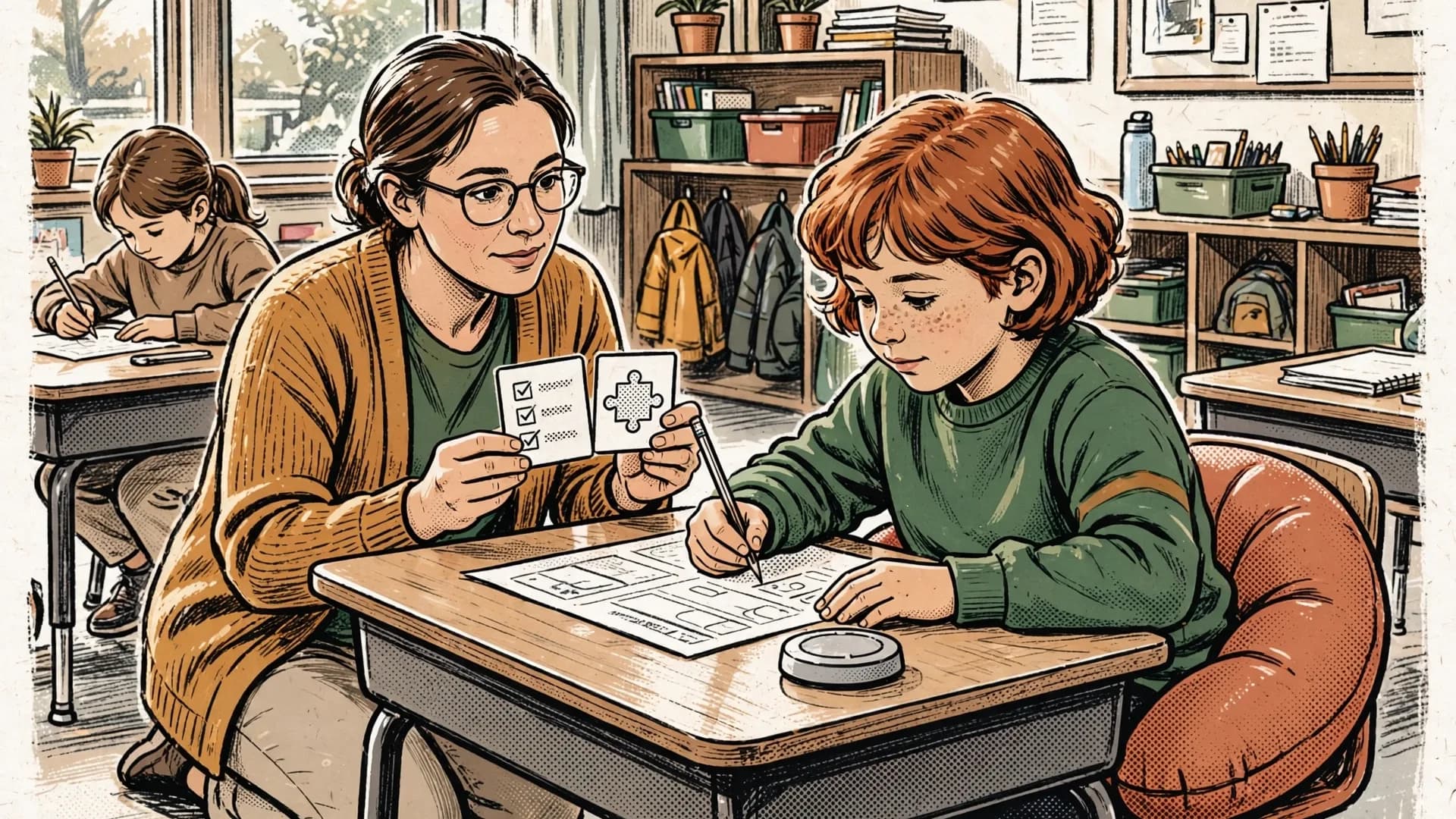
2. Short instructions plus a visual. If your verbal instructions are longer than two sentences, half the room is already lost and the student with ADHD is gone. Say it short. Then put it on the board. Numbers help: "1. Open page 47. 2. Read the first paragraph. 3. Underline the verbs." A written checklist on the board, on a sticky note on the desk, or on a slide is a working memory prosthetic. It costs you thirty seconds and saves you ten minutes of "what are we doing?"
3. Strategic seating. The best seat for a student who drifts is usually near you and away from windows, doors, and high-traffic zones. Not in the back. Not next to the loudest friend. The goal is not punishment, it is proximity. When you can make eye contact in two seconds and tap a desk without crossing the room, redirection happens before behavior escalates. Just frame it neutrally. "I want you up here so I can check in with you" lands very differently than "you are sitting up here because you cannot behave."
4. Transition warnings. Sudden changes are where things fall apart. "Pencils down, get out your math book" delivered cold often produces three minutes of chaos. Instead: "Two minutes until we switch to math." Then "thirty seconds." Then the actual switch. The student with ADHD gets time to mentally close the previous activity and brace for the next one. So does everyone else, honestly.
Interaction
5. Allow controlled movement. A student who cannot sit still is not defying you. Their nervous system is genuinely demanding input. The fight to suppress it eats the cognitive resources you wanted them to spend on your lesson. Build in legitimate movement. Send them to deliver a note to the office. Ask them to hand out the worksheets. Let them stand at the back of the room for the last ten minutes of the lesson if they want to. Errands are gold. They look like jobs. They feel like respect. They reset the body.
6. Optional silent fidgets. A stress ball, a piece of putty, a bit of velcro under the desk, or a smooth stone can help some students and distract others. Treat a fidget as an individual trial, not a universal ADHD intervention. Set one observable rule and check whether the student completes more work with it than without it.
7. Anchor phrases. When a student drifts mid-task, do not lecture. Use a short, calm, repeatable phrase. "Come back here, stay with me." "Eyes on the page." "You and me, one question at a time." Anchor phrases are not magic, but they are predictable, and predictability lowers the temperature. Over a few weeks the phrase becomes a cue the student can almost respond to before you finish saying it. Compare that to the cycle of escalating warnings that ends with a removal from the room.
8. Immediate concrete reinforcement. Students with ADHD often have a delay-aversive reward system. A grade that arrives next week does not motivate. A sticker, a quick "nice work on those first four," a tally mark on a card, a privilege earned by Friday morning, all of these land. The reinforcement does not need to be big. It needs to be fast and tied to a specific behavior. "You stayed with me through the whole instruction set, that is exactly what I asked for."
Symptom to adaptation map
| Symptom in the room | Adaptation that fits | Expected outcome |
|---|---|---|
| Drains attention after a few minutes | Break tasks into 5 to 10 minute chunks | More questions completed, less unfinished work |
| Misses multi-step verbal instructions | Short instructions plus a visual checklist | Fewer "what are we doing?" interruptions |
| Drifts toward windows, doors, or peers | Strategic seating near the teacher | Faster redirection before behavior escalates |
| Falls apart at the end of an activity | Two-minute and thirty-second transition warnings | Calmer switches, less chaos between tasks |
| Cannot stay physically still | Controlled movement and errands | Body resets, cognitive load freed for the lesson |
| Hands constantly busy or tapping | Silent fidget with one clear rule | Quiet engagement, ears free for instruction |
| Drifts mid-task, escalates if scolded | Calm anchor phrase | Lower temperature, faster return to work |
| Unmoved by delayed grades | Immediate concrete reinforcement | Stronger link between effort and reward |
A note before we move on. None of these adaptations require you to assume a student has ADHD. They are good practice for any restless, distracted, or overwhelmed kid. Some children are just kids who slept badly, who are bored because the work is too easy, who are anxious about something at home. Pathologizing every wiggle helps no one. Use these tools as tools, not diagnoses. Practitioner-focused write-ups at ADDitude Magazine and the Education Endowment Foundation toolkit on behaviour interventions both come back to the same point.
If you want to go further on adapting instruction for the full range of learners in your room, the practical guide to differentiated instruction is a useful companion.

Worked example: a 50-minute reading lesson
Let us put three of these adaptations to work in a real lesson. You are teaching a fifty-minute reading comprehension class. The text is two pages. There are ten questions at the end. You have one student, call him Marcus, who almost never finishes the questions.
Old version. You hand out the text. You say, "Read the text and answer the questions. You have forty-five minutes." Marcus reads the first paragraph, looks up, drops his pencil, finds his pencil, reads the first paragraph again, gets distracted by a poster, and at the thirty-minute mark has answered question one. You write "incomplete, see me" on his paper.
New version.
Before the lesson starts, you move Marcus to the desk closest to your teaching position. Not in front of the whole class, just to the end of the front row where you can lean in without anyone noticing. That is adaptation 3.
You begin. "We are doing three things today. One, read the text. Two, answer the first five questions. Three, answer the last five." You write those three steps on the board as you say them. That is adaptation 2. Then you add: "I will tell you when to switch from each step to the next."
You set a fifteen-minute window for the reading. At the thirteen-minute mark you say, calmly, "Two minutes until we move to questions one through five." That is adaptation 4. At fifteen minutes you call the switch.
Marcus has now done one chunk. You walk past, glance at his sheet, and say "good, you got the main idea, keep going." Twenty seconds of contact. He starts the questions. At the twenty-five minute mark you call the next transition. At forty-five minutes you collect.
Will Marcus finish all ten questions? Maybe not. But he will likely finish six or seven instead of one, and he will leave the room having had a successful lesson rather than another failure. Across a school year, that difference is the entire trajectory of how he sees himself as a learner.
You did not write a new curriculum. You broke the task into chunks, used a visual checklist, gave transition warnings, and moved one chair. Three adaptations. Maybe four minutes of extra prep. If Marcus has a formal plan, these choices must also follow it.
Put the supports into the lesson plan
Do not leave accommodations in a separate document that you remember only after the lesson. Add a short planning row beside each phase.
| Lesson phase | Planned support | What you will watch |
|---|---|---|
| Directions | Three numbered steps on the board | Can the student start without another verbal prompt? |
| Independent reading | Two seven-minute chunks with a check-in | Does attention drop at the same point in each chunk? |
| Questions | Five items, brief movement, then five items | Does the movement break improve completion? |
| Transition | Two-minute and thirty-second warnings | Can materials change without escalation? |
| Exit ticket | One question and immediate feedback | Can the student state the main idea before leaving? |
The observation column matters. Keep a support when it improves access or completion. Change it when it does not. Share recurring patterns through the school's normal support process rather than turning classroom notes into a diagnosis.
Many "behavior issues" disappear with structure
Here is the part that catches a lot of teachers off guard. When you implement adaptations like these consistently for a few weeks, a meaningful chunk of what you used to call behavior problems quietly evaporate. The kid who "could not sit still" sits longer because he gets a fidget and a movement break. The kid who "never listens" listens because the instructions are short and visible. The kid who "explodes at transitions" stops exploding because the transitions stop ambushing him.
This is not a claim that ADHD does not exist or that good structure replaces medical care. Some students need a formal diagnosis, support from a specialist, and sometimes medication. That conversation belongs with families and clinicians. Your job is not to diagnose. Your job is to make the classroom a place where a student who might have ADHD can do their best work today, before any of that paperwork arrives, and where students who do not have ADHD also benefit from cleaner structure.
The most respectful thing you can do for a student who is struggling with attention is to assume they want to succeed and that something in the environment is making it harder than it should be. Then change the environment. Watch what happens. Adjust again. That is the whole job, and it is one you already know how to do.
The eight adaptations above are a starting kit. Pick two or three this week. Try them for ten days. See which kids loosen up. You will know quickly which ones to keep.
Use the same structure in your next plan with a copyable lesson plan template, then adapt it to the supports already agreed for your students.
Related articles
Inclusive Education: 5 Myths Worth Debunking
Inclusive education is often misunderstood as extra paperwork or lowered standards. Here are five myths every K-12 teacher hears, honestly debunked with classroom-ready practice.
Read articleDifferentiated Instruction: Adapting Lessons for Every Student
Differentiation doesn't mean creating three separate lesson plans. Learn practical strategies to adapt your teaching for diverse learners without tripling your prep time.
Read articleEmergency Sub Plans: A Complete Low-Prep Day for Grade 4
Use a complete Grade 4 emergency sub plan with a full-day schedule, original reading and math pages, answer keys, no-internet backups, and handover notes.
Read articleReport Card Comments: Evidence, Progress, Next Steps
Write specific report card comments from classroom evidence, describe progress fairly, and give families one useful next step.
Read article