Teaching Reading in Elementary: Activities That Build Foundations
Teaching reading in elementary grades shapes a child's entire academic future. Here are the five components every classroom needs and ten activities you can use Monday morning.
Draft My Lesson Team
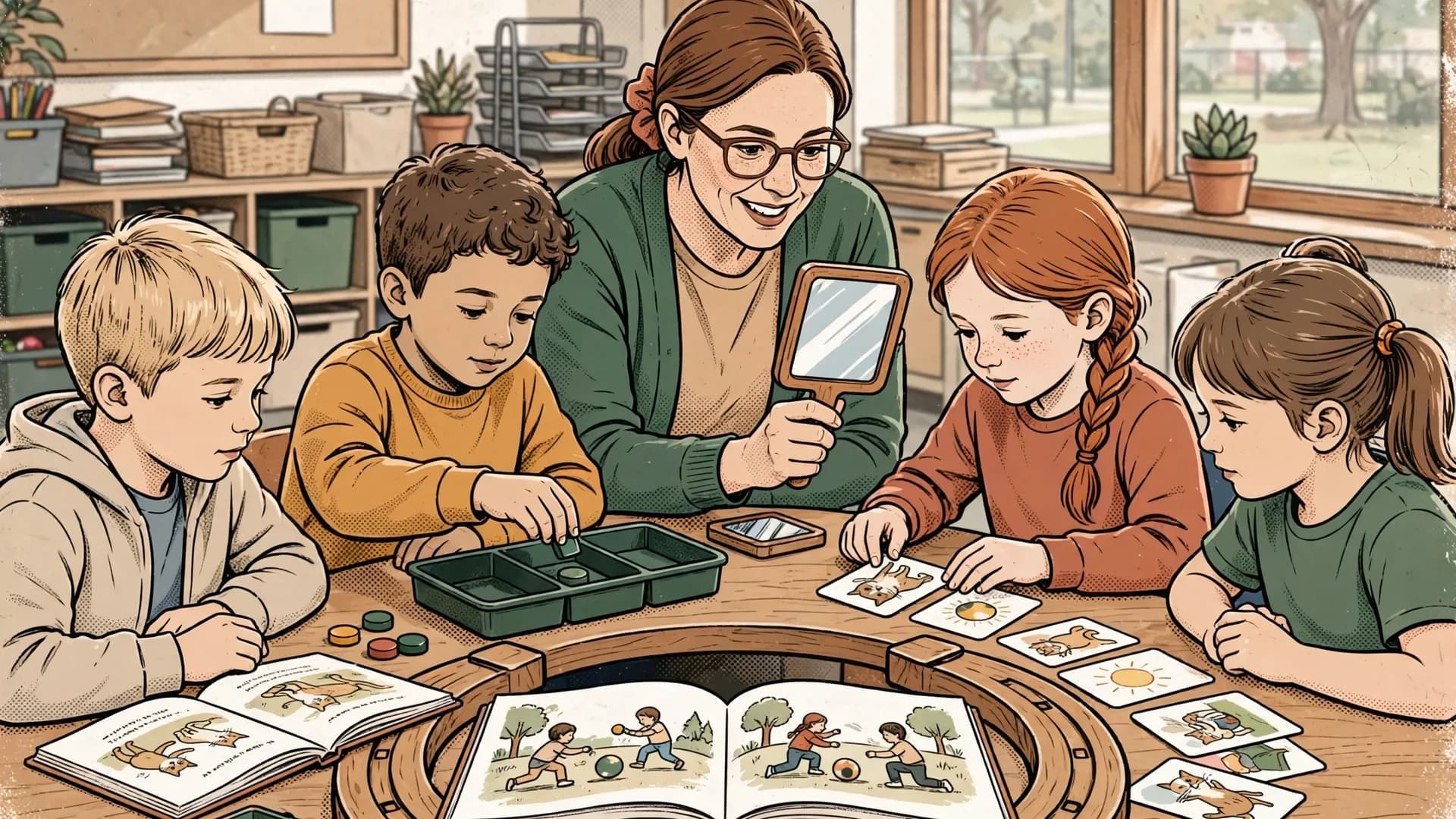
You know the kid. The one who slides their workbook a few inches under their elbow when you walk past, who suddenly needs the bathroom whenever it's their turn to read aloud, who can recite the entire plot of a movie but freezes when you ask them to sound out cat. They are not lazy. They are not unintelligent. They are a child who has figured out that hiding feels safer than failing in front of their friends.
In Kindergarten and first grade, that hiding looks small. By third grade, it is a chasm. The shift from "learning to read" to "reading to learn" happens around age eight or nine, and any kid who arrives there without solid decoding skills falls behind in every subject at once. Math word problems, science articles, social studies texts, even the morning agenda on the board, all of it becomes a cliff.
This article is about how you keep that cliff from forming. It is grounded in the National Reading Panel's framework and the broader body of research now called the science of reading. It is also written for the realities of a busy classroom, whether you teach in Sacramento, Sheffield, Sydney, Saskatoon, or Selwyn. The activities work in all five contexts because the human brain learns to read the same way everywhere, even if the spelling rules differ slightly.
<Callout type="info" title="Key takeaways"> - The five pillars of reading instruction (phonemic awareness, phonics, fluency, vocabulary, comprehension) all need weekly attention. - Ten low-prep activities, each 5 to 15 minutes, slot into any guided reading block without special purchases. - The reading wars are over: structured phonics taught alongside rich texts is the consensus position of the science of reading. - Early identification of struggling readers, before third grade, dramatically changes long-term outcomes. </Callout>The 5 components you can't skip
In 2000 the National Reading Panel reviewed thousands of studies and identified five pillars of effective reading instruction. Two and a half decades later, the consensus has only deepened. If your reading block is missing any of them, you have a leak. Reading Rockets maintains an excellent overview of each pillar with classroom-ready guidance.
Phonemic awareness. This is the ability to hear and manipulate the individual sounds in spoken words, with no letters involved. A child who can tell you that sun starts with /s/, or who can blend /k/ /a/ /t/ into cat in their head, has phonemic awareness. It is auditory, oral, and the strongest predictor of later reading success. Many struggling readers struggle because this layer was thin or skipped entirely.
Phonics. Now we add letters. Phonics teaches the link between sounds (phonemes) and the letters or letter combinations (graphemes) that represent them. Systematic, explicit phonics, short a before long a, simple consonant blends before digraphs, gives kids the code that unlocks every new word.
Fluency. Fluency is reading with appropriate speed, accuracy, and expression. It is the bridge between decoding and comprehension. A reader who has to sound out every third word burns all their cognitive fuel on letters and has nothing left for meaning.
Vocabulary. Kids comprehend what they have words for. Vocabulary instruction is not about Friday quiz lists. It is about exposure to rich language across the day, explicit teaching of high-utility words, and giving kids multiple encounters with new words in different contexts.
Comprehension. This is the goal. Everything else feeds into it. Comprehension means making meaning, asking questions, predicting, summarizing, and connecting text to the world. It is taught, not caught, and it starts in Kindergarten with read-alouds, not in fourth grade with worksheets.
You teach all five every week. Not necessarily every day, not necessarily in equal proportion, but never as a one-and-done unit. They reinforce each other constantly. The Education Endowment Foundation's KS1 literacy guidance translates these pillars into a sequenced teaching routine that holds up across school systems.
<Callout type="quote"> "The most important thing about reading is that nothing matters more than what the teacher does. Programs do not teach. Teachers teach."Attributed to Tim Shanahan, literacy researcher </Callout>

10 activities, 5-15 minutes each
These slot into a guided reading block, a morning meeting, or a transition. None of them require a special purchase. Most require nothing more than your voice and your students' attention.
1. Syllable claps. Say a word, have the class clap once per syllable. But-ter-fly. Three claps. Cat. One clap. Start with two-syllable compound words, move to longer ones. Five minutes, builds phonemic awareness, works as a brain break.
2. Sound-matching games. Say three words: bat, ball, fish. Which one doesn't belong? Kids point or call out. Reverse it: which two start the same? End the same? Rhyme? You can play this in line for lunch.
3. Elkonin boxes. Draw three or four squares on a whiteboard. Say a word like map. Students push a counter into each box as they say each sound: /m/ /a/ /p/. Then write the letters above the counters. This is phonemic awareness and phonics married together, and it is gold for kids who confuse letters and sounds.
4. Choral reading. The whole class reads the same passage out loud together. Confident readers carry the rhythm; struggling readers ride along without exposure. Use a poem, a chant, or a familiar paragraph. Repeat it across several days. Fluency rises, anxiety drops.
5. Partner reading. Pair a stronger reader with a developing reader. They take turns, sentence by sentence or page by page. The stronger partner gently corrects errors. You circulate and listen in. Fifteen minutes, twice a week, beats most things money can buy.
6. Echo reading. You read a line with full expression, students echo it back the same way. This is fluency plus prosody. It also lets kids who cannot yet decode the text hear what fluent reading sounds like, which they then start to imitate.
7. Word ladders. Start with cat. Change one letter to make bat. Change one letter to make bag. Continue. This is phonics in motion, makes the alphabetic principle feel like a puzzle, and works on the board or as a quiet pencil task.
8. Mini-writes. Five minutes of writing a single sentence about what you just read. The act of encoding a word strengthens decoding. Spelling and reading are two sides of the same coin, and a decade of neuroscience evidence on the reading brain keeps confirming it.
9. Read-aloud with think-alouds. You read a picture book or chapter aloud and pause to narrate your own thinking. I'm wondering why she looked sad there. I think she might be remembering her grandmother. You are showing kids what comprehension looks like from the inside. Do this daily, even with older elementary students.
10. Vocabulary in context. Pick two or three Tier 2 words from the day's read-aloud, words like furious, hesitate, enormous that show up across subjects. Define them simply, use them three times during the day, and notice when students start using them too. This beats any flashcard deck.
If you want to layer these onto the rest of your week, the differentiated instruction guide shows how to vary support without writing separate lessons.
Phonics, whole language, and the science of reading
You may have heard of the reading wars. For decades, English-speaking educators argued between two camps. Whole language said children learn to read the way they learn to speak: through immersion in rich, meaningful texts, with phonics taught only as needed. Phonics-first said children must be explicitly taught the alphabetic code before fluent reading is possible.
The argument is over. The science of reading, an interdisciplinary body of work spanning cognitive science, linguistics, neuroscience, and classroom research, has resolved it. The consensus, in plain English, is this: reading is not natural the way speaking is. The brain has dedicated regions for spoken language but no reading region. Fluent reading is built by explicitly wiring together the visual, sound, and meaning systems, and that wiring requires systematic phonics. David Pearson's body of work, including the Handbook of Reading Research, tracks how the field converged on this position over four decades.
But phonics alone is not enough. Children also need rich vocabulary, background knowledge, sentence-level practice, and whole books worth caring about. The dichotomy was always false. The right answer is structured phonics taught alongside meaningful texts, oral language, and content-rich read-alouds.
So when you plan your reading block, you do not have to pick a tribe. You teach the code explicitly. You read beautiful books aloud. You have students write. You build vocabulary and knowledge across every subject. The kids who needed phonics get phonics. The kids who already crack the code get pushed into deeper texts. Nobody is left in a lurch because of an ideological flag.
When it's something more
Most kids who struggle early catch up with good first teaching and a bit of small-group support. Some do not, and the earlier you spot them the better the outcome.
Watch for the following signals beyond the typical wobble:
- Difficulty rhyming or producing rhymes well past age five.
- Confusion of similar sounds (/b/ and /d/, /m/ and /n/) that persists after explicit teaching.
- Slow, halting oral reading that does not improve with practice on the same text.
- Strong listening comprehension paired with weak reading comprehension. The child understands the story when you read it but cannot extract meaning when reading alone.
- Avoidance behaviors: hiding work, claiming illness on reading days, acting out during literacy block.
- Family history of reading difficulty or dyslexia.
Any one of these is not a diagnosis. A cluster of them, persisting across a term despite good instruction, is a flag. Talk to your literacy coach, learning support coordinator, SENCO, or whatever the equivalent role is called in your school. Push for a screening. Early identification of dyslexia and other reading difficulties changes lives. Late identification costs them.
You are not the diagnostician. You are the person who notices first, documents what you see, and makes the referral. That is enormous.

Reading is freedom
Every other thing a child will learn rides on this. History, science, civic life, the warning label on a medicine bottle, a love letter, a contract, a poem. Children who read well grow into adults who can navigate a complicated world on their own terms. Children who do not are dependent in ways their younger selves never imagined.
That is why teaching reading in elementary grades is the most important work in the building. Not the most glamorous, not the easiest to assess on a single test, but the work that compounds. A first grader who leaves your room able to decode and loving stories has been handed a key that unlocks every door for the rest of their life.
You do not need a perfect curriculum. You need the five components, a handful of activities you trust, the courage to teach phonics explicitly, the wisdom to read beautiful books out loud, and the eyes to spot the kid who is hiding their workbook. Start there on Monday.
Draft My Lesson is the AI-powered lesson-planning tool built for English-speaking K-12 teachers. Plan your lessons in minutes and spend more time on what matters. Try it free.
Related articles
Reading Comprehension Lesson Plan: Research-Based Strategies
Plan a reading comprehension lesson with explicit modeling, guided practice, independent transfer, and an exit ticket. Includes a copyable 45-minute plan.
Read articleElementary Math Misconceptions: 8 You're Teaching Without Realizing
Eight common math misconceptions quietly slip into K-5 classrooms every week. Spot them, reframe them, and watch your students reason with real confidence.
Read articleEmergency Sub Plans: A Complete Low-Prep Day for Grade 4
Use a complete Grade 4 emergency sub plan with a full-day schedule, original reading and math pages, answer keys, no-internet backups, and handover notes.
Read articleReport Card Comments: Evidence, Progress, Next Steps
Write specific report card comments from classroom evidence, describe progress fairly, and give families one useful next step.
Read article