Teacher Burnout: Early Warning Signs and What to Do About It
Teacher burnout creeps in before you notice. Learn the early warning signs, what actually helps, and why this is a structural mismatch, not a personal failing.
JD Casanova
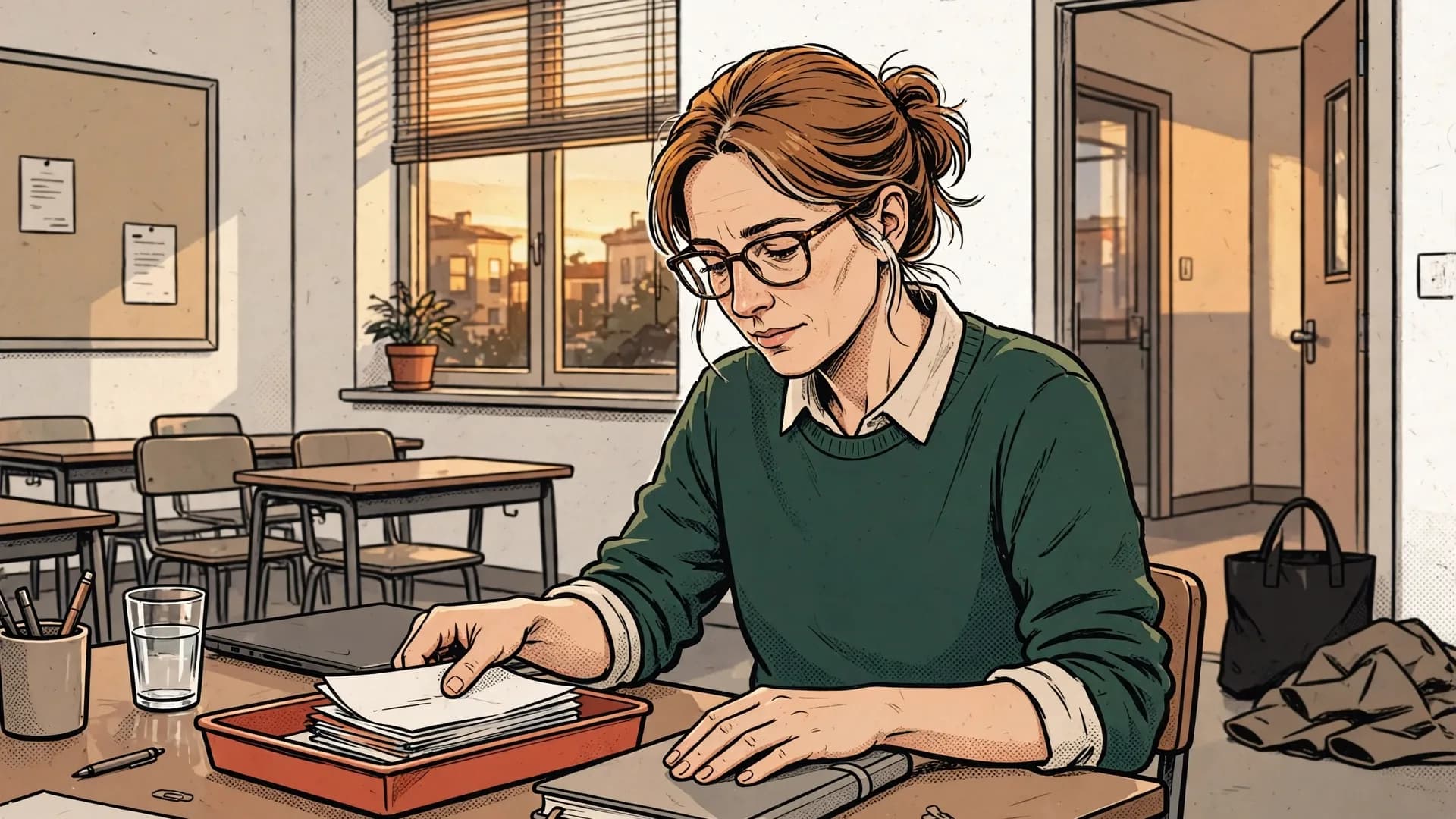
It is Sunday around 6 p.m. The light shifts. Your stomach tightens. You start mentally running through tomorrow: the meeting before homeroom, the parent email you still have not answered, the kid in third period who has been struggling and whose mom you keep meaning to call. By 8 p.m. you are quietly dreading a job that, last September, you genuinely loved.
If that feels uncomfortably familiar, you are not alone, and you are not weak. What you are describing has a name. Researchers call it burnout, and the signs you are noticing are real, measurable, and known. They are also, importantly, not a verdict on who you are as a person or a teacher.
This article is for you if you suspect something is off but you keep telling yourself to push through one more week. We will walk through the early warning signs, what genuinely helps, what does not (no, more mindfulness apps will not save you), and where to find real support depending on where you teach.
Stat callout. Since 2019, the World Health Organization classifies burnout as an occupational phenomenon in ICD-11. It is not a medical condition. It is a recognized syndrome resulting from chronic workplace stress that has not been successfully managed. That distinction matters: burnout is a workplace problem, not a personal weakness.
The 3 early signs
In 1981, psychologist Christina Maslach built the most widely used model for understanding burnout. She found that burnout is not one feeling. It is three, and they tend to show up together. Spotting them early is the difference between a hard term and a year off the profession. The Maslach Burnout Inventory remains the gold-standard instrument cited in occupational health research worldwide.
1. Emotional exhaustion that the weekend does not fix
This is the one most teachers notice first. You are tired in a way that sleep does not seem to repair. Saturday morning you sleep in, you have coffee, you do nothing productive, and by Saturday night you still feel hollowed out. Sunday you brace yourself instead of resting. Monday you start the week already running on empty.
Normal tiredness recovers with rest. Emotional exhaustion does not, because it is not really about hours slept. It is about the constant emotional labor of holding a room of 25 humans, mediating conflicts, absorbing other people's stress, and doing it all while being observed, evaluated, and underfunded.
If your weekends no longer recharge you, that is data. Pay attention to it.
"Burnout is not a problem of people. It is a problem of the social environments in which people work. When the workplace does not recognize the human side of work, the risk of burnout grows."
Attributed to Christina Maslach, UC Berkeley psychologist and co-developer of the Maslach Burnout Inventory.
2. Cynicism toward students you used to find rewarding
Last year you laughed at the kid who asked "but why do we have to learn this?" This year, when she asks, something inside you snaps shut. You catch yourself thinking she is being difficult. You catch yourself rolling your eyes. You go home and feel guilty about it, because you remember when that kind of question used to spark a great five-minute tangent.
Maslach calls this depersonalization. It is when the warmth you felt toward your students gets replaced by distance, irritation, or a flat sense of "just get through the period." It is a protective response. Your nervous system is trying to ration emotional output because there is not enough to go around.
This sign is the hardest to admit because it conflicts with your image of yourself as a caring educator. Notice it without judgment. The cynicism is not who you are. It is a symptom that the system around you is asking for more than it gives back.
3. Reduced sense of personal accomplishment
You finish a unit you spent weeks planning. The kids did well. A parent emailed something kind. And you feel... nothing. Or worse, you feel like it was not enough, that you should have done more, that anyone could have done it better.
This is the third leg of the Maslach model: the quiet erosion of the feeling that your work matters. When it shows up, small wins stop registering. Big wins feel like luck. You start measuring yourself only against what is still undone, and the to-do list never ends, so the verdict is always the same: not enough.
If you are reading this and thinking "yeah, all three," do not panic. Recognition is the first useful thing. Now let us talk about what actually moves the needle.

What HELPS
Most advice for burned-out teachers is some flavor of "take care of yourself." That advice is not wrong, but it is incomplete, because it puts the entire burden on you to fix a problem the system created. What follows are concrete, structural moves that have evidence behind them. The OECD TALIS survey on teacher wellbeing consistently shows that workload and autonomy, not personal resilience, are the strongest predictors of teacher exit.
Set a hard stop on grading. The single most useful boundary most teachers can adopt is a no-grading-after-7 p.m. rule. Pick a time. Make it non-negotiable. The work will still be there tomorrow. Your nervous system needs an evening that does not belong to your job. If 7 p.m. feels impossible, start with 9 p.m. and walk it back over a few weeks.
Delegate what is delegate-able. This includes work students themselves can do (peer grading low-stakes practice, classroom jobs, student-led routines) and work admin assistants or coaches can absorb. You are not paid to do everything. You are paid to teach. The rest is negotiable.
Cut at least one unnecessary meeting per week. Look at your calendar. There is at least one recurring meeting where your presence is performative rather than essential. Decline it for two weeks. See what happens. Usually the answer is: nothing, except you got 45 minutes back.
Talk to one trusted colleague. Not a vent session that leaves you both more drained. A real conversation with someone who gets it, where you can name what you are feeling without performing professionalism. Isolation amplifies burnout. One honest conversation a week is medicine.
Consider professional help. A therapist who works with educators, or a doctor who can rule out the physical contributors (thyroid, sleep apnea, vitamin deficiencies that mimic burnout). The American Psychological Association has solid public-facing guidance on work-related stress and when to seek clinical support. Teachers who get help recover faster and stay in the profession longer.
Use the tools that buy back hours. Lesson planning is a place where most teachers leak the most time. If a tool can take a 90-minute prep down to 15, that is 75 minutes back in your evening, every weeknight. We have a deeper guide on this in our time-saving strategies for teachers post.
What DOESN'T help
Some of the most popular advice for burned-out teachers is, frankly, useless. Sometimes worse than useless, because it makes you feel like a failure for trying it and not getting better.
More mindfulness alone. Mindfulness is fine. It is not a cure for understaffed schools, oversized classes, or unpaid overtime. Apps that ask you to breathe for two minutes between back-to-back lessons are a band-aid on a structural wound.
"Just say no." Easy advice from people who do not work in environments where saying no carries real professional risk. The answer is not individual willpower, it is structural change.
Self-care as a shopping problem. A bath bomb does not fix a 60-hour week. Buying yourself nice things is not a strategy. If a candle is the only intervention you have left, the system has already asked too much of you.
"You just need a hobby." You do not have time for a hobby. That is the whole point.
Performative gratitude exercises. Gratitude journaling has a place. It is not a substitute for being able to leave work at work. Telling a burned-out teacher to "focus on the positive" is gaslighting dressed up as wellness.
A step-by-step: the 7-day reset
If you read all of the above and felt overwhelmed, start here. This is one week, low-stakes, designed to give you a baseline.
- Day 1, Monday: pick your hard stop. Write down a time after which no school work happens. Tape it to your laptop.
- Day 2, Tuesday: identify one meeting to skip. Look at this week and next. Pick one. Send a polite "I have a conflict that day" email tomorrow morning.
- Day 3, Wednesday: text one colleague. Not to vent, just to schedule a 20-minute coffee or walk. Keep it short. Keep it honest.
- Day 4, Thursday: protect a lunch. Eat away from your desk. No grading. No emails. Twenty minutes. This is a rehearsal for what your relationship with work could look like.
- Day 5, Friday: actually leave at the contracted time. One Friday. The work can wait until Monday. It is allowed.
- Day 6, Saturday: zero school work. Not a single email. Not "just one quick thing." Zero.
- Day 7, Sunday: reflect, do not plan. Notice how you feel compared to last Sunday. Write three lines about it. That is your baseline. Next week you build from there.
One week will not cure burnout. It will tell you whether you can claw back small pieces of your life, which is the foundation everything else rests on.
Country-specific resources
Burnout responds to support, and support is structural. Here is where to find it depending on where you teach.
United States. Most school districts offer an Employee Assistance Program (EAP) with free, confidential short-term counseling. Ask HR or check your benefits portal. The American Federation of Teachers also maintains a member assistance line. If you are in crisis, call or text 988.
United Kingdom. Education Support is a UK charity dedicated specifically to teacher wellbeing. They run a free 24/7 helpline staffed by qualified counsellors. You do not need a referral. You do not need to justify the call. The Department for Education also publishes an education staff wellbeing charter that unions can use to push for structural change at the school level.
Australia. Beyond Blue offers free mental health support and has resources tailored to educators. The Australian Education Union also negotiates wellbeing funding in many states. Call 1300 22 4636 anytime.
Canada. Provincial teacher unions (OECTA in Ontario, BCTF in BC, ATA in Alberta, FAE in Quebec) run wellness funds and counseling programs as part of your benefits. Check your local union website. Wellness Together Canada is also free at 1-866-585-0445.
New Zealand. The NZ Education Institute (NZEI) and PPTA both offer member support services. The Mental Health Foundation of NZ has educator-specific resources, and 1737 is a free 24/7 text or call line for anyone needing to talk.
If you are reading this in crisis right now, please call your country's crisis line. Burnout can shade into depression, and depression is treatable. Reaching out is not failure. It is the most professional thing you can do.

Key takeaways
- Burnout is a recognized occupational syndrome, not a character flaw or a willpower issue.
- The three early signs to watch for are emotional exhaustion the weekend does not fix, growing cynicism toward students, and a fading sense that your work matters.
- Structural moves beat self-care: a hard stop on grading, fewer meetings, one honest conversation a week, and tools that buy back evening hours.
- Mindfulness apps, gratitude journals and bath bombs do not fix a 60-hour week. They are wallpaper over a structural problem.
- If you suspect you are slipping into clinical territory, reach out to a doctor, a therapist, or your country's helpline. That is the most professional thing you can do.
It is not your fault
You did not become a teacher because you wanted to fail at self-care. You became a teacher because you wanted to make a difference. The fact that you are tired does not mean you were wrong about that, and it does not mean you are bad at your job.
Burnout is what happens when sustained, high-stakes emotional work runs into systems that do not provide enough resources, autonomy, or recovery time. The mismatch is not your character flaw. It is the structure of the work. The fix, ultimately, has to be structural too: smaller classes, fewer unpaid hours, real planning time, leaders who protect teacher time instead of filling it. Until that fixes itself (and it will not, on its own), the best you can do is protect your own boundaries, lean on the people who get it, and use every tool available to claw back the hours that nobody else will give you.
You are allowed to want a job that does not eat you alive. You are allowed to set boundaries even when nobody else seems to. And you are allowed to ask for help, from a colleague, a therapist, a union, or a tool that does some of the lifting for you. None of that makes you less of a teacher. It makes you one who plans on still being here in five years.
JD Casanova
Draft My Lesson is the AI-powered lesson-planning tool built for English-speaking K-12 teachers. Plan your lessons in minutes and spend more time on what matters. Try it free.
Related articles
Emergency Sub Plans: A Complete Low-Prep Day for Grade 4
Use a complete Grade 4 emergency sub plan with a full-day schedule, original reading and math pages, answer keys, no-internet backups, and handover notes.
Read articleReport Card Comments: Evidence, Progress, Next Steps
Write specific report card comments from classroom evidence, describe progress fairly, and give families one useful next step.
Read articleExit Ticket Template: 30 Examples and 5 Copyable Formats
Copy 30 exit ticket examples for math, ELA, science, and social studies, then use five flexible templates to decide what your class needs next.
Read articleScope and Sequence Template: Build a Course in the Right Order
Copy a scope and sequence template, see a nine-week algebra example, and check prerequisites, pacing, assessment, and gaps before lessons begin.
Read article