Resolving Student Conflicts: A 4-Step Protocol
Resolving student conflicts in your classroom does not have to derail the whole period. This 4-step protocol takes ten minutes and actually teaches resolution.
Draft My Lesson Team
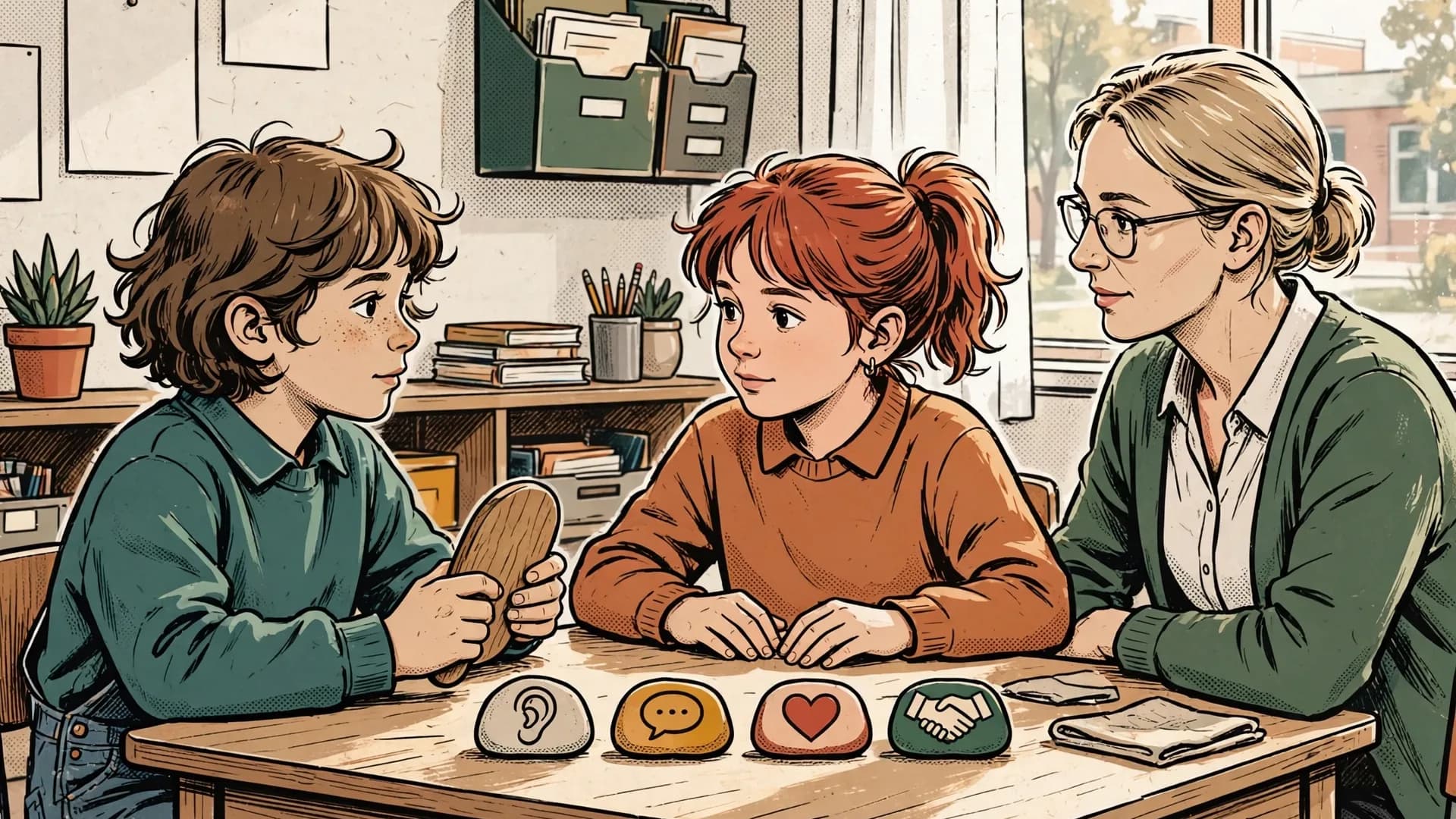
You are mid-sentence in a fractions lesson when you hear it. The shout. The chair scrape. Two of your students are on their feet, faces red, and the rest of the class has stopped breathing to watch what you do next.
Most of us handle this on instinct. We raise our voice over theirs. We deliver the lecture about respect. We separate the two kids and move on. The class settles, the lesson resumes, and we tell ourselves we handled it.
Except we did not handle it. We suppressed it. The two students are still angry, still convinced the other one started it, and the rest of the class learned that conflict is something the adult shuts down by being louder. Nobody learned how to resolve anything. So tomorrow, or next week, the same fight comes back wearing a different jacket.
Key takeaways
- The default reflex (yell, lecture, separate) suppresses conflict but never teaches resolution.
- A 10-minute facilitator protocol with four steps (Pause, Asymmetric listen, Neutral reframe, Concrete agreement) shifts the work to the students.
- Reflect each side without judging, then translate surface behavior into the unmet need underneath.
- Escalate to admin, counselor, or family when there is physical danger, repeated patterns, or mental health concerns.
- The point is not a quiet room. It is students who can resolve conflict without you standing over them.
Why typical methods fail
The default playbook for student conflict has three moves: yell, lecture, separate. Each one feels productive in the moment. None of them teach resolution.
Yelling works because it interrupts the escalation. But it also models exactly the behavior you are trying to stop. You are telling two ten-year-olds that volume wins, while asking them not to use volume. Kids notice that contradiction even if they cannot name it. UNESCO reports on school violence and bullying consistently show that adult modeling shapes peer behavior more than any classroom rule poster.
Lecturing feels educational, which is why we love it. The problem is that nobody learns anything new from a lecture delivered while their amygdala is on fire. Your speech about kindness is hitting a brain that is still rehearsing comebacks. The words land somewhere between zero and useless.
Separation works for the next twelve minutes. Then the bell rings, the two students walk into the same hallway, and you have outsourced the resolution to recess, the bus, or the parking lot after school. None of those venues have a trained adult.
The real problem with all three methods is the role they cast you in. You become the police officer. You enforce, you punish, you decide. The students become defendants. Their job is to either argue their case or shut up until you are done. They never become the people who actually solve the problem, which means they never learn how.
What follows is a different role. You become the facilitator. The students do the work. It takes ten minutes, and it is teachable.

The 4-step protocol
This protocol assumes nobody is in physical danger. If someone is, that is not a conflict, that is a safety incident, and you skip straight to admin. Otherwise, run the four steps in order. Do not improvise the sequence. The order is what makes it work.
The structure draws on social-emotional learning research summarized by CASEL's framework on relationship skills and responsible decision-making, which treats conflict resolution as a teachable competency rather than a character trait.
Step 1: Pause
Physical separation, two minutes of silence, no talking allowed.
The first move is to remove the audience and lower the heart rate. Send the rest of the class to independent work, a read-aloud, or anything that does not require your attention. Move the two students to opposite corners of the room, or to the hallway if your school allows it. Tell them, calmly: "We are going to talk about this in two minutes. Until then, no words. Just breathe."
Set a timer if you need to. Two minutes feels like an hour when you are a furious eleven-year-old, which is the point. You are letting the body come down before the mouth opens. If you skip this step, the next three will fail, because nobody can listen with a pulse of 140.
You also need this pause. Take three breaths yourself. You are about to be the calmest person in the room for the next eight minutes, and you cannot fake that.
Step 2: Asymmetric listen
Each student tells their version, uninterrupted, while you only reflect.
Bring the two students together at a quiet table. Explain the rule once: "Each of you gets to tell me what happened. The other person does not interrupt. I will not interrupt either. When you are done, I will say back what I heard, and you will tell me if I got it right."
Then pick one student to start. Let them talk. Do not correct, do not editorialize, do not say "well actually." When they finish, reflect: "What I hear is that you sat down at the desk because you got there first, and when she pushed your bag off, you felt disrespected. Did I get that right?"
Adjust until they say yes. Then turn to the second student and repeat. Same rule, same reflection.
This step is the hardest because your instinct will be to point out where one of them is wrong. Do not. Your job here is not truth. Your job is to make each student feel heard, because a student who feels heard becomes capable of hearing someone else. A student who feels dismissed stays in fight mode. The asymmetry, where you reflect but never judge, is what unlocks the next step.
"What others do may be a stimulus of our feelings, but not the cause."
Attributed to Marshall Rosenberg, Nonviolent Communication
Step 3: Neutral reframe
You summarize without blame and name the unmet need behind each side.
Now you talk. Briefly. You restate the situation in language that contains no villain. You name what each student needed and was not getting.
Something like: "So it sounds like both of you wanted the same seat. You wanted it because you sit there every day and it feels like yours. You wanted it because your friend is at the next table and you wanted to talk to her at lunch. Two reasonable wants, one chair."
Notice what you did not say. You did not say who was right. You did not say who started it. You translated the surface behavior, the shove, the shout, into the underlying need: belonging, routine, friendship, fairness. Almost every classroom conflict, when you scrape off the top layer, is one of those four needs colliding with another one of those four needs. Peer-reviewed work on needs-based conflict resolution in schools supports this: naming the unmet need reliably lowers behavioral escalation.
This reframe does two things at once. It tells each student that their motivation was legitimate. And it tells them that the other student was not evil, just also legitimate. That is the moment the temperature drops.
Step 4: Concrete agreement
Both students propose what they will do differently next time, and you write it down.
Final step. You ask each student: "Next time this happens, what will you do differently?" Not what the other student should do. What they will do.
Push for specifics. "Be nicer" is not a plan. "I will ask before I move someone's bag" is a plan. "I will say I want the seat instead of just sitting" is a plan. Write both commitments on a sticky note or an index card. Both students sign it. You keep it.
The agreement does not have to be balanced or fair in some cosmic sense. It has to be concrete and owned. Two ten-year-olds who each named one thing they will do differently have just learned more about resolution than a forty-five minute lecture would deliver.
Send them back to their seats. Total elapsed time, if you stay tight: ten minutes.
Real case: 5th grade, two students, one seat
Maya and Jordan, both ten. Maya has sat at the window desk for the entire school year. Jordan has just transferred in three weeks ago and decided this morning that the window desk has the best light. Maya arrives, Jordan is in her seat, Jordan refuses to move, Maya pushes Jordan's pencil case onto the floor, Jordan stands up, both start shouting, the class freezes.
You stop your read-aloud. "Class, page 42, silent reading until I come back. Maya, the corner by the door. Jordan, the corner by my desk. Two minutes, no talking." You set the timer on your phone.
After two minutes you bring them to the small table at the back. "Maya, you go first. What happened, from your side." Maya: "I always sit there. He took my seat and he would not move and I do not know why he is even doing this." You reflect: "What I hear is that the window desk has been your spot all year, and when Jordan was in it and would not move, it felt like he was taking something that was yours. Right?" Maya nods.
Jordan: "She just shoved my stuff on the floor. I was just sitting in a seat. There was no name on it." Reflect: "So from your side, you sat down in what looked like an open seat, and you were surprised when Maya reacted the way she did because nothing said it was assigned. Right?" Jordan: "Yes."
Now the reframe. "Okay. Maya, you have had that desk all year and it feels like home base. Jordan, you are still finding your spots in this room because you are new, and that one looked good. Both of those make sense. The seats are not officially assigned, but Maya, you are right that there is a pattern. Jordan, you are right that there is no rule."
Step four. "Maya, what will you do differently next time someone is in a seat you usually use?" Maya, after a pause: "I will ask them instead of moving their stuff." "Jordan, what will you do differently?" Jordan: "I will ask if a seat is taken before I sit down, since I am still new." You write both on a card. They sign. They go back, Maya to a different desk for the day, Jordan to the window.
The fight does not come back. Not because you scared them, but because they each own one specific behavior change. Compare that to the version where you yelled, separated them, and moved on. Same ten minutes, completely different learning.
If you want more on building classroom systems that prevent these flare-ups in the first place, the guide to classroom management without yelling covers routines and calm redirection. The Education Endowment Foundation's behaviour guidance is also worth a slow read on building proactive routines.
When to escalate
The protocol works for most peer conflicts. It does not work for everything, and the worst mistake you can make is using it on a situation that needs an adult with more authority than you have.
Escalate to admin when there has been physical contact beyond a shove, when a weapon of any kind is involved, when one student is significantly larger or older and the dynamic is coercive, or when the same two students have been through the protocol twice and the conflict keeps reigniting. Pattern is information.
Escalate to the school counselor when the conflict touches mental health, when one student appears to be in crisis, when you suspect the behavior is a symptom of something happening at home, or when a student starts disclosing during step two and you realize you are out of your depth. You are a teacher, not a therapist. Knowing the line is part of the job.
Loop in family when the agreement from step four is broken repeatedly, when the conflict is part of a broader pattern you have seen across weeks, or when the student involved is struggling in ways that go beyond this one incident. Frame the family conversation around what you are seeing, not what the student is. Behavior, not character.
A note for UK, Australian, Canadian, and New Zealand colleagues: substitute your local terms. Head teacher or principal or deputy. Pastoral lead or wellbeing coordinator or guidance counselor. The structure of the escalation is the same everywhere. The titles change, the logic does not.

The role you are teaching them
Here is the part that matters more than the four steps. When you run this protocol, your students watch you do it. Then they watch you do it again with two other kids. By the third time, something changes. They start to internalize the sequence. Pause. Listen. Reframe. Agree.
Some of them, eventually, start to do it themselves. Not perfectly, not every time, but you will catch two of them at recess working through a small disagreement using language that sounds suspiciously like yours. That is the actual goal. Not a quiet classroom. Students who can resolve conflict without you in the room.
It costs you something. Ten minutes of class time. The emotional energy of staying neutral while two kids you care about are upset. The patience to not lecture when lecturing would feel so good. That cost is real, and pretending otherwise is dishonest. But the alternative cost, the same fight every Tuesday for the rest of the year, is higher.
You are not the police. You are the person who shows them how to do it themselves. That is a much better job.
Draft My Lesson is the AI-powered lesson-planning tool built for English-speaking K-12 teachers. Plan your lessons in minutes and spend more time on what matters. Try it free.
Related articles
Classroom Management Without Yelling: Strategies That Actually Work
Yelling drains you and stops working by Wednesday. Here are concrete classroom management strategies that protect your voice, your energy, and your students.
Read articleAdvisory Period: Using Your 50 Minutes Well
The advisory period is often the most wasted slot in the schedule. Here is a 4-block framework and 8 ready-to-use topics that turn 50 minutes into real conversation.
Read articleEmergency Sub Plans: A Complete Low-Prep Day for Grade 4
Use a complete Grade 4 emergency sub plan with a full-day schedule, original reading and math pages, answer keys, no-internet backups, and handover notes.
Read articleReport Card Comments: Evidence, Progress, Next Steps
Write specific report card comments from classroom evidence, describe progress fairly, and give families one useful next step.
Read article