Emotional Intelligence in the Classroom: Activities by Age
Concrete activities to teach emotional intelligence in your classroom, sorted by age band. Short, repeatable, and designed to fit a real teaching week.
Draft My Lesson Team
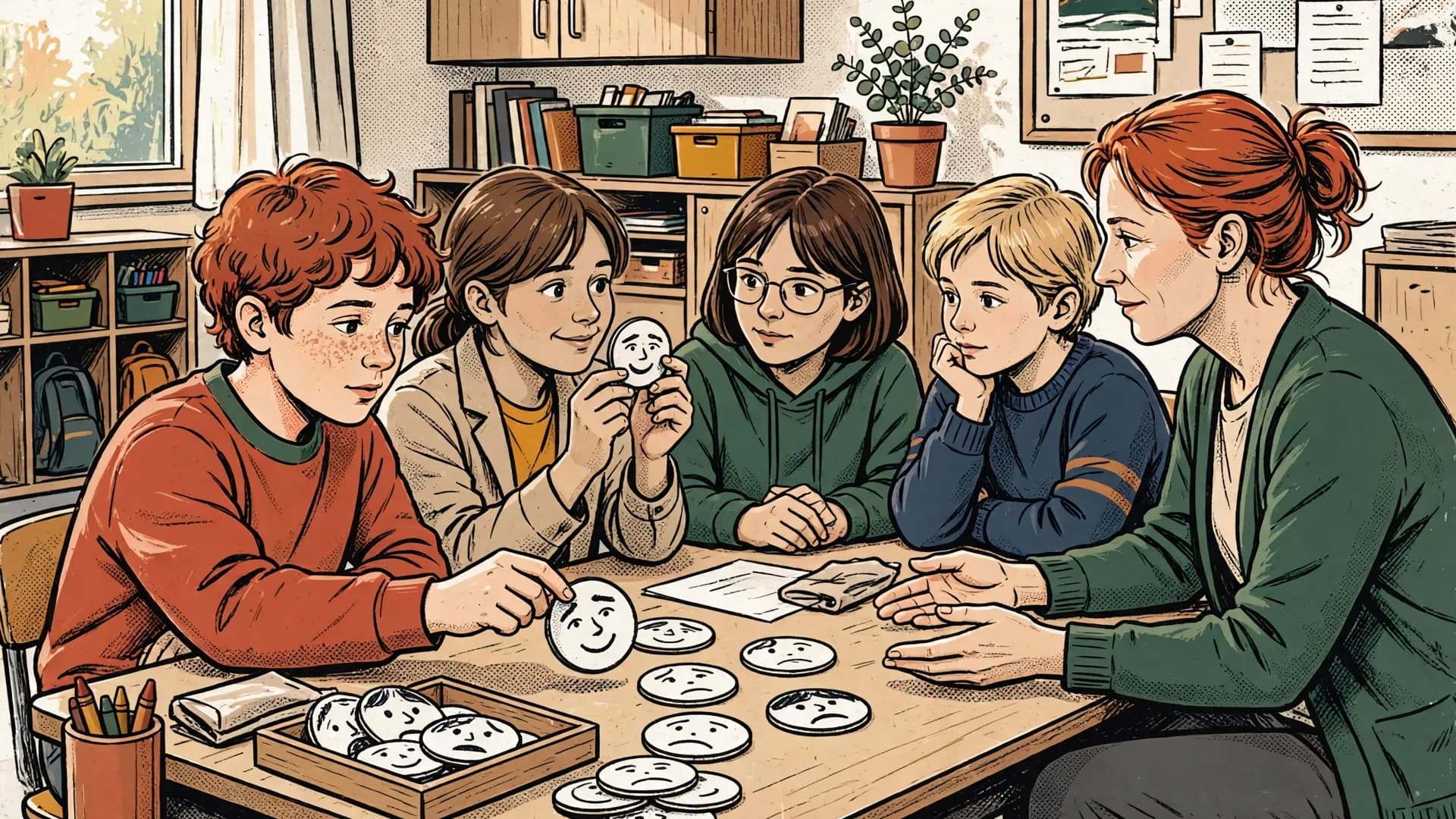
It is 10:47 on a Tuesday. A nine-year-old at the back of your room slams a pencil down, kicks the chair leg, and shouts something you cannot quite catch. The other twenty-six kids freeze and look at you. You have a math objective on the board, a learning walk in fifteen minutes, and absolutely no script for what just happened.
If you have lived this moment, you already know that academic content is only half of what your classroom runs on. The other half is emotional regulation, self-awareness, empathy, and the kind of quiet social skill we lump under "SEL" or "emotional intelligence." Every curriculum frames it as essential. Very few give you anything to actually teach with. The CASEL framework breaks the territory into five competencies, which is a useful map when you are deciding what to teach first.
This guide is the opposite. Below you will find concrete activities, sorted by age band, that you can run in five to fifteen minutes. Each one has a frequency, a step-by-step, and a way to know it is working. None of them require a special period, a kit, or a counsellor in the room. They are designed to fit between fractions and phonics, because that is where real life actually happens.
"If your emotional abilities aren't in hand, if you don't have self-awareness, if you are not able to manage your distressing emotions, if you can't have empathy and have effective relationships, then no matter how smart you are, you are not going to get very far."
Attributed to Daniel Goleman, psychologist
Ages 4 to 7: naming what you feel
Young children do not yet have the vocabulary for what is going on inside them. "Bad" covers anger, sadness, hunger, and tiredness. The first job of emotional intelligence at this age is simply giving feelings their right names.
Three short routines work well here:
- Emotion wheel check-in (5 minutes, daily on arrival). A printed wheel with four to six faces. Each child taps where they are.
- Traffic-light feelings (3 minutes, before transitions). Red, yellow, green cards. Children hold up the colour that matches them right now.
- Story of the day (10 minutes, three times a week). A picture book with a clear emotion arc, followed by one open question: "When did you feel like the bear?"
Step by step: the emotion wheel (5 minutes)
- Print a wheel with six faces and label them: happy, sad, angry, scared, tired, calm.
- As children enter, each one places a clothes peg with their name on the face that matches.
- Glance at the wheel before starting the lesson. Do not call out individuals.
- If three or more pegs sit on "angry" or "sad," open with a one-minute breathing exercise instead of jumping into the lesson.
- At the end of the day, ask one volunteer: "Did your feeling change? What made it move?"
Success indicators: by week six, children name feelings without prompting, use at least four distinct emotion words, and start asking peers "are you okay?" without you scripting it.

Ages 8 to 11: noticing patterns
By upper elementary, students can name emotions but rarely connect them to triggers or behaviour. The goal here shifts from labelling to reflection. The Education Endowment Foundation review of SEL programmes finds an average impact of around four months of additional progress when the work is sustained and embedded.
Three routines that fit a real week:
- Three-minute emotion journal (3 minutes, daily after lunch). Three prompts: how do I feel, why might that be, what do I want to do next.
- Brief role-play (10 minutes, once a week). Two students act out a real classroom scenario, the rest of the class names what each character might be feeling.
- Calm passport (ongoing). Each student keeps a small card with five strategies they have personally tested for calming down: counting, drawing, asking for water, walking to the window, naming five things they can see.
Step by step: the three-minute journal
- Hand out a single page split into three columns.
- Set a visible timer for three minutes.
- Students write or draw their answer to: "Right now I feel..." / "Maybe because..." / "Next, I will..."
- No marking, no sharing, no grading. Sealed with the date.
- Once a month, students reread their last four entries privately and circle any pattern they notice.
Success indicators: students start using "I feel X because Y" sentence frames spontaneously during conflicts. Trips to the office for emotional outbursts drop. Journals fill up.
This age band is also where differentiation matters most. Some students need more scaffolding around the journal prompts, others race ahead. If that gap is wide in your class, the practical guide to differentiated instruction covers ways to adjust without doubling your prep.
Ages 12 to 15: navigating the messy middle
Middle school is where emotional intelligence either becomes a real skill or quietly disappears under social pressure. Students this age can engage with abstract questions but will refuse anything that feels childish or forced. Pitch it as adult.
Three formats that work:
- Guided debate on real situations (15 minutes, weekly). A short scenario from the news or school life, structured turns, a rule that you must steelman the opposing view before disagreeing.
- Reflective writing (10 minutes, twice a week). Single prompt, no audience. Examples: "Describe a moment this week you handled well." / "Describe a moment you would replay differently."
- Moral dilemmas (15 minutes, fortnightly). Short, ambiguous cases. No correct answer. Students argue, then write what they would actually do.
Step by step: the guided debate
- Pick a scenario with two defensible sides. "A friend cheated on a test. Do you tell?" works.
- Split the class in half. Side A defends one position, Side B the other. Assign at random, regardless of personal view.
- Three minutes preparation in pairs.
- Two minutes per side to argue, alternating.
- Before any rebuttal, the rebutter must summarise the other side's strongest point in one sentence. If they cannot, they sit.
- Close with a private one-line written reflection: "What did I actually think before? What do I think now?"
Success indicators: students start steelmanning each other in unrelated lessons. Hallway arguments cool faster. Reflective writing gets longer over the term, not shorter.
Ages 16 to 18: self-knowledge and stepping up
By the end of secondary, the work shifts from regulating yourself to understanding yourself and helping others. Activities here should respect that students are nearly adults. The OECD work on social and emotional skills tracks how these capacities predict later wellbeing and school outcomes, which is worth knowing when a colleague asks why you are spending lesson time on this.
Two strong formats:
- Brief self-knowledge tests (10 to 15 minutes, monthly). Short, evidence-based instruments adapted for classroom use: stress signals checklist, communication style inventory, values ranking. Always private.
- Peer mediation (ongoing, trained volunteers). A small group of trained students helps resolve low-stakes conflicts before they reach staff. Requires real training, not just a poster.
Step by step: the values ranking
- Provide a list of fifteen values: honesty, achievement, family, independence, security, creativity, fairness, kindness, ambition, freedom, loyalty, learning, health, faith, fun.
- Students cut and rank their top five, then top three, then top one.
- They write half a page on: "Where in my last week did I act in line with my top value? Where did I not?"
- No sharing required. The reflection is the point.
- Repeat in three months. Compare.
Success indicators: students reference their own values when discussing decisions. Peer mediators handle minor conflicts without staff. Older students start mentoring younger ones unprompted.

Integrating SEL across subjects
Here is the honest part. None of the activities above will move the needle if they live inside a single advisory hour and nowhere else. Emotional intelligence is not a subject. It is a thread that has to run through everything. The 2017 meta-analysis of follow-up effects of SEL interventions found that benefits to academic performance and social behaviour persisted years after the original programmes ended, which is the case for embedding rather than bolting on.
A few ways to weave it in without rewriting your scheme of work:
- In English, ask "what is this character feeling and why" before "what is the theme."
- In history, frame events around the emotions of the people involved, not just the dates.
- In science, normalise frustration when an experiment fails. Name it out loud: "This is the moment where most scientists want to quit. Notice it."
- In math, when a student gets stuck, model your own self-talk: "Okay, I feel a bit lost here. Let me back up one step."
- In PE, debrief after competitive games with one question: "How did you handle losing the point?"
The pattern is the same. You are not adding a new lesson. You are naming the emotional layer that was already there.
If you are short on planning bandwidth to design these moments, that is a real constraint, not a personal failing. AI lesson planning can absorb the mechanical parts of prep so you keep energy for the human layer. Tools like Draft My Lesson are built for exactly this kind of integration.
When activities are not enough
Be honest with yourself about the limits of classroom SEL. Some students arrive with trauma, anxiety, or family situations that no five-minute routine will touch. Watch for warning signs: sudden withdrawal, persistent flat affect, talk of self-harm, drastic changes in eating or sleeping that students mention, repeated explosive outbursts that do not respond to your usual strategies.
When you see those signs, your job is not to become a therapist. Your job is to refer. Loop in your school counsellor, pastoral lead, or safeguarding officer the same day. Document what you saw, factually. Keep the door open with the student without prying. The activities in this guide are for the broad middle of your class. The students at the edges need more than activities, and they need it from someone trained for it.
Key takeaways
- Emotional intelligence is taught best in five to fifteen minute routines, repeated for weeks, not in one-off lessons.
- The work changes shape by age: name feelings (4 to 7), spot patterns (8 to 11), steelman and reflect (12 to 15), self-knowledge and peer support (16 to 18).
- SEL only moves the needle when it runs through every subject, not just an advisory slot.
- Run one routine for three weeks before adding a second, and refer early when you see warning signs that classroom activities cannot reach.
The classroom version of emotional intelligence is modest by design. You are not curing anyone. You are giving twenty-eight humans a shared vocabulary, a few tested strategies, and the quiet message that what they feel is allowed in this room. Done five minutes a day, repeated for a year, that is enough to change how a class behaves and how a child sees themselves. Start with one routine, run it for three weeks, and only then add a second. Your future Tuesday at 10:47 will look different.
Draft My Lesson is the AI-powered lesson-planning tool built for English-speaking K-12 teachers. Plan your lessons in minutes and spend more time on what matters. Try it free.
Related articles
Low-Tech Classroom: 12 No-Screen Resources That Engage Students
Twelve no screen activities that wake up tired classrooms, from talking circles to paper escape rooms. Practical, low-prep, and built for K-12 teachers who want balance, not luddism.
Read articleInteractive Whiteboard: 9 Activities That Actually Engage Students
Most classrooms use the interactive whiteboard like a glorified projector. Here are nine activities that actually use the touch, the drag, and the room.
Read articleEmergency Sub Plans: A Complete Low-Prep Day for Grade 4
Use a complete Grade 4 emergency sub plan with a full-day schedule, original reading and math pages, answer keys, no-internet backups, and handover notes.
Read articleReport Card Comments: Evidence, Progress, Next Steps
Write specific report card comments from classroom evidence, describe progress fairly, and give families one useful next step.
Read article