Designing a Fair Test in Under an Hour
Designing tests that are fair, focused, and finished in 60 minutes is possible. Here is a five-block process that protects your evening and your students.
Draft My Lesson Team
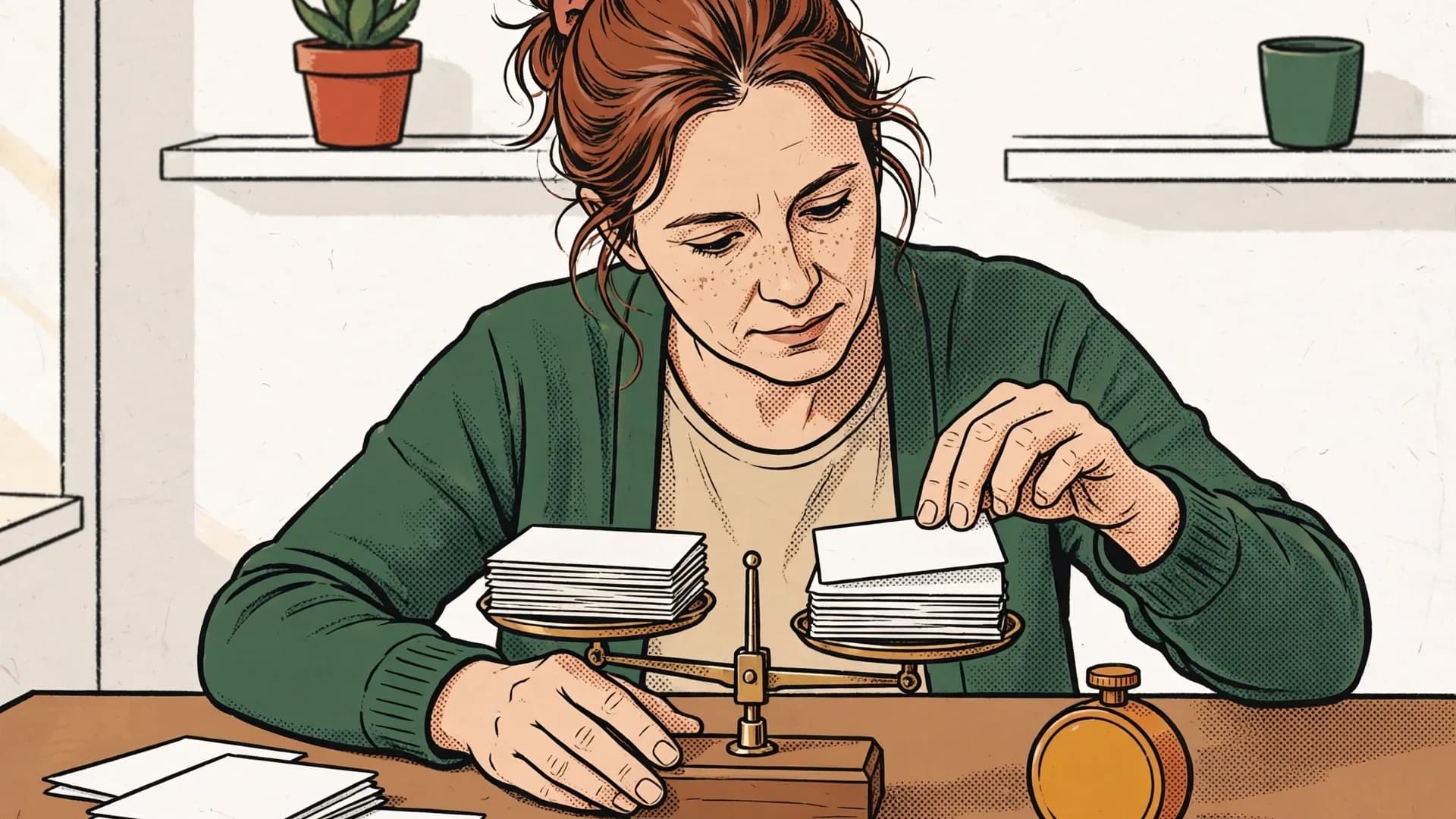
It is 9:47 p.m. the night before Tuesday's unit test. You have a half-finished document on the screen, a stack of student work on the desk, and a coffee that went cold ninety minutes ago. The questions you wrote first feel too easy. The ones you wrote last feel like trick questions. You tell yourself you will fix it in the morning, but you know how the morning goes.
Most of us were never taught how to design a test. We were taught how to teach. So when assessment week arrives, we improvise. We borrow questions from last year, add a couple of new ones, guess at point values, and hope the average lands somewhere reasonable. Four hours later, we have a document that mostly checks whether students memorized the right pages, not whether they understood what we taught.
There is a better way, and it fits in 60 minutes. The trick is to stop treating a test as a writing task and start treating it as a measurement instrument. You do not need more time. You need a sequence.
<Callout type="info" title="Key takeaways"> - A focused test of 4 to 6 questions tied to clear learnings beats a sprawling test that measures nothing in particular. - Decide point values and rubrics before students take the test, not after, so grading stays fair and consistent. - A 30-second table of specifications catches missing learnings and unbalanced weighting before the test goes out. - Use AI to generate equivalent variants and to spot ambiguous wording, not to replace your judgment on what matters. </Callout>The 5 Blocks of 60 Minutes
The method below assumes you have already taught the unit. You know what you covered. What you do not yet know, with precision, is what you want this test to measure. That is block one.
Block 1: Decide What to Measure (10 minutes)
Open a blank page. Write down the three or four key learnings from the unit. Not ten. Not seven. Three or four. If you cannot narrow it down, your unit had too many goals to begin with, and the test will inherit that fog.
For each learning, write a single sentence in plain language. "Students can identify the main idea of a short non-fiction passage." "Students can solve a two-step linear equation." "Students can explain why the American Revolution started, using two specific causes." Then check each sentence against your standards document, whether that is the Common Core, the National Curriculum, the Australian Curriculum, the Ontario curriculum, or the New Zealand Curriculum. Cross out anything you cannot tie to a standard.
You now have your blueprint. Everything else flows from it.
Block 2: Write 4 to 6 Varied Questions (15 minutes)
Resist the urge to write 20 questions. A focused test of 4 to 6 questions, each tied to a specific learning, beats a sprawling test that measures nothing in particular.
Aim for variety. A solid mix looks like this: two well-crafted multiple choice questions, two short open-response questions, and one application case. The multiple choice items check recognition and quick reasoning. The short open responses force students to produce, not pick. The application case asks them to use what they learned in a slightly new context, which is where real understanding shows up.
Write the questions fast. Do not edit yet. Editing happens in block four.
Block 3: Write the Rubric and Scoring (15 minutes)
This is the block most teachers skip, and it is the one that makes the test fair. Decide point values before students take the test, not after. The OECD's work on assessment design frames this as the difference between assessment of learning and assessment for learning: a clear rubric supports both.
A rough rule of thumb: weight questions by the cognitive load they require, not by the time they take. A multiple choice item testing recall is worth 1 to 2 points. A short open response is worth 4 to 6 points. The application case carries 8 to 12 points and gets a small rubric of its own. For the rubric, list two or three observable criteria. For example: "Identifies the correct concept (3 pts). Applies it correctly (4 pts). Explains the reasoning (3 pts)." Plain. Specific. No vibes.
If a colleague could grade the test using only your rubric and arrive at the same score you would, the rubric is good.
<Callout type="quote"> "Students do not learn what we teach. They learn what we assess."Attributed to Dylan Wiliam </Callout>
Block 4: Check Against a Table of Specifications (10 minutes)
A table of specifications sounds bureaucratic. It is actually a 30-second sanity check. Draw a small table with your three or four key learnings as rows and your questions as columns. Put an X in the cell where a question measures a learning.
You are looking for two problems. First: is there a learning with no X? You forgot to assess it. Second: is there a learning with five Xs while another has one? Your test is unbalanced and the grade will not reflect overall mastery. Move points around until the weight matches what you actually taught.
While you are at it, make sure your question types cover different cognitive levels. If every question is recall, you are testing memory. If every question is application, you are punishing students who never had a chance to practice that level. Aim for a spread. The Education Endowment Foundation's guidance on feedback and assessment underlines how much the design of the instrument shapes what students actually learn from it.
Block 5: Adjust Difficulty (10 minutes)
Read the test as if you were the student in the third row who tries hard but struggles. Then read it as if you were the student who finishes early and gets bored. Both should find the test fair. John Hattie's Visible Learning synthesis on feedback is worth a glance here: the most useful feedback comes from items pitched just above current mastery, not from items that simply sort students.
Two quick adjustments help here. Order questions from accessible to demanding so students build momentum. And cut anything ambiguous. If a question can be read two ways, students will read it the wrong way, and you will spend grading time arbitrating instead of evaluating.
You are done. Save the file. Close the laptop. The test is fair, focused, and finished.
5 Common Mistakes
Even with the method above, a few traps catch most of us. Here is what they look like and what to do instead.
Trick questions. Bad: "Which of the following is NOT not an example of a metaphor?" Good: "Which of the following is a metaphor?" Double negatives test reading, not learning. If you want to measure whether a student understands metaphors, ask about metaphors.
Ambiguity. Bad: "Discuss the French Revolution." Good: "Name two causes of the French Revolution and explain how each contributed to the events of 1789." The first version invites a paragraph that could go anywhere, which makes grading subjective and stressful for students who do not know what you want.
Unequal weighting. Bad: a 100-point test where one short-answer question is worth 40 points and three application cases are worth 20 points combined. Good: weight that matches cognitive demand. If application matters more, give it more points. If recall is a small part of the unit, do not let it carry half the grade.
Unnecessary freebies. Bad: "Write your name (5 points)." Or a question so easy that 100 percent of students get it right. Free points feel kind, but they hide who actually mastered the content and who did not. Use them sparingly, and only as a warm-up.
Standards drift. Bad: a question on a topic you mentioned once, in passing, three weeks ago. Good: every question maps to something you explicitly taught and practiced. Students should never see a question and think "we never did that." If they do, the test is measuring what you forgot to teach, not what they failed to learn.
If you want a deeper look at how different assessment types fit together across a unit, this guide on assessment types every teacher should know pairs well with the method above.
How to Use AI for Variants
Once you have a fair test, the next problem is preventing copying without rewriting the whole thing for each class period. This is where AI saves you a second hour.
Feed your finished test into an AI lesson-planning tool and ask for three variants. Keep the same key learnings, the same point distribution, and the same difficulty level. Change the surface details: the numbers in the math problems, the names and contexts in the word problems, the passages in the reading items. The structure stays. The questions look different.
You now have version A, version B, and version C. Print them on slightly different paper, distribute them in alternating rows, and watch the temptation to glance sideways drop to zero. Grading is still simple because the rubric is identical across versions.
A second use is calibration. Paste your test into the AI and ask: "Which of these questions might be ambiguous, and why?" The answers will not all be useful, but two or three will catch wording you missed at 9:47 p.m. on a Monday night. Treat it as a colleague who will read your draft without judgment.
A third use is the reverse direction. Give the AI your three or four key learnings and ask it to draft 6 questions before you write your own. Then pick, edit, and replace. Starting from a draft is faster than starting from a blank page, and you stay in control of the final version.
Your Test Is Your Last Lesson
Students learn from the test itself. The questions you ask tell them what you valued in the unit. If you ask only recall, they learn that recall was the point. If you ask application, they learn that you wanted them to think.
Designing tests well is not about elaborate formatting or clever twists. It is about deciding what matters, measuring it cleanly, and weighting the result honestly. Sixty minutes, five blocks, three or four learnings. The students get a fair shot. You get your evening back. And next term, when you open this test to reuse it, you will recognize the work of someone who knew what they were doing, because you did.
Draft My Lesson is the AI-powered lesson-planning tool built for English-speaking K-12 teachers. Plan your lessons in minutes and spend more time on what matters. Try it free.
Related articles
Report Card Comments: Evidence, Progress, Next Steps
Write specific report card comments from classroom evidence, describe progress fairly, and give families one useful next step.
Read articleExit Ticket Template: 30 Examples and 5 Copyable Formats
Copy 30 exit ticket examples for math, ELA, science, and social studies, then use five flexible templates to decide what your class needs next.
Read articleBackward Design Lesson Plan: A Practical Guide for K-12 Teachers
Backward design flips traditional lesson planning on its head. Start with the results you want, work backward to the assessment, then plan the activities. Here is how to do it without burning a weekend.
Read articleLesson Plan Objectives: 3 Types, Bloom's Verbs, and ABCD Examples
The 3 objective types are cognitive, affective, and psychomotor. Use the free builder, Bloom's verb bank, and ABCD examples to write your own.
Read article