Classroom Management Without Yelling: Strategies That Actually Work
Yelling drains you and stops working by Wednesday. Here are concrete classroom management strategies that protect your voice, your energy, and your students.
Draft My Lesson Team
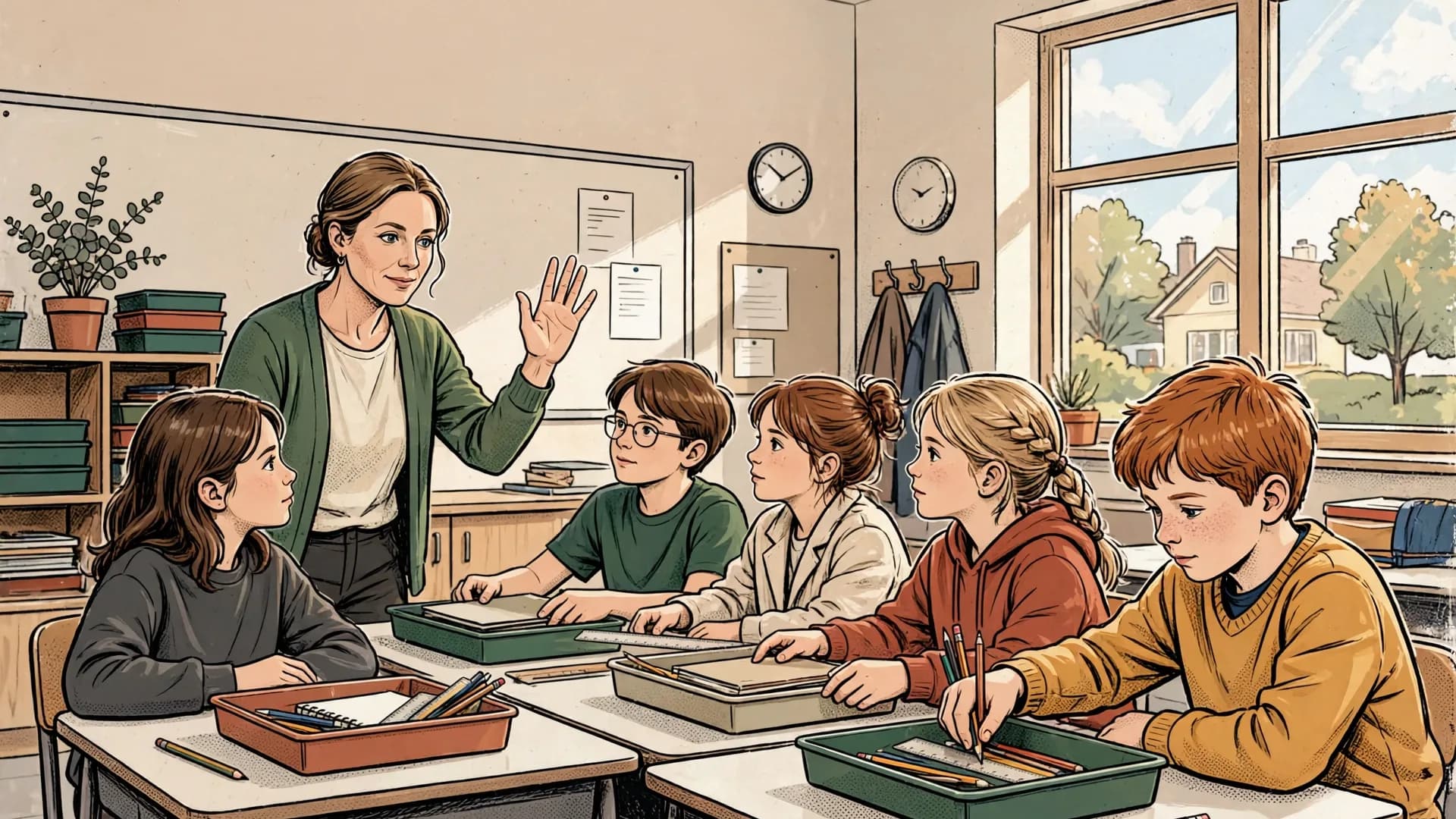
You know the moment. It is Wednesday, third period, and someone has just thrown a pencil for the second time in ten minutes. Your throat is already raw from the morning. Before you can stop yourself, you hear your own voice, louder than you wanted, sharper than you meant, snapping across the room. The class goes quiet. You feel awful. And by Thursday, the volume is back up anyway.
If that scene feels familiar, you are not a bad teacher. You are a tired one. Yelling is not a strategy. It is a stress response, and like most stress responses, it works exactly once before students stop hearing it. By the second week of school, the kids who were going to listen are listening, and the kids who were not have learned to wait you out.
The good news is that classroom management is mostly built before any disruption happens. The teachers whose rooms feel calm are not louder or scarier. They have systems. This article walks through the systems that actually hold up, plus an honest conversation at the end about what chronic disruption is often really telling us.
Key takeaways
- Yelling is a stress response, not a strategy: it works once, then students learn to wait you out.
- Strong routines, non-verbal signals, and physical proximity carry most of the load before words are needed.
- A four-to-one ratio of specific praise to correction reshapes the room within a week.
- Chronic disruption is almost always a signal (wrong-fit work, home stress, or an undiagnosed need), not disrespect.
- You cannot run a calm classroom from a depleted nervous system. Protect your own energy first.
Routines: the first three minutes set the tone
Every class period is a small story, and the opening scene matters more than anything else you do. If students walk into noise, indecision, or you still typing at your laptop, you have already lost the room. If they walk into a clear, predictable opening, you have bought yourself the next forty minutes.
A strong entry routine has three parts. First, a visible task on the board the second they sit down. Not a worksheet, not a quiz, just a low-stakes prompt: a question, a vocab word to copy, a one-sentence prediction. Second, a known place for materials, so no one is wandering. Third, you at the door, greeting students by name as they arrive.
That last part sounds soft, but it is the most powerful classroom management move in the building. A two-second hello at the door tells every student you saw them, you noticed them, and the next forty minutes are a shared thing, not a battle. The Education Endowment Foundation's behaviour guidance treats consistent, predictable routines as the single highest-leverage move a teacher can make, well ahead of any sanction system.

Non-verbal signals: save your voice for teaching
Your voice is a tool, and like any tool, it gets dull from overuse. Every time you raise it to get attention, you spend a little of the authority it carries. Smart teachers use almost everything except their voice to manage transitions.
A few signals that travel well across grade levels and across the US, UK, Australia, Canada, and New Zealand:
- Lights off, then on. Universal. Works from kindergarten through Year 13. Pair it with a single phrase like "eyes up" once the lights come back.
- The countdown. Hold up five fingers, count down silently. By the time you reach one, the room should be quiet. If it is not, you wait. Do not start over, do not yell. Just wait. Silence is uncomfortable, and the class will regulate itself faster than you think.
- The call-and-response clap. Two short claps from you, two short claps back from them. Younger students love it. Older students will pretend to hate it and then do it anyway.
- A bell, a chime, or a small wind-up music box. Anything with a distinctive sound that means "pause." Train it once, use it for the rest of the year.
The point is not the gimmick. The point is that none of these require you to shout over thirty voices. You set the signal, you wait, and the room comes to you.
Physical proximity: the cheapest tool you own
Most low-level disruption can be handled without saying a single word. You walk over. You stand near the desk. You keep teaching. The student stops, because nobody actually wants to be the kid the teacher is standing next to.
Proximity works because it is private. You are not calling anyone out, you are not making a scene, you are just there. It also keeps you off your stool. Teachers who teach from a fixed point have noisier rooms than teachers who move. Plan your lesson so you have natural reasons to walk: handing back work, checking in on small groups, glancing at notebooks. The room calms simply because you are circulating.
A small refinement: when you stand next to a struggling student, do not stare at them. Stare at the board, at another student's work, at anything else. Your presence is the message. Eye contact turns it into a confrontation.
Bridge phrases: redirect, do not confront
When you do have to speak, the words you choose matter enormously. Confrontational phrasing forces the student to defend themselves in front of their peers, and most kids will choose social standing over compliance every time. Redirect phrasing gives them a way out.
A few phrases worth memorizing:
- "I need you to..." instead of "Stop doing that." Names the behavior you want, not the one you are angry about.
- "Are you OK? You don't usually do that." Reframes the disruption as a one-off, not an identity. Hard for a student to argue with.
- "Let's reset. Page forty-two, question three. Go." Skips the negotiation entirely. You are already moving on.
- "Talk to me after class." Defers the confrontation to a private moment when nobody has an audience.
Notice none of these involve raising your voice, and none of them give the student a stage. Confrontation is a script with two parts. If you refuse to play yours, the script falls apart.
"The most successful teachers do not have fewer disruptions. They have shorter ones, because they redirect before the moment becomes a stage."
Attributed to Doug Lemov, author of Teach Like a Champion
Specific positive reinforcement: kill "good job"
"Good job" is the empty calorie of the classroom. Students hear it, register that you are pleased, and learn nothing about what they did well or how to do it again. Worse, when you say it to everyone for everything, it stops meaning anything at all.
Specific reinforcement names the behavior. "I noticed you started writing the second the bell rang. That is exactly the kind of focus that gets long projects done." "The way you disagreed with Maya's argument and still stayed kind, that is real debate." "You came back from break and were ready to go in under a minute. Thank you."
This takes more thought than "good job," which is the point. The student knows you actually saw them. And the rest of the class hears, in concrete terms, what you value. Behavior follows attention. Whatever you describe out loud is what students will do more of.
A practical tip: aim for a four-to-one ratio. Four specific positive observations for every correction. It feels excessive at first. After a week, the room feels different. The Visible Learning meta-analyses on classroom climate and teacher-student relationships consistently put feedback and climate among the highest-effect-size influences on achievement, well above any disciplinary system.
The classroom contract: build it with them, not at them
Rules handed down from on high are rules waiting to be broken. Rules that students helped write are rules they will defend, even against each other.
In the first week of the year, take twenty minutes and run a real conversation. Ask the class: what does a good lesson look like? What gets in the way of learning? What do you need from me, and what do I need from you? Capture their answers on the board. Group them. Boil them down to four or five short principles in their own words.
You will be surprised how strict students are when they write the rules themselves. They know exactly which behaviors ruin a class, because they have suffered through them. A student-written contract usually ends up tougher than anything you would have proposed alone, and ten times more enforceable, because it is theirs.
Print it. Sign it. Put it on the wall. Refer to it by name when something goes sideways: "Remember what we said about side conversations during instructions? Let's get back to it."

A worked example: the first three minutes of class
Here is what the opening of a well-run lesson actually looks like, step by step.
- Two minutes before the bell. You are at the door. The board has tomorrow's date, the lesson title, and a single warm-up prompt. Materials are stacked where students expect them.
- The bell rings. You greet students by name as they enter. "Morning, Sam. Hey, Priya. Good to see you, Marcus."
- First sixty seconds. Students sit down, pick up materials from the known spot, and start the warm-up prompt. You are still at the door, finishing greetings.
- Sixty to ninety seconds in. You move to the front of the room. You do not speak yet. You let the warm-up do its job.
- Ninety seconds to two minutes. A student talks. You walk over. You stand near their desk. You point at the prompt. You keep walking. The talking stops.
- Three-minute mark. You hit the chime, the lights, or whatever signal you have trained. You wait for silence. You do not start until you have it. Then: "Eyes up. Here is what we are doing today."
That is it. No yelling, no negotiation, no power struggle. The lesson has started, and the tone is set for the next forty minutes. Most of the work happened before the bell even rang.
For more on building lessons that hold student attention from minute one, use the lesson plan ideas guide and choose an activity pattern that produces visible student work.
What disruption is actually telling us
Here is the honest part. If you have done all of the above, week after week, and one student is still chronically disrupting, the problem is almost never disrespect.
Chronic disruption is a signal. It is the smoke, not the fire. Underneath, the cause is usually one of three things. The work is the wrong fit, too hard or too easy, and acting out is more socially survivable than admitting they cannot read the worksheet. Something is happening at home, and they are bringing it to school in the only way an eleven-year-old knows how. Or there is an undiagnosed need, an attention difference, a learning difference, a sensory difference, a trauma response, that nobody has named yet.
None of those are fixable with a louder voice. They are fixable with a quiet conversation, a referral to a counselor, a chat with a parent, a pull-aside with the SENCO or special education team, an academic accommodation, a different seat, a different task. They take time, they take partners, and they sometimes take more than you alone can give. Teacher-focused writing on managing chronic disruption in Tes keeps coming back to the same point: when a strategy has failed five times, the problem is rarely the strategy.
The hardest thing about classroom management is admitting when behavior is not really about behavior. The teachers who burn out fastest are the ones who keep treating it as a willpower contest. The ones who last treat it as a diagnostic puzzle.
A note on you
You cannot pour from an empty cup, and you cannot run a calm classroom from a depleted nervous system. The strategies above work, but they assume a teacher who has slept, eaten, and had at least one human conversation that was not about a student.
Take the lunch break. Close the laptop at a reasonable hour. Say no to the extra committee. Find one colleague you can vent to without judgment. Get outside on the weekend, even when there is grading. The version of you that walks into school rested is the version that does not need to yell.
Classroom management, in the end, is mostly about energy. Protect yours.
Draft My Lesson is the AI-powered lesson-planning tool built for English-speaking K-12 teachers. Plan your lessons in minutes and spend more time on what matters. Try it free.
Related articles
Resolving Student Conflicts: A 4-Step Protocol
Resolving student conflicts in your classroom does not have to derail the whole period. This 4-step protocol takes ten minutes and actually teaches resolution.
Read articleEmergency Sub Plans: A Complete Low-Prep Day for Grade 4
Use a complete Grade 4 emergency sub plan with a full-day schedule, original reading and math pages, answer keys, no-internet backups, and handover notes.
Read articleReport Card Comments: Evidence, Progress, Next Steps
Write specific report card comments from classroom evidence, describe progress fairly, and give families one useful next step.
Read articleExit Ticket Template: 30 Examples and 5 Copyable Formats
Copy 30 exit ticket examples for math, ELA, science, and social studies, then use five flexible templates to decide what your class needs next.
Read article